

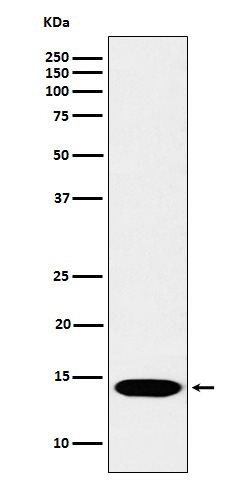

Anti-MonoMethyl-Histone H2B antibody [R96-4G-1] (STJA0035527)
SPECIFICATIONS
ClonalityMonoclonal
HostRabbit
ConjugationUnconjugated
IsotypeIgG
ImmunogenA synthesized peptide derived from human Histone H2B (mono methyl K116)
General Information
| Short Description | Rabbit monoclonal anti-MonoMethyl-Histone H2B for use in WB, IHC-P, ICC and IF in Human, Mouse and Rat samples. Datasheet included with dilution recommendations, and related reagents. |
| Applications | WB/IHC-P/ICC/IF |
| Host | Rabbit |
| Reactivity | Human/Mouse/Rat |
| Note | STRICTLY FOR FURTHER SCIENTIFIC RESEARCH USE ONLY (RUO). MUST NOT TO BE USED IN DIAGNOSTIC OR THERAPEUTIC APPLICATIONS. |
Product Properties
| Clonality | Monoclonal |
| Clone ID | R96-4G-1 |
| Isotype | IgG |
| Conjugation | Unconjugated |
| Purification | Affinity Chromatography |
| Dilution Range | WB 1:500-1:1000IHC 1:100-1:200IF 1:50-1:200 |
| Formulation | Liquid in PBS, pH 7.4, 150mM NaCl, 0.02% sodium azide and 50% glycerol. |
| Storage Instruction | Store at 4°C short term. Aliquot and store at-20°C long term. Avoid freeze/thaw cycles. |
Target Information
| Gene Symbol | H2BC21 |
| Gene ID | 8349 |
| Uniprot ID | H2B2E_HUMAN |
| Immunogen | A synthesized peptide derived from human Histone H2B (mono methyl K116) |
Additional Info
| Post Translational Modifications | Monoubiquitination at Lys-35 (H2BK34Ub) by the MSL1/MSL2 dimer is required for histone H3 'Lys-4' (H3K4me) and 'Lys-79' (H3K79me) methylation and transcription activation at specific gene loci, such as HOXA9 and MEIS1 loci. Similarly, monoubiquitination at Lys-121 (H2BK120Ub) by the RNF20/40 complex gives a specific tag for epigenetic transcriptional activation and is also prerequisite for histone H3 'Lys-4' and 'Lys-79' methylation. It also functions cooperatively with the FACT dimer to stimulate elongation by RNA polymerase II. H2BK120Ub also acts as a regulator of mRNA splicing: deubiquitination by USP49 is required for efficient cotranscriptional splicing of a large set of exons. Phosphorylation at Ser-37 (H2BS36ph) by AMPK in response to stress promotes transcription. Phosphorylated on Ser-15 (H2BS14ph) by STK4/MST1 during apoptosis.which facilitates apoptotic chromatin condensation. Also phosphorylated on Ser-15 in response to DNA double strand breaks (DSBs), and in correlation with somatic hypermutation and immunoglobulin class-switch recombination. GlcNAcylation at Ser-113 promotes monoubiquitination of Lys-121. It fluctuates in response to extracellular glucose, and associates with transcribed genes. ADP-ribosylated by PARP1 or PARP2 on Ser-7 (H2BS6ADPr) in response to DNA damage. H2BS6ADPr promotes recruitment of CHD1L. Mono-ADP-ribosylated on Glu-3 (H2BE2ADPr) by PARP3 in response to single-strand breaks. Poly ADP-ribosylation on Glu-36 (H2BE35ADPr) by PARP1 regulates adipogenesis: it inhibits phosphorylation at Ser-37 (H2BS36ph), thereby blocking expression of pro-adipogenetic genes. Crotonylation (Kcr) is specifically present in male germ cells and marks testis-specific genes in post-meiotic cells, including X-linked genes that escape sex chromosome inactivation in haploid cells. Crotonylation marks active promoters and enhancers and confers resistance to transcriptional repressors. It is also associated with post-meiotically activated genes on autosomes. Lactylated in macrophages by EP300/P300 by using lactoyl-CoA directly derived from endogenous or exogenous lactate, leading to stimulates gene transcription. |
| Function | Core component of nucleosome. Nucleosomes wrap and compact DNA into chromatin, limiting DNA accessibility to the cellular machineries which require DNA as a template. Histones thereby play a central role in transcription regulation, DNA repair, DNA replication and chromosomal stability. DNA accessibility is regulated via a complex set of post-translational modifications of histones, also called histone code, and nucleosome remodeling. Has broad antibacterial activity. May contribute to the formation of the functional antimicrobial barrier of the colonic epithelium, and to the bactericidal activity of amniotic fluid. |
| Protein Name | Histone H2b Type 2-EH2b-Clustered Histone 21Histone H2b-Gl105Histone H2b.qH2b/Q |
| Database Links | Reactome: R-HSA-110328Reactome: R-HSA-110329Reactome: R-HSA-110330Reactome: R-HSA-110331Reactome: R-HSA-1221632Reactome: R-HSA-171306Reactome: R-HSA-1912408Reactome: R-HSA-201722Reactome: R-HSA-212300Reactome: R-HSA-2299718Reactome: R-HSA-2559580Reactome: R-HSA-2559582Reactome: R-HSA-2559586Reactome: R-HSA-3214815Reactome: R-HSA-3214847Reactome: R-HSA-427359Reactome: R-HSA-427389Reactome: R-HSA-427413Reactome: R-HSA-5250924Reactome: R-HSA-5334118Reactome: R-HSA-5578749Reactome: R-HSA-5617472Reactome: R-HSA-5625886Reactome: R-HSA-5689880Reactome: R-HSA-5693565Reactome: R-HSA-5693571Reactome: R-HSA-5693607Reactome: R-HSA-606279Reactome: R-HSA-68616Reactome: R-HSA-69473Reactome: R-HSA-73728Reactome: R-HSA-73772Reactome: R-HSA-8936459Reactome: R-HSA-8939236Reactome: R-HSA-9018519Reactome: R-HSA-912446Reactome: R-HSA-9609690Reactome: R-HSA-9610379Reactome: R-HSA-9616222Reactome: R-HSA-9670095Reactome: R-HSA-9710421Reactome: R-HSA-977225Reactome: R-HSA-9821002Reactome: R-HSA-9821993Reactome: R-HSA-9841922Reactome: R-HSA-9843940Reactome: R-HSA-9843970Reactome: R-HSA-9845323 |
| Cellular Localisation | NucleusChromosome |
| Alternative Antibody Names | Anti-Histone H2b Type 2-E antibodyAnti-H2b-Clustered Histone 21 antibodyAnti-Histone H2b-Gl105 antibodyAnti-Histone H2b.q antibodyAnti-H2b/Q antibodyAnti-H2BC21 antibodyAnti-H2BFQ antibodyAnti-HIST2H2BE antibody |
Information sourced from Uniprot.org