


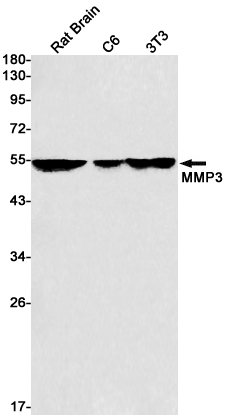
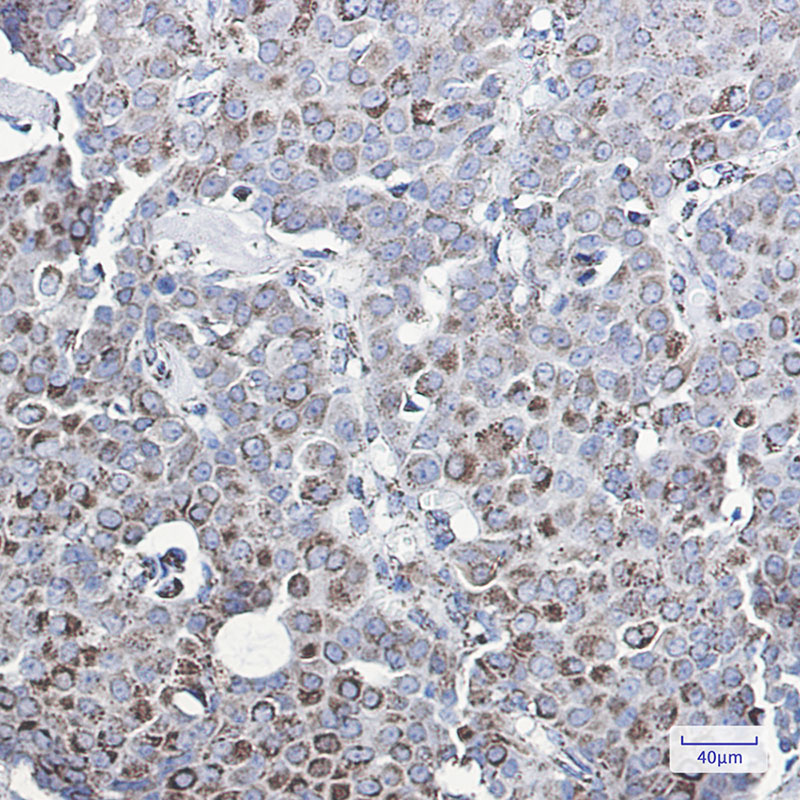

Anti-MMP3 antibody (457-470 aa) [R04-8G6] (STJA0011610)
SPECIFICATIONS
ClonalityMonoclonal
HostRabbit
ConjugationUnconjugated
IsotypeIgG
ImmunogenA synthetic peptide of human MMP3
General Information
| Short Description | Rabbit monoclonal anti-MMP3 (457-470 aa) for use in WB and IHC-P in Human, Mouse and Rat samples. Datasheet included with dilution recommendations, and related reagents. |
| Applications | WB/IHC-P |
| Host | Rabbit |
| Reactivity | Human/Mouse/Rat |
| Note | STRICTLY FOR FURTHER SCIENTIFIC RESEARCH USE ONLY (RUO). MUST NOT TO BE USED IN DIAGNOSTIC OR THERAPEUTIC APPLICATIONS. |
Product Properties
| Clonality | Monoclonal |
| Clone ID | R04-8G6 |
| Isotype | IgG |
| Conjugation | Unconjugated |
| Concentration | 0.3 mg/mL |
| Purification | Affinity Purified |
| Dilution Range | WB 1:500-1:1000IHC 1:50-1:100 |
| Formulation | 50mM Tris-Glycine (pH7.4) , 0.15M NaCl, 40% Glycerol, 0.01% Sodium azide and 0.05% BSA |
| Storage Instruction | Store at 4°C short term. Aliquot and store at-20°C long term. Avoid freeze/thaw cycles. |
Target Information
| Gene Symbol | MMP3 |
| Gene ID | 4314 |
| Uniprot ID | MMP3_HUMAN |
| Immunogen | A synthetic peptide of human MMP3 |
| Immunogen Region | 457-470 aa |
Additional Info
| Post Translational Modifications | Directly cleaved by HTRA2 to produce active form. |
| Function | Metalloproteinase with a rather broad substrate specificity that can degrade fibronectin, laminin, gelatins of type I, III, IV, and V.collagens III, IV, X, and IX, and cartilage proteoglycans. Activates different molecules including growth factors, plasminogen or other matrix metalloproteinases such as MMP9. Once released into the extracellular matrix (ECM), the inactive pro-enzyme is activated by the plasmin cascade signaling pathway. Also acts intracellularly. For example, in dopaminergic neurons, gets activated by the serine protease HTRA2 upon stress and plays a pivotal role in DA neuronal degeneration by mediating microglial activation and alpha-synuclein/SNCA cleavage. In addition, plays a role in immune response and possesses antiviral activity against various viruses such as vesicular stomatitis virus, influenza A virus (H1N1) and human herpes virus 1. Mechanistically, translocates from the cytoplasm into the cell nucleus upon virus infection to influence NF-kappa-B activities. |
| Protein Name | Stromelysin-1Sl-1Matrix Metalloproteinase-3Mmp-3Transin-1 |
| Database Links | Reactome: R-HSA-1442490Reactome: R-HSA-1474228Reactome: R-HSA-1592389Reactome: R-HSA-2022090Reactome: R-HSA-2179392Reactome: R-HSA-6785807Reactome: R-HSA-9009391 |
| Cellular Localisation | SecretedExtracellular SpaceExtracellular MatrixNucleusCytoplasm |
| Alternative Antibody Names | Anti-Stromelysin-1 antibodyAnti-Sl-1 antibodyAnti-Matrix Metalloproteinase-3 antibodyAnti-Mmp-3 antibodyAnti-Transin-1 antibodyAnti-MMP3 antibodyAnti-STMY1 antibody |
Information sourced from Uniprot.org