

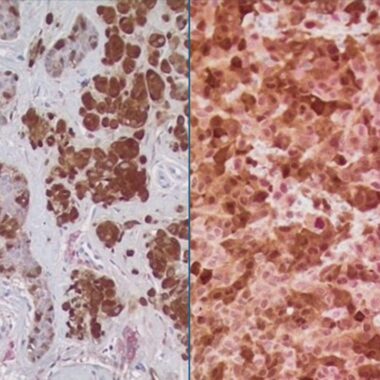

Anti-Malanoma cocktail antibody (100-509) [PRAME (ZR383) + S-100 (4C4.9)] (STJ180697)
SPECIFICATIONS
ClonalityMonoclonal
HostRabbit/Mouse
ConjugationUnconjugated
IsotypeIgG/IgG2ak
ImmunogenRecombinant fragment (around aa100-509) of human PRAME protein; Purified bovine brain S100
General Information
| Short Description | Rabbit/Mouse monoclonal Malanoma cocktail (100-509) antibody for use in IHC-P in human samples. Datasheet included with dilution recommendations, and related reagents. |
| Applications | IHC-P |
| Host | Rabbit/Mouse |
| Reactivity | Human |
| Note | STRICTLY FOR FURTHER SCIENTIFIC RESEARCH USE ONLY (RUO). MUST NOT TO BE USED IN DIAGNOSTIC OR THERAPEUTIC APPLICATIONS. |
Product Properties
| Clonality | Monoclonal |
| Clone ID | PRAME (ZR383) + S-100 (4C4.9) |
| Isotype | IgG/IgG2ak |
| Conjugation | Unconjugated |
| Purification | Affinity purified |
| Dilution Range | 1:100-200 |
| Formulation | Tris-HCI buffer containing stabilizing protein (BSA) and <0.1% ProClin |
| Storage Instruction | Store at 2‐8°C for up to 24 months. Predilute: Ready to use, no reconstitution necessary. Concentrate: Use dilution range and appropriate lab‐standardized diluent. Stability after dilution: 7 days at 24°C, 3 months at 2‐8°C, 6months at ‐20°C. |
Target Information
| Immunogen | Recombinant fragment (around aa100-509) of human PRAME protein; Purified bovine brain S100 |
| Immunogen Region | 100-509 |
| Specificity | Positive Control: Melanoma |
Additional Info
| Background | Zeta s Melanoma Cocktail – DUAL STAIN. Zeta s Melanoma Cocktail provides dual staining for PRAME and S-100, where dual immunohistochemical staining for PRAME and S-100 plays an increasingly important role in the diagnostic workup of melanocytic lesions, particularly in distinguishing benign nevi from malignant melanoma, including ambiguous or borderline cases. Zeta s Melanoma Cocktail contains recombinant antibodies against both PRAME+S-100. PRAME (Preferentially Expressed Antigen in Melanoma) functions as a transcriptional repressor, inhibiting the signaling of retinoic acid through the retinoic acid receptors RARA, RARB and RARG. It prevents retinoic acid-induced cell proliferation arrest, differentiation, and apoptosis. This gene encodes an antigen that is preferentially expressed in human melanomas and that is recognized by cytolytic T lymphocytes. It is not expressed in normal tissues, except testis. S100 belongs to the family of calcium binding proteins such as calmodulin and troponin C. S100 protein is expressed in melanocytes and the antigen presenting cells such as the Langerhans cells in skin and interdigitating reticulum cells in the paracortex of lymph nodes. Antibody to S100 stains Schwannomas, ependymomas, astrogliomas, almost all benign and malignant melanomas and their metastases. The combination of PRAME (red) and S-100 (brown) immunohistochemical staining will help in differentiating malignant melanoma and atypical nevus (PRAME positive, S-100 positive) from benign nevus (PRAME negative, S-100 positive). Marker Expression Location Role in Melanocytic Diagnosis PRAME (Preferentially Expressed Antigen in Melanoma) Nuclear expression in melanoma and some other malignancies Marker of malignancy; typically not expressed in benign nevi S-100 Nuclear and cytoplasmic expression in all melanocytic cells Sensitive but not specific melanocytic marker; identifies both benign and malignant cells Zeta s Melanoma Cocktail can provide enhanced specificity for malignancy. S-100 is a sensitive melanocytic marker, but it is non-specific—expressed in both benign nevi and melanomas whereas PRAME expression, especially diffuse and strong nuclear positivity, is highly associated with malignant melanoma. Dual staining helps highlight PRAME-positive (malignant) cells within the melanocytic population defined by S-100. Additionally, the Melanoma cocktail can improve interpretation of ambiguous lesions. In borderline lesions (e.g., dysplastic nevi, Spitz nevi) , where morphology is uncertain, dual staining provides morphologic context (via S-100) and malignancy biomarker (PRAME) localization. This is especially useful in pediatric or spitzoid lesions, where diagnosis is challenging. Zeta s DUAL STAIN products provide more information from limited tissues, by seeing two related markers on the same slide while also allowing pathologists to see cellular localization and interaction within the tumor environment. Zeta uses one mouse and one rabbit recombinant monoclonal in each cocktail to allow for differential color results. Zeta Corporation is a leader in recombinant monoclonal IVD antibodies for immunohistochemistry (IHC) offering 400+ tumor and tissue specific relevant products developed by a pathologist for pathologists. Visit Precision Recombinant Antibodies – IVD Antibodies – About Zeta Corporation (zeta-corp.com) to learn more about Zeta Corporation. |
Information sourced from Uniprot.org