

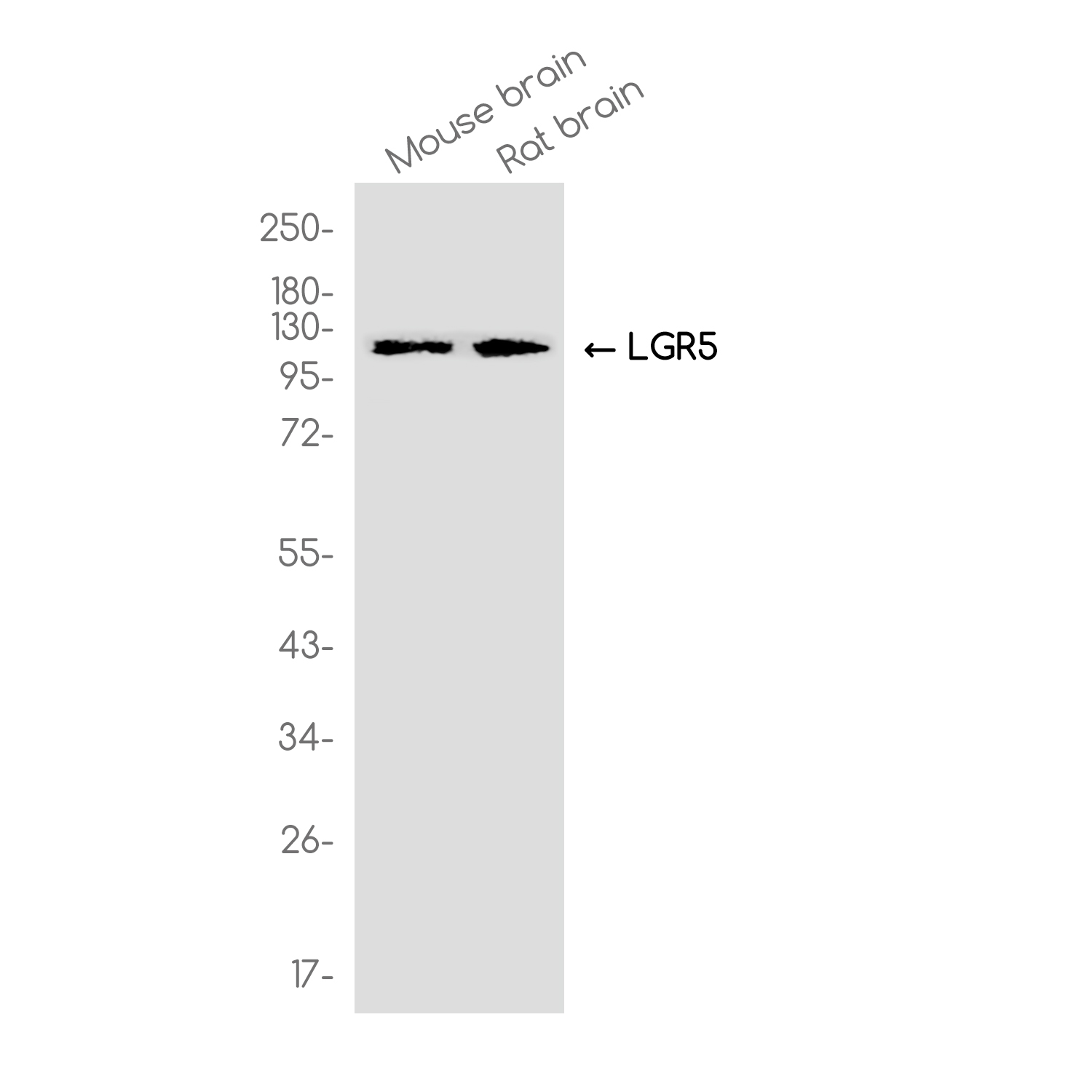

Anti-LGR5 antibody [R01-3D9] (STJA0035901)
SPECIFICATIONS
ClonalityMonoclonal
HostRabbit
ConjugationUnconjugated
IsotypeIgG
ImmunogenA synthesized peptide derived from human LGR5/GPR49
General Information
| Short Description | Rabbit monoclonal anti-LGR5 for use in WB, IP and FC in Human, Mouse and Rat samples. Datasheet included with dilution recommendations, and related reagents. |
| Applications | WB/IP/FC |
| Host | Rabbit |
| Reactivity | Human/Mouse/Rat |
| Note | STRICTLY FOR FURTHER SCIENTIFIC RESEARCH USE ONLY (RUO). MUST NOT TO BE USED IN DIAGNOSTIC OR THERAPEUTIC APPLICATIONS. |
Product Properties
| Clonality | Monoclonal |
| Clone ID | R01-3D9 |
| Isotype | IgG |
| Conjugation | Unconjugated |
| Purification | Affinity Chromatography |
| Dilution Range | WB 1:500-1:1000IP 1:50FC 1:50-1:100 |
| Formulation | Rabbit IgG in phosphate buffered saline, pH 7.4, 150mM NaCl, 0.02% sodium azide and 50% glycerol. |
| Storage Instruction | Store at 4°C short term. Aliquot and store at-20°C long term. Avoid freeze/thaw cycles. |
Target Information
| Gene Symbol | LGR5 |
| Gene ID | 8549 |
| Uniprot ID | LGR5_HUMAN |
| Immunogen | A synthesized peptide derived from human LGR5/GPR49 |
Additional Info
| Tissue Specificity | Expressed in skeletal muscle, placenta, spinal cord, and various region of brain. Expressed at the base of crypts in colonic and small mucosa stem cells. In premalignant cancer expression is not restricted to the cript base. Overexpressed in cancers of the ovary, colon and liver. |
| Function | Receptor for R-spondins that potentiates the canonical Wnt signaling pathway and acts as a stem cell marker of the intestinal epithelium and the hair follicle. Upon binding to R-spondins (RSPO1, RSPO2, RSPO3 or RSPO4), associates with phosphorylated LRP6 and frizzled receptors that are activated by extracellular Wnt receptors, triggering the canonical Wnt signaling pathway to increase expression of target genes. In contrast to classical G-protein coupled receptors, does not activate heterotrimeric G-proteins to transduce the signal. Involved in the development and/or maintenance of the adult intestinal stem cells during postembryonic development. |
| Protein Name | Leucine-Rich Repeat-Containing G-Protein Coupled Receptor 5G-Protein Coupled Receptor 49G-Protein Coupled Receptor 67G-Protein Coupled Receptor Hg38 |
| Database Links | Reactome: R-HSA-4641263 |
| Cellular Localisation | Cell MembraneMulti-Pass Membrane ProteinGolgi ApparatusTrans-Golgi Network MembraneRapidly And Constitutively Internalized To The Trans-Golgi Network At Steady StateInternalization To The Trans-Golgi Network May Be The Result Of Phosphorylation At Ser-861 And Ser-864HoweverThe Phosphorylation Event Has Not Been Proven |
| Alternative Antibody Names | Anti-Leucine-Rich Repeat-Containing G-Protein Coupled Receptor 5 antibodyAnti-G-Protein Coupled Receptor 49 antibodyAnti-G-Protein Coupled Receptor 67 antibodyAnti-G-Protein Coupled Receptor Hg38 antibodyAnti-LGR5 antibodyAnti-GPR49 antibodyAnti-GPR67 antibody |
Information sourced from Uniprot.org