

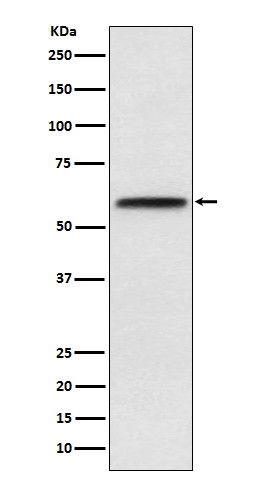

Anti-LCAT antibody [R01-7D2] (STJA0037380)
SPECIFICATIONS
ClonalityMonoclonal
HostRabbit
ConjugationUnconjugated
IsotypeIgG
ImmunogenA synthesized peptide derived from human LCAT
General Information
| Short Description | Rabbit monoclonal anti-LCAT for use in WB, IHC-P, ICC, IF and IP in Human, Mouse and Rat samples. Datasheet included with dilution recommendations, and related reagents. |
| Applications | WB/IHC-P/ICC/IF/IP |
| Host | Rabbit |
| Reactivity | Human/Mouse/Rat |
| Note | STRICTLY FOR FURTHER SCIENTIFIC RESEARCH USE ONLY (RUO). MUST NOT TO BE USED IN DIAGNOSTIC OR THERAPEUTIC APPLICATIONS. |
Product Properties
| Clonality | Monoclonal |
| Clone ID | R01-7D2 |
| Isotype | IgG |
| Conjugation | Unconjugated |
| Purification | Affinity Purified |
| Dilution Range | WB 1:500-1:1000IHC 1:50-1:100IF 1:50-1:200IP 1:50 |
| Formulation | Rabbit IgG in phosphate buffered saline, pH 7.4, 150mM NaCl, 0.02% sodium azide and 50% glycerol. |
| Storage Instruction | Store at 4°C short term. Aliquot and store at-20°C long term. Avoid freeze/thaw cycles. |
Target Information
| Gene Symbol | LCAT |
| Gene ID | 3931 |
| Uniprot ID | LCAT_HUMAN |
| Immunogen | A synthesized peptide derived from human LCAT |
Additional Info
| Tissue Specificity | Detected in blood plasma. Detected in cerebral spinal fluid (at protein level). Detected in liver. Expressed mainly in brain, liver and testes. |
| Post Translational Modifications | O- and N-glycosylated. O-glycosylation on Thr-431 and Ser-433 consists of sialylated galactose beta 1-->3N-acetylgalactosamine structures. N-glycosylated sites contain sialylated triantennary and/or biantennary complex structures. |
| Function | Central enzyme in the extracellular metabolism of plasma lipoproteins. Synthesized mainly in the liver and secreted into plasma where it converts cholesterol and phosphatidylcholines (lecithins) to cholesteryl esters and lysophosphatidylcholines on the surface of high and low density lipoproteins (HDLs and LDLs). The cholesterol ester is then transported back to the liver. Has a preference for plasma 16:0-18:2 or 18:O-18:2 phosphatidylcholines. Also produced in the brain by primary astrocytes, and esterifies free cholesterol on nascent APOE-containing lipoproteins secreted from glia and influences cerebral spinal fluid (CSF) APOE- and APOA1 levels. Together with APOE and the cholesterol transporter ABCA1, plays a key role in the maturation of glial-derived, nascent lipoproteins. Required for remodeling high-density lipoprotein particles into their spherical forms. Catalyzes the hydrolysis of 1-O-alkyl-2-acetyl-sn-glycero-3-phosphocholine (platelet-activating factor or PAF) to 1-O-alkyl-sn-glycero-3-phosphocholine (lyso-PAF). Also catalyzes the transfer of the acetate group from PAF to 1-hexadecanoyl-sn-glycero-3-phosphocholine forming lyso-PAF. Catalyzes the esterification of (24S)-hydroxycholesterol (24(S)OH-C), also known as cerebrosterol to produce 24(S)OH-C monoesters. |
| Protein Name | Phosphatidylcholine-Sterol Acyltransferase1-Alkyl-2-Acetylglycerophosphocholine EsteraseLecithin-Cholesterol AcyltransferasePhospholipid-Cholesterol AcyltransferasePlatelet-Activating Factor AcetylhydrolasePaf Acetylhydrolase |
| Database Links | Reactome: R-HSA-8964058 |
| Cellular Localisation | SecretedSecreted Into Blood PlasmaProduced In Astrocytes And Secreted Into Cerebral Spinal Fluid (Csf) |
| Alternative Antibody Names | Anti-Phosphatidylcholine-Sterol Acyltransferase antibodyAnti-1-Alkyl-2-Acetylglycerophosphocholine Esterase antibodyAnti-Lecithin-Cholesterol Acyltransferase antibodyAnti-Phospholipid-Cholesterol Acyltransferase antibodyAnti-Platelet-Activating Factor Acetylhydrolase antibodyAnti-Paf Acetylhydrolase antibodyAnti-LCAT antibody |
Information sourced from Uniprot.org