


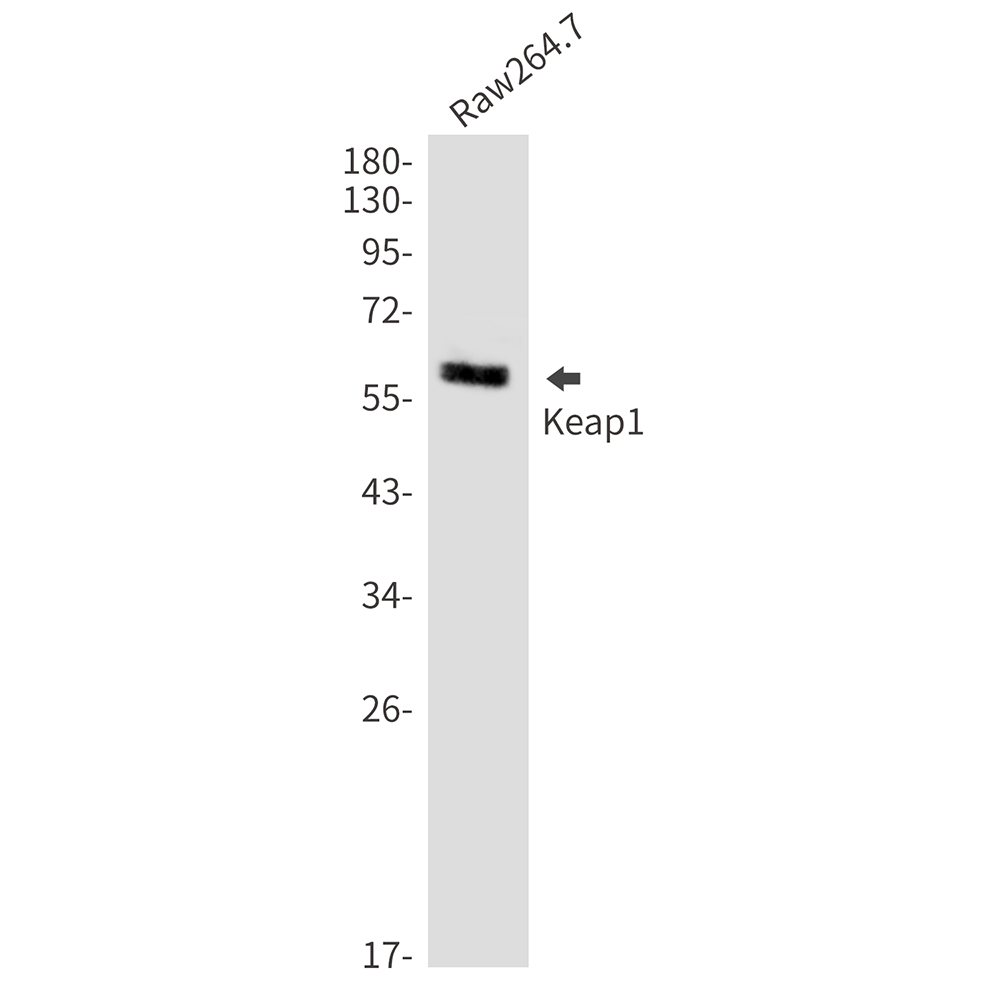
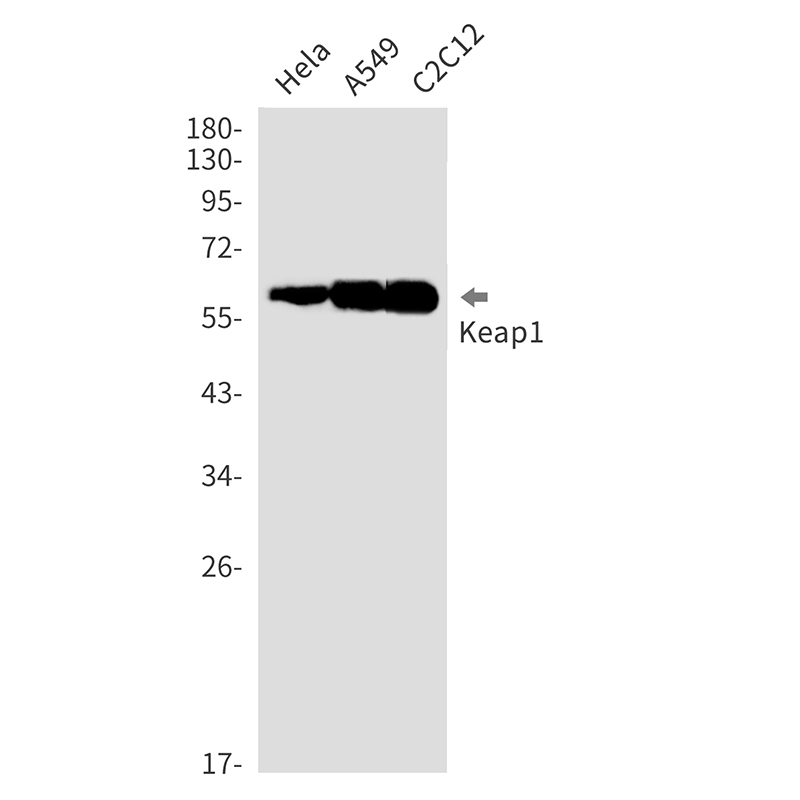
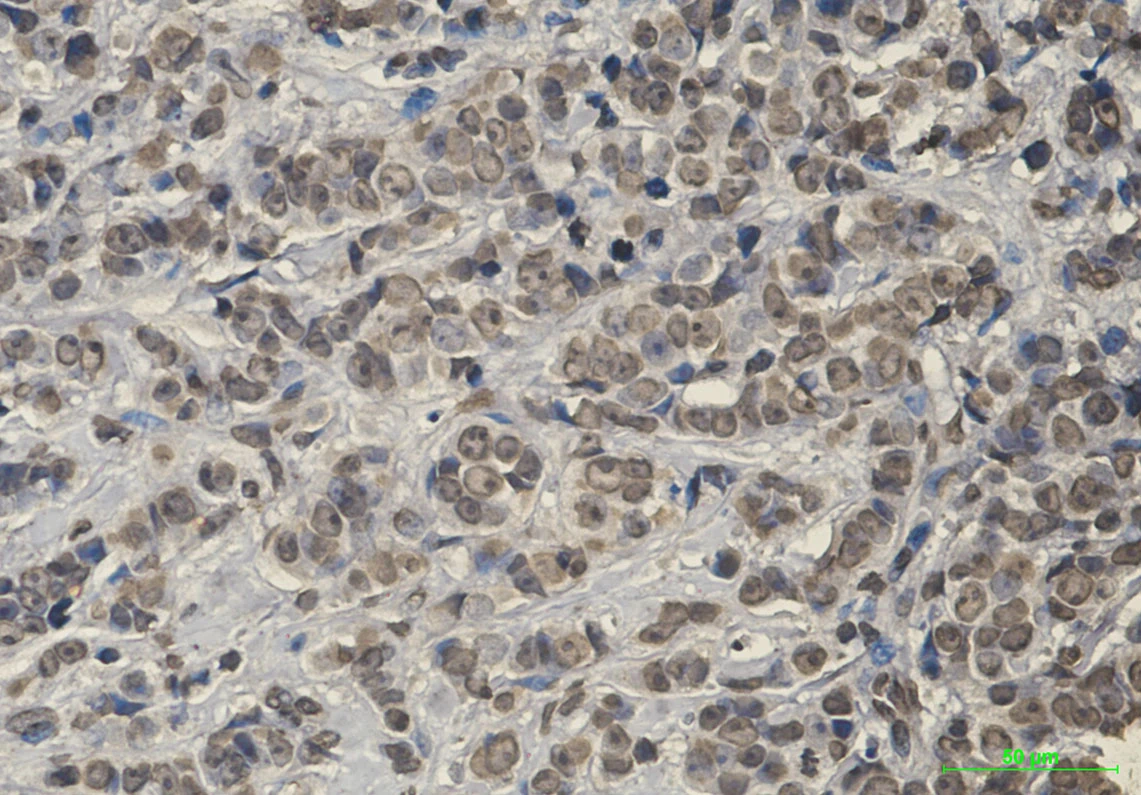

Anti-KEAP1 antibody (321-609 aa) [R02-1H7] (STJA0012438)
SPECIFICATIONS
ClonalityMonoclonal
HostRabbit
ConjugationUnconjugated
IsotypeIgG
ImmunogenRecombinant protein of human Keap1
General Information
| Short Description | Rabbit monoclonal anti-Keap1 (321-609 aa) for use in WB and IHC-P in Human and Mouse samples. Datasheet included with dilution recommendations, and related reagents. |
| Applications | WB/IHC-P |
| Host | Rabbit |
| Reactivity | Human/Mouse |
| Note | STRICTLY FOR FURTHER SCIENTIFIC RESEARCH USE ONLY (RUO). MUST NOT TO BE USED IN DIAGNOSTIC OR THERAPEUTIC APPLICATIONS. |
Product Properties
| Clonality | Monoclonal |
| Clone ID | R02-1H7 |
| Isotype | IgG |
| Conjugation | Unconjugated |
| Concentration | 0.3 mg/mL |
| Purification | Affinity Purified |
| Dilution Range | WB 1:500-1:1000IHC 1:50-1:100 |
| Formulation | 50mM Tris-Glycine (pH7.4) , 0.15M NaCl, 40% Glycerol, 0.01% Sodium azide and 0.05% BSA |
| Storage Instruction | Store at 4°C short term. Aliquot and store at-20°C long term. Avoid freeze/thaw cycles. |
Target Information
| Gene Symbol | KEAP1 |
| Gene ID | 9817 |
| Uniprot ID | KEAP1_HUMAN |
| Immunogen | Recombinant protein of human Keap1 |
| Immunogen Region | 321-609 aa |
Additional Info
| Tissue Specificity | Broadly expressed, with highest levels in skeletal muscle. |
| Post Translational Modifications | Non-enzymatic covalent modifications of reactive cysteines by electrophile metabolites inactivate the BCR(KEAP1) complex. Accumulation of fumarate promotes the formation of cysteine S-succination (S-(2-succinyl)cysteine), leading to inactivate the BCR(KEAP1) complex and promote NFE2L2/NRF2 nuclear accumulation and activation. Nitric oxide-dependent 8-Nitro-cGMP formation promotes cysteine guanylation (S-cGMP-cysteine), leading to NFE2L2/NRF2 nuclear accumulation and activation. Itaconate, an anti-inflammatory metabolite generated in response to lipopolysaccharide, alkylates cysteines, activating NFE2L2/NRF2. Methylglyoxal, a reactive metabolite that accumulates when the glycolytic enzyme PGK1 is inhibited, promotes formation of a methylimidazole cross-link between proximal Cys-151 and Arg-135 on another KEAP1 molecule, resulting in an inactive dimer that inactivates the BCR(KEAP1) complex. Degraded via a proteasomal-independent process during selective autophagy: interaction with phosphorylated SQSTM1/p62 sequesters KEAP1 in inclusion bodies, leading to its degradation. Auto-ubiquitinated by the BCR(KEAP1) complex. Quinone-induced oxidative stress, but not sulforaphane, increases its ubiquitination. Ubiquitination and subsequent degradation is most pronounced following prolonged exposure of cells to oxidative stress, particularly in glutathione-deficient cells that are highly susceptible to oxidative stress. Deubiquitinated by USP25.leading to stabilization. Ubiquitinated by TRIM25.leading to degradation upon ER stress. |
| Function | Substrate-specific adapter of a BCR (BTB-CUL3-RBX1) E3 ubiquitin ligase complex that regulates the response to oxidative stress by targeting NFE2L2/NRF2 for ubiquitination. KEAP1 acts as a key sensor of oxidative and electrophilic stress: in normal conditions, the BCR(KEAP1) complex mediates ubiquitination and degradation of NFE2L2/NRF2, a transcription factor regulating expression of many cytoprotective genes. In response to oxidative stress, different electrophile metabolites trigger non-enzymatic covalent modifications of highly reactive cysteine residues in KEAP1, leading to inactivate the ubiquitin ligase activity of the BCR(KEAP1) complex, promoting NFE2L2/NRF2 nuclear accumulation and expression of phase II detoxifying enzymes. In response to selective autophagy, KEAP1 is sequestered in inclusion bodies following its interaction with SQSTM1/p62, leading to inactivation of the BCR(KEAP1) complex and activation of NFE2L2/NRF2. The BCR(KEAP1) complex also mediates ubiquitination of SQSTM1/p62, increasing SQSTM1/p62 sequestering activity and degradation. The BCR(KEAP1) complex also targets BPTF and PGAM5 for ubiquitination and degradation by the proteasome. |
| Protein Name | Kelch-Like Ech-Associated Protein 1Cytosolic Inhibitor Of Nrf2Inrf2Kelch-Like Protein 19 |
| Database Links | Reactome: R-HSA-5689880Reactome: R-HSA-8951664Reactome: R-HSA-9679191Reactome: R-HSA-9755511Reactome: R-HSA-9759194Reactome: R-HSA-983168 |
| Cellular Localisation | CytoplasmNucleusMainly CytoplasmicIn Response To Selective AutophagyRelocalizes To Inclusion Bodies Following Interaction With Sqstm1/P62 |
| Alternative Antibody Names | Anti-Kelch-Like Ech-Associated Protein 1 antibodyAnti-Cytosolic Inhibitor Of Nrf2 antibodyAnti-Inrf2 antibodyAnti-Kelch-Like Protein 19 antibodyAnti-KEAP1 antibodyAnti-INRF2 antibodyAnti-KIAA0132 antibodyAnti-KLHL19 antibody |
Information sourced from Uniprot.org