

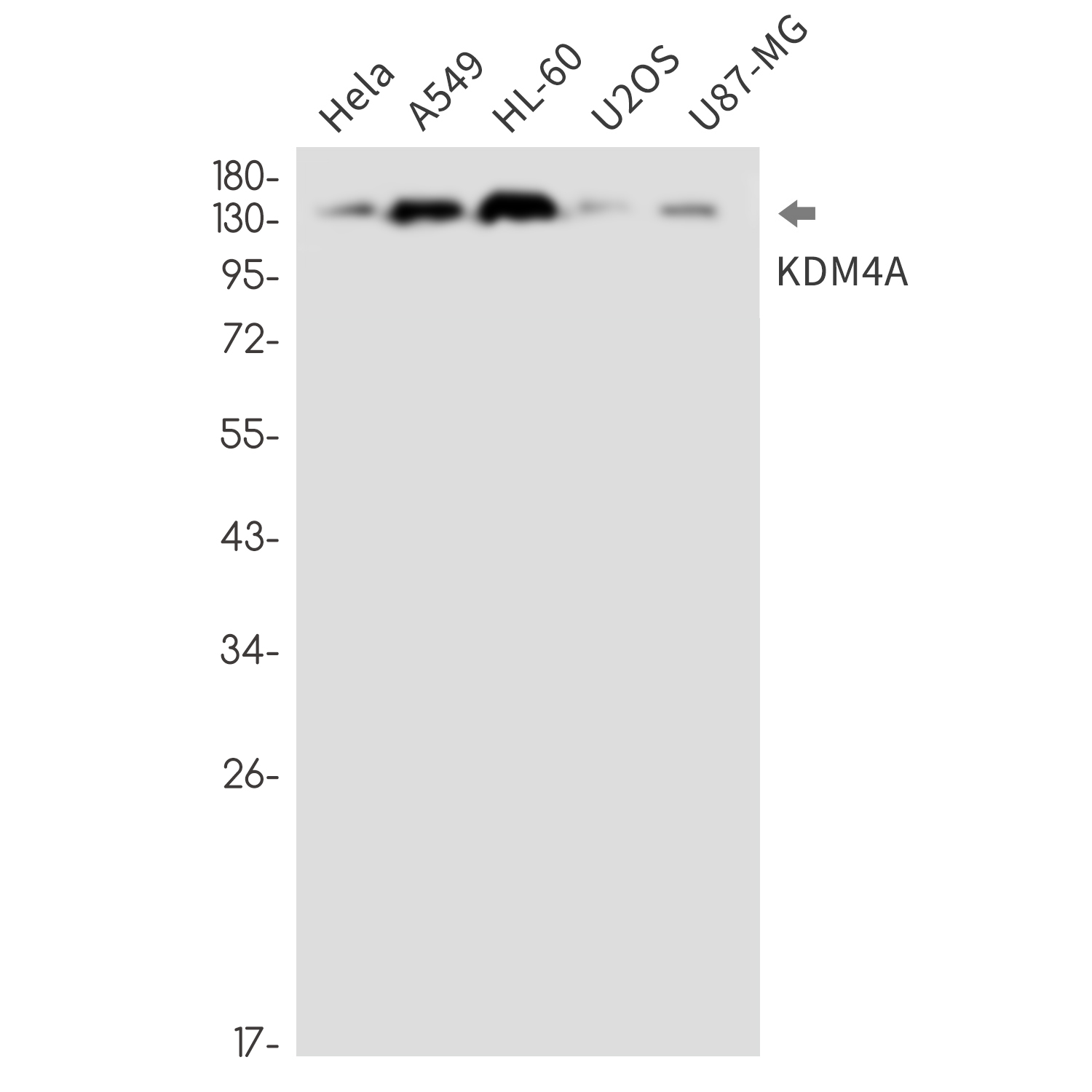

Anti-KDM4A antibody (591-607 aa) [R01-7F2] (STJA0012664)
SPECIFICATIONS
ClonalityMonoclonal
HostRabbit
ConjugationUnconjugated
IsotypeIgG
ImmunogenA synthesized peptide derived from human KDM4A/JHDM3A/JMJD2A
General Information
| Short Description | Rabbit monoclonal anti-KDM4A (591-607 aa) for use in WB and IP in Human samples. Datasheet included with dilution recommendations, and related reagents. |
| Applications | WB/IP |
| Host | Rabbit |
| Reactivity | Human |
| Note | STRICTLY FOR FURTHER SCIENTIFIC RESEARCH USE ONLY (RUO). MUST NOT TO BE USED IN DIAGNOSTIC OR THERAPEUTIC APPLICATIONS. |
Product Properties
| Clonality | Monoclonal |
| Clone ID | R01-7F2 |
| Isotype | IgG |
| Conjugation | Unconjugated |
| Concentration | 0.3 mg/mL |
| Purification | Affinity Purified |
| Dilution Range | WB 1:500-1:1000IP 1:20 |
| Formulation | 50mM Tris-Glycine (pH7.4) , 0.15M NaCl, 40% Glycerol, 0.01% Sodium azide and 0.05% BSA |
| Storage Instruction | Store at 4°C short term. Aliquot and store at-20°C long term. Avoid freeze/thaw cycles. |
Target Information
| Gene Symbol | KDM4A |
| Gene ID | 9682 |
| Uniprot ID | KDM4A_HUMAN |
| Immunogen | A synthesized peptide derived from human KDM4A/JHDM3A/JMJD2A |
| Immunogen Region | 591-607 aa |
Additional Info
| Tissue Specificity | Ubiquitous. |
| Post Translational Modifications | (Microbial infection) SUMOylated by human herpesvirus 8 E3 SUMO-protein ligase K-bZIP/K8 at Lys-471.thereby modulating the chromatin binding and histone demethylase activity of KDM4A. Ubiquitinated by RNF8 and RNF168 following DNA damage, leading to its degradation. Degradation promotes accessibility of H4K20me2 mark for DNA repair protein TP53BP1, which is then recruited. Also ubiquitinated by the SCF(FBXO22) complex.leading to proteasomal degradation. |
| Function | Histone demethylase that specifically demethylates 'Lys-9' and 'Lys-36' residues of histone H3, thereby playing a central role in histone code. Does not demethylate histone H3 'Lys-4', H3 'Lys-27' nor H4 'Lys-20'. Demethylates trimethylated H3 'Lys-9' and H3 'Lys-36' residue, while it has no activity on mono- and dimethylated residues. Demethylation of Lys residue generates formaldehyde and succinate. Participates in transcriptional repression of ASCL2 and E2F-responsive promoters via the recruitment of histone deacetylases and NCOR1, respectively. Isoform 2: Crucial for muscle differentiation, promotes transcriptional activation of the Myog gene by directing the removal of repressive chromatin marks at its promoter. Lacks the N-terminal demethylase domain. |
| Protein Name | Lysine-Specific Demethylase 4aJmjc Domain-Containing Histone Demethylation Protein 3aJumonji Domain-Containing Protein 2aHistone H3-Trimethyl-L-Lysine(36 Demethylase 4aHistone H3-Trimethyl-L-Lysine(9 Demethylase 4a |
| Database Links | Reactome: R-HSA-3214842Reactome: R-HSA-5693565Reactome: R-HSA-9029569 |
| Cellular Localisation | Nucleus |
| Alternative Antibody Names | Anti-Lysine-Specific Demethylase 4a antibodyAnti-Jmjc Domain-Containing Histone Demethylation Protein 3a antibodyAnti-Jumonji Domain-Containing Protein 2a antibodyAnti-Histone H3-Trimethyl-L-Lysine(36 Demethylase 4a antibodyAnti-Histone H3-Trimethyl-L-Lysine(9 Demethylase 4a antibodyAnti-KDM4A antibodyAnti-JHDM3A antibodyAnti-JMJD2 antibodyAnti-JMJD2A antibodyAnti-KIAA0677 antibody |
Information sourced from Uniprot.org