


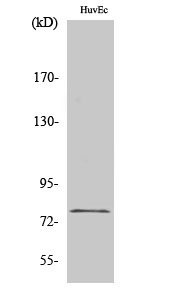
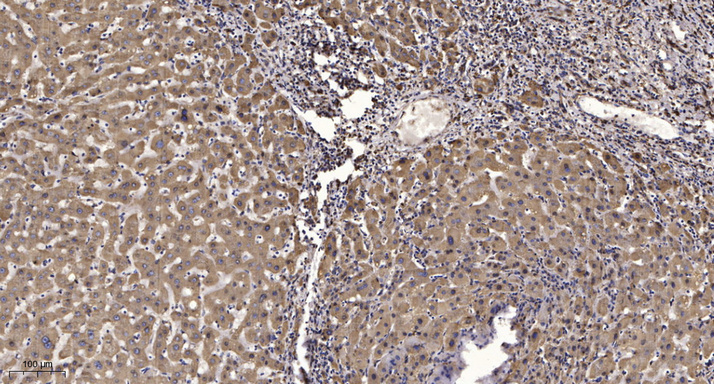

Anti-KCNQ4 antibody (644-693 aa) (STJ93824)
SPECIFICATIONS
ClonalityPolyclonal
HostRabbit
ConjugationUnconjugated
IsotypeIgG
ImmunogenThe antiserum was produced against synthesized peptide derived from the human KCNQ4 at the amino acid range 644-693
General Information
| Short Description | Rabbit polyclonal anti-Potassium voltage-gated channel subfamily KQT member 4 (644-693 aa) for use in WB, ELISA and IHC in Human and Mouse samples. Datasheet included with dilution recommendations, and related reagents. |
| Applications | WB/ELISA/IHC |
| Host | Rabbit |
| Reactivity | Human/Mouse |
| Note | STRICTLY FOR FURTHER SCIENTIFIC RESEARCH USE ONLY (RUO). MUST NOT TO BE USED IN DIAGNOSTIC OR THERAPEUTIC APPLICATIONS. |
Product Properties
| Clonality | Polyclonal |
| Isotype | IgG |
| Conjugation | Unconjugated |
| Concentration | 1 mg/mL |
| Purification | The antibody was affinity-purified from rabbit antiserum by affinity-chromatography using epitope-specific immunogen. |
| Dilution Range | WB 1:500-2000IHC-P 1:50-300ELISA 2000-20000 |
| Formulation | Liquid in PBS containing 50% Glycerol, 0.5% BSA and 0.02% Sodium Azide. |
| Storage Instruction | Store at-20°C for up to 1 year from the date of receipt, and avoid repeat freeze-thaw cycles. |
Target Information
| Gene Symbol | KCNQ4 |
| Gene ID | 9132 |
| Uniprot ID | KCNQ4_HUMAN |
| Immunogen | The antiserum was produced against synthesized peptide derived from the human KCNQ4 at the amino acid range 644-693 |
| Immunogen Region | 644-693 aa |
| Specificity | KCNQ4 Polyclonal Antibody detects endogenous levels of KCNQ4 protein. |
Additional Info
| Function | Pore-forming subunit of the voltage-gated potassium (Kv) channel involved in the regulation of sensory cells excitability in the cochlea. KCNQ4/Kv7.4 channel is composed of 4 pore-forming subunits assembled as tetramers. Promotes the outflow of potassium ions in the repolarization phase of action potential which plays a role in regulating membrane potential of excitable cells. The channel conducts a slowly activating and deactivating current. Current often shows some inward rectification at positive potentials. Channel may be selectively permeable in vitro to other cations besides potassium, in decreasing order of affinity K(+) = Rb(+) > Cs(+) > Na(+). Important for normal physiological function of inner ear such as sensory perception of sound. |
| Protein Name | Potassium Voltage-Gated Channel Subfamily Kqt Member 4Kqt-Like 4Potassium Channel Subunit Alpha Kvlqt4Voltage-Gated Potassium Channel Subunit Kv7.4 |
| Database Links | Reactome: R-HSA-1296072Reactome: R-HSA-9662360Reactome: R-HSA-9662361 |
| Cellular Localisation | Basal Cell MembraneMulti-Pass Membrane ProteinSituated At The Basal Membrane Of Cochlear Outer Hair Cells |
| Alternative Antibody Names | Anti-Potassium Voltage-Gated Channel Subfamily Kqt Member 4 antibodyAnti-Kqt-Like 4 antibodyAnti-Potassium Channel Subunit Alpha Kvlqt4 antibodyAnti-Voltage-Gated Potassium Channel Subunit Kv7.4 antibodyAnti-KCNQ4 antibody |
Information sourced from Uniprot.org