
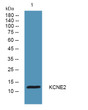


Anti-KCNE2 antibody (30-110 aa) (STJ191185)
SPECIFICATIONS
ClonalityPolyclonal
HostRabbit
ConjugationUnconjugated
IsotypeIgG
ImmunogenSynthesized peptide derived from the human protein at the amino acid range 30-110
General Information
| Short Description | Rabbit polyclonal anti-Potassium voltage-gated channel subfamily E member 2 (30-110 aa) for use in WB and ELISA in Human, Mouse and Rat samples. Datasheet included with dilution recommendations, and related reagents. |
| Applications | WB/ELISA |
| Host | Rabbit |
| Reactivity | Human/Mouse/Rat |
| Note | STRICTLY FOR FURTHER SCIENTIFIC RESEARCH USE ONLY (RUO). MUST NOT TO BE USED IN DIAGNOSTIC OR THERAPEUTIC APPLICATIONS. |
Product Properties
| Clonality | Polyclonal |
| Isotype | IgG |
| Conjugation | Unconjugated |
| Concentration | 1 mg/mL |
| Purification | The antibody was affinity-purified from rabbit antiserum by affinity-chromatography using epitope-specific immunogen. |
| Dilution Range | WB 1:500-2000ELISA 1:5000-20000 |
| Formulation | Liquid in PBS containing 50% Glycerol and 0.02% Sodium Azide. |
| Storage Instruction | Store at-20°C for up to 1 year from the date of receipt, and avoid repeat freeze-thaw cycles. |
Target Information
| Gene Symbol | KCNE2 |
| Gene ID | 9992 |
| Uniprot ID | KCNE2_HUMAN |
| Immunogen | Synthesized peptide derived from the human protein at the amino acid range 30-110 |
| Immunogen Region | 30-110 aa |
| Specificity | KCNE2 Polyclonal Antibody detects endogenous levels of protein. |
Additional Info
| Function | Ancillary protein that functions as a regulatory subunit of the voltage-gated potassium (Kv) channel complex composed of pore-forming and potassium-conducting alpha subunits and of regulatory beta subunits. KCNE2 beta subunit modulates the gating kinetics and enhances stability of the channel complex. Alters the gating of the delayed rectifier Kv channel containing KCNB1 alpha subunit. Associates with KCNH2/HERG alpha subunit Kv channel to form the rapidly activating component of the delayed rectifying potassium current (IKr) in heart. May associate with KCNQ2 and/or KCNQ3 alpha subunits to modulate the native M-type current. May associate with HCN1 and HCN2 channel subunits to increase potassium current. Forms a heterooligomer complex with KCNQ1/KVLQT1 alpha subunits which leads to currents with an apparently instantaneous activation, a rapid deactivation process and a linear current-voltage relationship and decreases the amplitude of the outward current. KCNQ1-KCNE2 channel associates with Na(+)-coupled myo-inositol symporter in the apical membrane of choroid plexus epithelium and regulates the myo-inositol gradient between blood and cerebrospinal fluid with an impact on neuron excitability. |
| Protein Name | Potassium Voltage-Gated Channel Subfamily E Member 2Mink-Related Peptide 1Mirp1Minimum Potassium Ion Channel-Related Peptide 1Potassium Channel Subunit Beta Mirp1 |
| Database Links | Reactome: R-HSA-5576890Reactome: R-HSA-5576893 |
| Cellular Localisation | Cell MembraneSingle-Pass Type I Membrane ProteinApical Cell MembraneSingle-Pass Membrane ProteinColocalizes With Kcnb1 At The Plasma Membrane |
| Alternative Antibody Names | Anti-Potassium Voltage-Gated Channel Subfamily E Member 2 antibodyAnti-Mink-Related Peptide 1 antibodyAnti-Mirp1 antibodyAnti-Minimum Potassium Ion Channel-Related Peptide 1 antibodyAnti-Potassium Channel Subunit Beta Mirp1 antibodyAnti-KCNE2 antibody |
Information sourced from Uniprot.org