
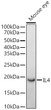


Anti-IL4 antibody (1-100) (STJ11102765)
SPECIFICATIONS
ClonalityPolyclonal
HostRabbit
ConjugationUnconjugated
IsotypeIgG
General Information
| Short Description | Rabbit polyclonal IL4 (1-100) antibody for use in WB and ELISA in human, mouse and rat samples. Datasheet included with dilution recommendations, and related reagents. |
| Applications | WB/ELISA |
| Host | Rabbit |
| Reactivity | Human/Mouse/Rat |
| Note | STRICTLY FOR FURTHER SCIENTIFIC RESEARCH USE ONLY (RUO). MUST NOT TO BE USED IN DIAGNOSTIC OR THERAPEUTIC APPLICATIONS. |
Product Properties
| Clonality | Polyclonal |
| Isotype | IgG |
| Conjugation | Unconjugated |
| Concentration | Lot specific |
| Purification | Affinity purification |
| Dilution Range | WB:1:500-1:1000ELISA:Recommended starting concentration is 1 Mu g/mL. Please optimize the concentration based on your specific assay requirements. |
| Formulation | PBS with 0.05% Proclin300, 50% Glycerol, pH 7.3. |
| Storage Instruction | Store at-20°C for up to 1 year from the date of receipt, and avoid repeat freeze-thaw cycles. |
Target Information
| Gene Symbol | IL4 |
| Gene ID | 3565 |
| Uniprot ID | IL4_HUMAN |
| Immunogen Region | 1-100 |
| Immunogen Sequence | MGLTSQLLPPLFFLLACAGN FVHGHKCDITLQEIIKTLNS LTEQKTLCTELTVTDIFAAS KNTTEKETFCRAATVLRQFY SHHEKDTRCLGATAQQFHRH |
| Specificity | A synthetic peptide corresponding to a sequence within amino acids 1-100 of human IL4 (NP_000580.1). |
Additional Info
| Function | Cytokine secreted primarily by mast cells, T-cells, eosinophils, and basophils that plays a role in regulating antibody production, hematopoiesis and inflammation, and the development of effector T-cell responses. Induces the expression of class II MHC molecules on resting B-cells. Enhances both secretion and cell surface expression of IgE and IgG1. Also regulates the expression of the low affinity Fc receptor for IgE (CD23) on both lymphocytes and monocytes. Positively regulates IL31RA expression in macrophages. Stimulates autophagy in dendritic cells by interfering with mTORC1 signaling and through the induction of RUFY4. In addition, plays a critical role in higher functions of the normal brain, such as memory and learning. Upon binding to IL4, IL4R receptor dimerizes either with the common IL2R gamma chain/IL2RG to produce the type 1 signaling complex, located mainly on hematopoietic cells, or with the IL13RA1 to produce the type 2 complex, which is also expressed on nonhematopoietic cells. Engagement of both types of receptors initiates JAK3 and to a lower extend JAK1 phosphorylation leading to activation of the signal transducer and activator of transcription 6/STAT6. |
| Protein Name | Interleukin-4Il-4B-Cell Stimulatory Factor 1Bsf-1BinetrakinLymphocyte Stimulatory Factor 1Pitrakinra |
| Database Links | Reactome: R-HSA-6785807Reactome: R-HSA-9012546 |
| Cellular Localisation | Secreted |
| Alternative Antibody Names | Anti-Interleukin-4 antibodyAnti-Il-4 antibodyAnti-B-Cell Stimulatory Factor 1 antibodyAnti-Bsf-1 antibodyAnti-Binetrakin antibodyAnti-Lymphocyte Stimulatory Factor 1 antibodyAnti-Pitrakinra antibodyAnti-IL4 antibody |
Information sourced from Uniprot.org