

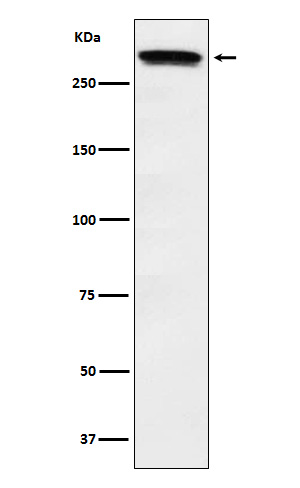

Anti-Huntingtin antibody [R02-2B7] (STJA0036601)
SPECIFICATIONS
ClonalityMonoclonal
HostRabbit
ConjugationUnconjugated
IsotypeIgG
ImmunogenA synthesized peptide derived from human Huntingtin
General Information
| Short Description | Rabbit monoclonal anti-Huntingtin for use in WB, IHC-P, ICC, IF and FC in Human, Mouse and Rat samples. Datasheet included with dilution recommendations, and related reagents. |
| Applications | WB/IHC-P/ICC/IF/FC |
| Host | Rabbit |
| Reactivity | Human/Mouse/Rat |
| Note | STRICTLY FOR FURTHER SCIENTIFIC RESEARCH USE ONLY (RUO). MUST NOT TO BE USED IN DIAGNOSTIC OR THERAPEUTIC APPLICATIONS. |
Product Properties
| Clonality | Monoclonal |
| Clone ID | R02-2B7 |
| Isotype | IgG |
| Conjugation | Unconjugated |
| Purification | Affinity Chromatography |
| Dilution Range | WB 1:500-1:1000IHC 1:50-1:100IF 1:50-1:200FC 1:50-1:100 |
| Formulation | Rabbit IgG in phosphate buffered saline, pH 7.4, 150mM NaCl, 0.02% sodium azide and 50% glycerol. |
| Storage Instruction | Store at 4°C short term. Aliquot and store at-20°C long term. Avoid freeze/thaw cycles. |
Target Information
| Gene Symbol | HTT |
| Gene ID | 3064 |
| Uniprot ID | HD_HUMAN |
| Immunogen | A synthesized peptide derived from human Huntingtin |
Additional Info
| Tissue Specificity | Expressed in the brain cortex (at protein level). Widely expressed with the highest level of expression in the brain (nerve fibers, varicosities, and nerve endings). In the brain, the regions where it can be mainly found are the cerebellar cortex, the neocortex, the striatum, and the hippocampal formation. |
| Post Translational Modifications | Huntingtin: Cleaved by caspases downstream of the polyglutamine stretch. The resulting N-terminal fragments are cytotoxic and provokes apoptosis. Huntingtin: Forms with expanded polyglutamine expansion are specifically ubiquitinated by SYVN1, which promotes their proteasomal degradation. Huntingtin: Phosphorylation at Ser-1179 and Ser-1199 by CDK5 in response to DNA damage in nuclei of neurons protects neurons against polyglutamine expansion as well as DNA damage mediated toxicity. Huntingtin, myristoylated N-terminal fragment: Myristoylated at Gly-551, following proteolytic cleavage at Asp-550. |
| Function | Huntingtin: May play a role in microtubule-mediated transport or vesicle function. Huntingtin, myristoylated N-terminal fragment: Promotes the formation of autophagic vesicles. |
| Protein Name | HuntingtinHuntington Disease ProteinHd Protein Cleaved Into - Huntingtin - Myristoylated N-Terminal Fragment |
| Database Links | Reactome: R-HSA-9022692 |
| Cellular Localisation | Huntingtin: CytoplasmNucleusEarly EndosomeThe Mutant Huntingtin Protein Colocalizes With Akap8l In The Nuclear Matrix Of Huntington Disease NeuronsShuttles Between Cytoplasm And Nucleus In A Ran Gtpase-Independent MannerRecruits Onto Early Endosomes In A Rab5- And Hap40-Dependent FashionHuntingtinMyristoylated N-Terminal Fragment: Cytoplasmic VesicleAutophagosome |
| Alternative Antibody Names | Anti-Huntingtin antibodyAnti-Huntington Disease Protein antibodyAnti-Hd Protein Cleaved Into - Huntingtin - Myristoylated N-Terminal Fragment antibodyAnti-HTT antibodyAnti-HD antibodyAnti-IT15 antibody |
Information sourced from Uniprot.org