

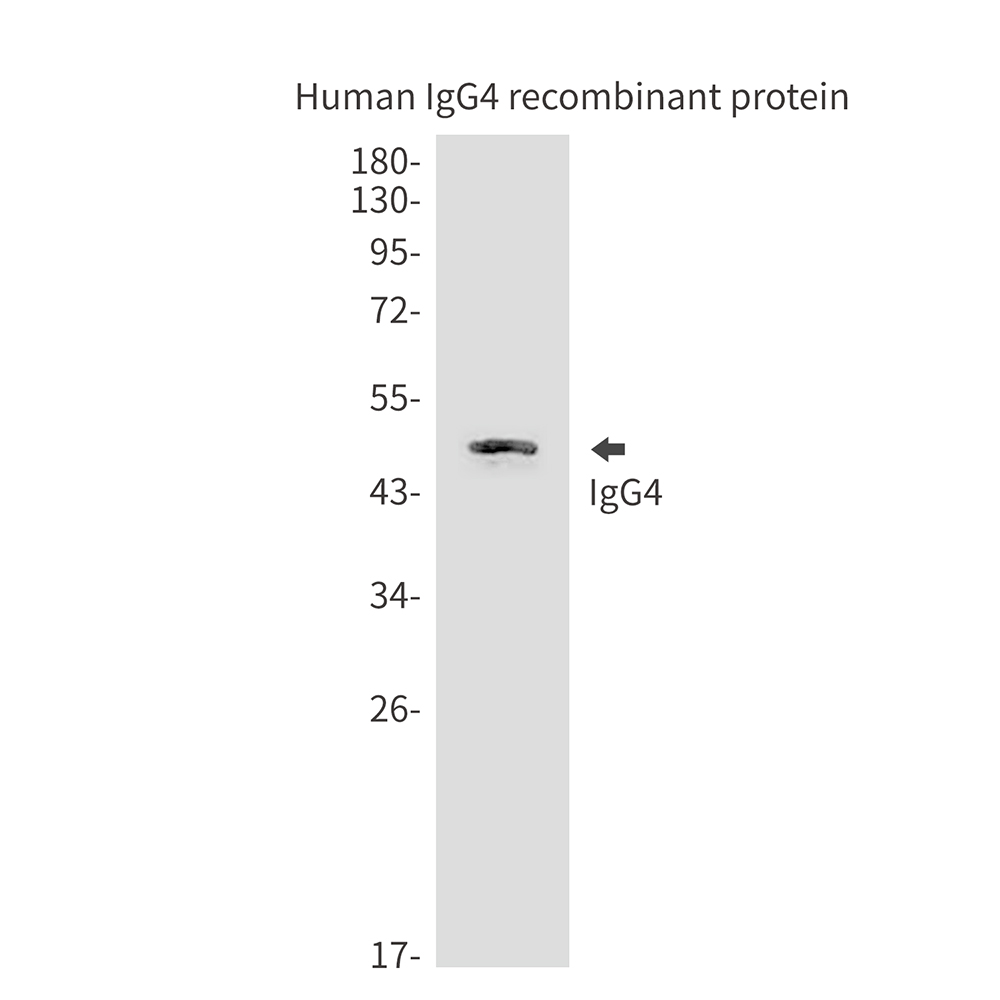
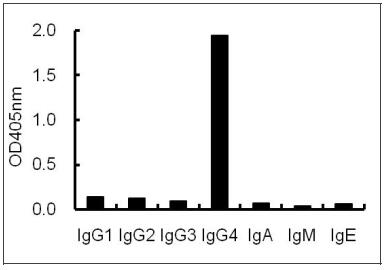

Anti-Human IgG4 antibody [9G12] (STJA0032560)
SPECIFICATIONS
ClonalityMonoclonal
HostMouse
ConjugationUnconjugated
IsotypeIgG1
ImmunogenHuman IgG4
General Information
| Short Description | Mouse monoclonal anti-Human IgG4 for use in WB and ELISA in Human samples. Datasheet included with dilution recommendations, and related reagents. |
| Applications | WB/ELISA |
| Host | Mouse |
| Reactivity | Human |
| Note | STRICTLY FOR FURTHER SCIENTIFIC RESEARCH USE ONLY (RUO). MUST NOT TO BE USED IN DIAGNOSTIC OR THERAPEUTIC APPLICATIONS. |
Product Properties
| Clonality | Monoclonal |
| Clone ID | 9G12 |
| Isotype | IgG1 |
| Conjugation | Unconjugated |
| Concentration | 1 mg/mL |
| Purification | Affinity Purified |
| Dilution Range | WB 1:500-1:1000ELISA 1:10000 |
| Formulation | Liquid in PBS containing 0.09% sodium azide as a preservative. |
| Storage Instruction | Store at 4°C short term. Aliquot and store at-20°C long term. Avoid freeze/thaw cycles. |
Target Information
| Gene Symbol | IGHG4Uniprot ID=IGHG4_HUMAN" |
| Immunogen | Human IgG4 |
Additional Info
| Post Translational Modifications | Glycosylation on Asn-177 is required for interaction with Fc receptors and ability to activate the complement pathway. (Microbial infection) Deglycosylation on Asn-177 by S.pyogenes EndoS or Endos2 endoglucosidases prevents interaction between immunoglobulin-gamma (IgG) and Fc receptors, impairing ability to activate the complement pathway. |
| Function | Constant region of immunoglobulin heavy chains. Immunoglobulins, also known as antibodies, are membrane-bound or secreted glycoproteins produced by B lymphocytes. In the recognition phase of humoral immunity, the membrane-bound immunoglobulins serve as receptors which, upon binding of a specific antigen, trigger the clonal expansion and differentiation of B lymphocytes into immunoglobulins-secreting plasma cells. Secreted immunoglobulins mediate the effector phase of humoral immunity, which results in the elimination of bound antigens. The antigen binding site is formed by the variable domain of one heavy chain, together with that of its associated light chain. Thus, each immunoglobulin has two antigen binding sites with remarkable affinity for a particular antigen. The variable domains are assembled by a process called V-(D)-J rearrangement and can then be subjected to somatic hypermutations which, after exposure to antigen and selection, allow affinity maturation for a particular antigen. |
| Protein Name | Immunoglobulin Heavy Constant Gamma 4Ig Gamma-4 Chain C Region |
| Cellular Localisation | Isoform 1: SecretedIsoform 2: Cell MembraneSingle-Pass Membrane Protein |
| Alternative Antibody Names | Anti-Immunoglobulin Heavy Constant Gamma 4 antibodyAnti-Ig Gamma-4 Chain C Region antibodyAnti-IGHG4 antibody |
Information sourced from Uniprot.org