
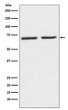


Anti-HTR2C antibody [R01-7H8] (STJA0036505)
SPECIFICATIONS
ClonalityMonoclonal
HostRabbit
ConjugationUnconjugated
IsotypeIgG
ImmunogenA synthesized peptide derived from human 5HT2C Receptor
General Information
| Short Description | Rabbit monoclonal anti-HTR2C for use in WB in Human, Mouse and Rat samples. Datasheet included with dilution recommendations, and related reagents. |
| Applications | WB |
| Host | Rabbit |
| Reactivity | Human/Mouse/Rat |
| Note | STRICTLY FOR FURTHER SCIENTIFIC RESEARCH USE ONLY (RUO). MUST NOT TO BE USED IN DIAGNOSTIC OR THERAPEUTIC APPLICATIONS. |
Product Properties
| Clonality | Monoclonal |
| Clone ID | R01-7H8 |
| Isotype | IgG |
| Conjugation | Unconjugated |
| Purification | Affinity Chromatography |
| Dilution Range | WB 1:500-1:1000 |
| Formulation | Rabbit IgG in phosphate buffered saline, pH 7.4, 150mM NaCl, 0.02% sodium azide and 50% glycerol. |
| Storage Instruction | Store at 4°C short term. Aliquot and store at-20°C long term. Avoid freeze/thaw cycles. |
Target Information
| Gene Symbol | HTR2C |
| Gene ID | 3358 |
| Uniprot ID | 5HT2C_HUMAN |
| Immunogen | A synthesized peptide derived from human 5HT2C Receptor |
Additional Info
| Tissue Specificity | Detected in brain. |
| Post Translational Modifications | N-glycosylated. |
| Function | G-protein coupled receptor for 5-hydroxytryptamine (serotonin). Also functions as a receptor for various drugs and psychoactive substances, including ergot alkaloid derivatives, 1-2,5,-dimethoxy-4-iodophenyl-2-aminopropane (DOI) and lysergic acid diethylamide (LSD). Ligand binding causes a conformation change that triggers signaling via guanine nucleotide-binding proteins (G proteins) and modulates the activity of downstream effectors. HTR2C is coupled to G(q)/G(11) G alpha proteins and activates phospholipase C-beta, releasing diacylglycerol (DAG) and inositol 1,4,5-trisphosphate (IP3) second messengers that modulate the activity of phosphatidylinositol 3-kinase and promote the release of Ca(2+) ions from intracellular stores, respectively. Beta-arrestin family members inhibit signaling via G proteins and mediate activation of alternative signaling pathways. Regulates neuronal activity via the activation of short transient receptor potential calcium channels in the brain, and thereby modulates the activation of pro-opiomelanocortin neurons and the release of CRH that then regulates the release of corticosterone. Plays a role in the regulation of appetite and eating behavior, responses to anxiogenic stimuli and stress. Plays a role in insulin sensitivity and glucose homeostasis. |
| Protein Name | 5-Hydroxytryptamine Receptor 2c5-Ht-2c5-Ht2c5-Htr2c5-Hydroxytryptamine Receptor 1c5-Ht-1c5-Ht1cSerotonin Receptor 2c |
| Database Links | Reactome: R-HSA-390666Reactome: R-HSA-416476 |
| Cellular Localisation | Cell MembraneMulti-Pass Membrane Protein |
| Alternative Antibody Names | Anti-5-Hydroxytryptamine Receptor 2c antibodyAnti-5-Ht-2c antibodyAnti-5-Ht2c antibodyAnti-5-Htr2c antibodyAnti-5-Hydroxytryptamine Receptor 1c antibodyAnti-5-Ht-1c antibodyAnti-5-Ht1c antibodyAnti-Serotonin Receptor 2c antibodyAnti-HTR2C antibodyAnti-HTR1C antibody |
Information sourced from Uniprot.org