
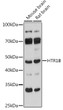


Anti-HTR1B antibody (1-390) (STJ11100241)
SPECIFICATIONS
ClonalityPolyclonal
HostRabbit
ConjugationUnconjugated
IsotypeIgG
General Information
| Short Description | Rabbit polyclonal HTR1B (1-390) antibody for use in WB and ELISA in human, mouse and rat samples. Datasheet included with dilution recommendations, and related reagents. |
| Applications | WB/ELISA |
| Host | Rabbit |
| Reactivity | Human/Mouse/Rat |
| Note | STRICTLY FOR FURTHER SCIENTIFIC RESEARCH USE ONLY (RUO). MUST NOT TO BE USED IN DIAGNOSTIC OR THERAPEUTIC APPLICATIONS. |
Product Properties
| Clonality | Polyclonal |
| Isotype | IgG |
| Conjugation | Unconjugated |
| Concentration | Lot specific |
| Purification | Affinity purification |
| Dilution Range | WB:1:500-1:2000ELISA:Recommended starting concentration is 1 Mu g/mL. Please optimize the concentration based on your specific assay requirements. |
| Formulation | PBS with 0.01% Thimerosal, 50% Glycerol, pH 7.3. |
| Storage Instruction | Store at-20°C for up to 1 year from the date of receipt, and avoid repeat freeze-thaw cycles. |
Target Information
| Gene Symbol | HTR1B |
| Gene ID | 3351 |
| Uniprot ID | 5HT1B_HUMAN |
| Immunogen Region | 1-390 |
| Immunogen Sequence | MEEPGAQCAPPPPAGSETWV PQANLSSAPSQNCSAKDYIY QDSISLPWKVLLVMLLALIT LATTLSNAFVIATVYRTRKL HTPANYLIASLAVTDLLVSI LVMPISTMYTVTGRWTLGQV VCDFWLSSDITCCTASILHL CVIALDRYWAITDAVEYSAK RTPKRAAVMIALVWVFSISI SLPPFFWRQAKAEEEVSECV VNTDHILYTVYSTVGAFYFP TLLLIALYGRIYVEARSRI |
| Specificity | Recombinant fusion protein containing a sequence corresponding to amino acids 1-390 of human HTR1B (P28222). |
Additional Info
| Tissue Specificity | Detected in cerebral artery smooth muscle cells (at protein level). Detected in brain cortex, striatum, amygdala, medulla, hippocampus, caudate nucleus and putamen. |
| Post Translational Modifications | Phosphorylated. Desensitization of the receptor may be mediated by its phosphorylation. Palmitoylated. |
| Function | G-protein coupled receptor for 5-hydroxytryptamine (serotonin). Also functions as a receptor for ergot alkaloid derivatives, various anxiolytic and antidepressant drugs and other psychoactive substances, such as lysergic acid diethylamide (LSD). Ligand binding causes a conformation change that triggers signaling via guanine nucleotide-binding proteins (G proteins) and modulates the activity of downstream effectors, such as adenylate cyclase. HTR1B is coupled to G(i)/G(o) G alpha proteins and mediates inhibitory neurotransmission by inhibiting adenylate cyclase activity. Arrestin family members inhibit signaling via G proteins and mediate activation of alternative signaling pathways. Regulates the release of 5-hydroxytryptamine, dopamine and acetylcholine in the brain, and thereby affects neural activity, nociceptive processing, pain perception, mood and behavior. Besides, plays a role in vasoconstriction of cerebral arteries. |
| Protein Name | 5-Hydroxytryptamine Receptor 1b5-Ht-1b5-Ht1bS12Serotonin 1d Beta Receptor5-Ht-1d-BetaSerotonin Receptor 1b |
| Database Links | Reactome: R-HSA-390666Reactome: R-HSA-418594 |
| Cellular Localisation | Cell MembraneMulti-Pass Membrane Protein |
| Alternative Antibody Names | Anti-5-Hydroxytryptamine Receptor 1b antibodyAnti-5-Ht-1b antibodyAnti-5-Ht1b antibodyAnti-S12 antibodyAnti-Serotonin 1d Beta Receptor antibodyAnti-5-Ht-1d-Beta antibodyAnti-Serotonin Receptor 1b antibodyAnti-HTR1B antibodyAnti-HTR1DB antibody |
Information sourced from Uniprot.org