

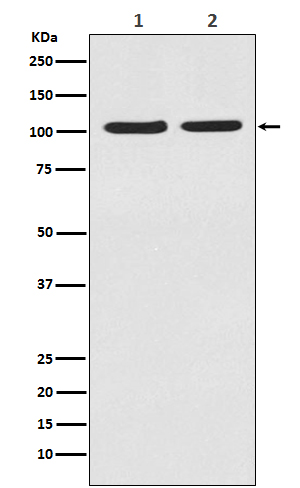

Anti-HIF2 alpha antibody [R05-3H4] (STJA0035779)
SPECIFICATIONS
ClonalityMonoclonal
HostRabbit
ConjugationUnconjugated
IsotypeIgG
ImmunogenA synthesized peptide derived from human HIF-2 alpha
General Information
| Short Description | Rabbit monoclonal anti-HIF2 alpha for use in WB, ICC, IF and FC in Human, Mouse and Rat samples. Datasheet included with dilution recommendations, and related reagents. |
| Applications | WB/ICC/IF/FC |
| Host | Rabbit |
| Reactivity | Human/Mouse/Rat |
| Note | STRICTLY FOR FURTHER SCIENTIFIC RESEARCH USE ONLY (RUO). MUST NOT TO BE USED IN DIAGNOSTIC OR THERAPEUTIC APPLICATIONS. |
Product Properties
| Clonality | Monoclonal |
| Clone ID | R05-3H4 |
| Isotype | IgG |
| Conjugation | Unconjugated |
| Purification | Affinity Chromatography |
| Dilution Range | WB 1:500-1:1000IF 1:50-1:200FC 1:50-1:100 |
| Formulation | Rabbit IgG in phosphate buffered saline, pH 7.4, 150mM NaCl, 0.02% sodium azide and 50% glycerol. |
| Storage Instruction | Store at 4°C short term. Aliquot and store at-20°C long term. Avoid freeze/thaw cycles. |
Target Information
| Gene Symbol | EPAS1 |
| Gene ID | 2034 |
| Uniprot ID | EPAS1_HUMAN |
| Immunogen | A synthesized peptide derived from human HIF-2 alpha |
Additional Info
| Tissue Specificity | Expressed in most tissues, with highest levels in placenta, lung and heart. Selectively expressed in endothelial cells. |
| Post Translational Modifications | In normoxia, is probably hydroxylated on Pro-405 and Pro-531 by EGLN1/PHD1, EGLN2/PHD2 and/or EGLN3/PHD3. The hydroxylated prolines promote interaction with VHL, initiating rapid ubiquitination and subsequent proteasomal degradation. Under hypoxia, proline hydroxylation is impaired and ubiquitination is attenuated, resulting in stabilization. In normoxia, is hydroxylated on Asn-847 by HIF1AN thus probably abrogating interaction with CREBBP and EP300 and preventing transcriptional activation. Phosphorylated on multiple sites in the CTAD. The iron and 2-oxoglutarate dependent 3-hydroxylation of asparagine is (S) stereospecific within HIF CTAD domains. |
| Function | Transcription factor involved in the induction of oxygen regulated genes. Heterodimerizes with ARNT.heterodimer binds to core DNA sequence 5'-TACGTG-3' within the hypoxia response element (HRE) of target gene promoters. Regulates the vascular endothelial growth factor (VEGF) expression and seems to be implicated in the development of blood vessels and the tubular system of lung. May also play a role in the formation of the endothelium that gives rise to the blood brain barrier. Potent activator of the Tie-2 tyrosine kinase expression. Activation requires recruitment of transcriptional coactivators such as CREBBP and probably EP300. Interaction with redox regulatory protein APEX1 seems to activate CTAD. |
| Protein Name | Endothelial Pas Domain-Containing Protein 1Epas-1Basic-Helix-Loop-Helix-Pas Protein Mop2Class E Basic Helix-Loop-Helix Protein 73Bhlhe73Hif-1-Alpha-Like FactorHlfHypoxia-Inducible Factor 2-AlphaHif-2-AlphaHif2-AlphaMember Of Pas Protein 2Pas Domain-Containing Protein 2 |
| Database Links | Reactome: R-HSA-1234158Reactome: R-HSA-1234174Reactome: R-HSA-1234176Reactome: R-HSA-452723Reactome: R-HSA-8849473Reactome: R-HSA-8951664Reactome: R-HSA-9664873 |
| Cellular Localisation | NucleusNucleus SpeckleColocalizes With Hif3a In The Nucleus And Speckles |
| Alternative Antibody Names | Anti-Endothelial Pas Domain-Containing Protein 1 antibodyAnti-Epas-1 antibodyAnti-Basic-Helix-Loop-Helix-Pas Protein Mop2 antibodyAnti-Class E Basic Helix-Loop-Helix Protein 73 antibodyAnti-Bhlhe73 antibodyAnti-Hif-1-Alpha-Like Factor antibodyAnti-Hlf antibodyAnti-Hypoxia-Inducible Factor 2-Alpha antibodyAnti-Hif-2-Alpha antibodyAnti-Hif2-Alpha antibodyAnti-Member Of Pas Protein 2 antibodyAnti-Pas Domain-Containing Protein 2 antibodyAnti-EPAS1 antibodyAnti-BHLHE73 antibodyAnti-HIF2A antibodyAnti-MOP2 antibodyAnti-PASD2 antibody |
Information sourced from Uniprot.org