


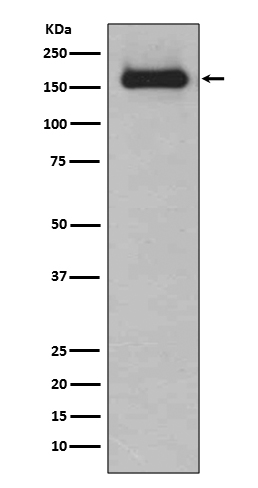
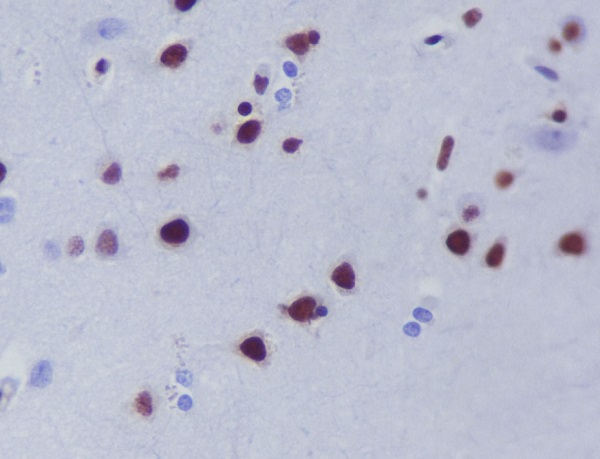


Anti-HDAC9 antibody [R03-3C3] (STJA0036156)
SPECIFICATIONS
ClonalityMonoclonal
HostRabbit
ConjugationUnconjugated
IsotypeIgG
ImmunogenA synthesized peptide derived from human HDAC9
General Information
| Short Description | Rabbit monoclonal anti-HDAC9 for use in WB, IHC-P, ICC and IF in Human and Rat samples. Datasheet included with dilution recommendations, and related reagents. |
| Applications | WB/IHC-P/ICC/IF |
| Host | Rabbit |
| Reactivity | Human/Rat |
| Note | STRICTLY FOR FURTHER SCIENTIFIC RESEARCH USE ONLY (RUO). MUST NOT TO BE USED IN DIAGNOSTIC OR THERAPEUTIC APPLICATIONS. |
Product Properties
| Clonality | Monoclonal |
| Clone ID | R03-3C3 |
| Isotype | IgG |
| Conjugation | Unconjugated |
| Purification | Affinity Chromatography |
| Dilution Range | WB 1:500-1:1000IHC 1:50-1:100IF 1:50-1:200 |
| Formulation | Rabbit IgG in phosphate buffered saline, pH 7.4, 150mM NaCl, 0.02% sodium azide and 50% glycerol. |
| Storage Instruction | Store at 4°C short term. Aliquot and store at-20°C long term. Avoid freeze/thaw cycles. |
Target Information
| Gene Symbol | HDAC9 |
| Gene ID | 9734 |
| Uniprot ID | HDAC9_HUMAN |
| Immunogen | A synthesized peptide derived from human HDAC9 |
Additional Info
| Tissue Specificity | Broadly expressed, with highest levels in brain, heart, muscle and testis. Isoform 3 is present in human bladder carcinoma cells (at protein level). |
| Post Translational Modifications | Phosphorylated on Ser-220 and Ser-450.which promotes 14-3-3-binding, impairs interaction with MEF2, and antagonizes antimyogenic activity. Phosphorylated on Ser-240.which impairs nuclear accumulation. Isoform 7 is phosphorylated on Tyr-1010. Phosphorylated by the PKC kinases PKN1 and PKN2, impairing nuclear import. Sumoylated. |
| Function | Responsible for the deacetylation of lysine residues on the N-terminal part of the core histones (H2A, H2B, H3 and H4). Histone deacetylation gives a tag for epigenetic repression and plays an important role in transcriptional regulation, cell cycle progression and developmental events. Represses MEF2-dependent transcription. Isoform 3 lacks active site residues and therefore is catalytically inactive. Represses MEF2-dependent transcription by recruiting HDAC1 and/or HDAC3. Seems to inhibit skeletal myogenesis and to be involved in heart development. Protects neurons from apoptosis, both by inhibiting JUN phosphorylation by MAPK10 and by repressing JUN transcription via HDAC1 recruitment to JUN promoter. |
| Protein Name | Histone Deacetylase 9Hd9Histone Deacetylase 7bHd7Hd7bHistone Deacetylase-Related ProteinMef2-Interacting Transcription Repressor Mitr |
| Database Links | Reactome: R-HSA-2122947Reactome: R-HSA-2644606Reactome: R-HSA-2894862Reactome: R-HSA-350054 |
| Cellular Localisation | Nucleus |
| Alternative Antibody Names | Anti-Histone Deacetylase 9 antibodyAnti-Hd9 antibodyAnti-Histone Deacetylase 7b antibodyAnti-Hd7 antibodyAnti-Hd7b antibodyAnti-Histone Deacetylase-Related Protein antibodyAnti-Mef2-Interacting Transcription Repressor Mitr antibodyAnti-HDAC9 antibodyAnti-HDAC7 antibodyAnti-HDAC7B antibodyAnti-HDRP antibodyAnti-KIAA0744 antibodyAnti-MITR antibody |
Information sourced from Uniprot.org