

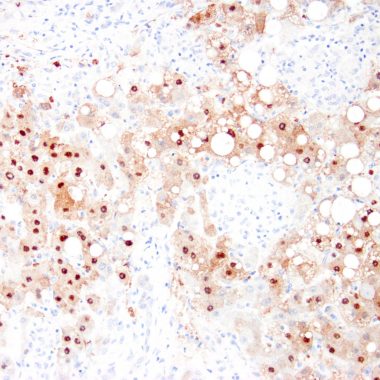

Anti-HBcAg antibody [Polyclonal] (STJ180118)
SPECIFICATIONS
ClonalityPolyclonal
HostRabbit
ConjugationUnconjugated
IsotypeIgG
ImmunogenHepatitis B virus
General Information
| Short Description | Rabbit polyclonal HBcAg antibody for use in IHC-P in human samples. Datasheet included with dilution recommendations, and related reagents. |
| Applications | IHC-P |
| Host | Rabbit |
| Reactivity | Human |
| Note | STRICTLY FOR FURTHER SCIENTIFIC RESEARCH USE ONLY (RUO). MUST NOT TO BE USED IN DIAGNOSTIC OR THERAPEUTIC APPLICATIONS. |
Product Properties
| Clonality | Polyclonal |
| Clone ID | Polyclonal |
| Isotype | IgG |
| Conjugation | Unconjugated |
| Purification | Affinity purified |
| Dilution Range | 1:50-100 |
| Formulation | Tris-HCI buffer containing stabilizing protein (BSA) and <0.1% ProClin |
| Storage Instruction | Store at 2‐8°C for up to 24 months. Predilute: Ready to use, no reconstitution necessary. Concentrate: Use dilution range and appropriate lab‐standardized diluent. Stability after dilution: 7 days at 24°C, 3 months at 2‐8°C, 6months at ‐20°C. |
Target Information
| Immunogen | Hepatitis B virus |
| Specificity | Positive control: Hepatitis B infected liver |
Additional Info
| Background | Hepatitis B virus is spherical in shape with a diameter of 42 nm. It contains a 27 nm partially double stranded DNA core enclosed within a lipoprotein coat. The antigenic activity of the nucleocapsid core is designated as hepatitis B core antigen. The antigens in the outer surface are called as hepatitis B virus surface antigens. Core antigens are localized within the nuclei whereas the surface antigens are present in the cytoplasm of the infected cells. Antibodies to surface antigens appear in circulation at an early stage of infection whereas the antibodies to the core antigens are detected after several weeks. |
Information sourced from Uniprot.org