

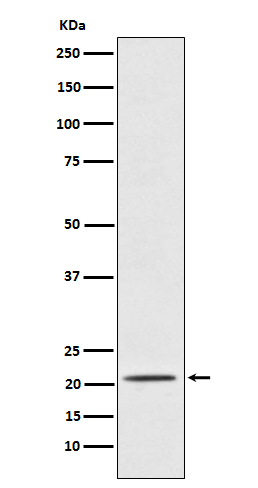

Anti-Glycodelin antibody [R02-6V7] (STJA0037054)
SPECIFICATIONS
ClonalityMonoclonal
HostRabbit
ConjugationUnconjugated
IsotypeIgG
ImmunogenA synthesized peptide derived from human Placental Protein 14/PAEP
General Information
| Short Description | Rabbit monoclonal anti-Glycodelin for use in WB in Human samples. Datasheet included with dilution recommendations, and related reagents. |
| Applications | WB |
| Host | Rabbit |
| Reactivity | Human |
| Note | STRICTLY FOR FURTHER SCIENTIFIC RESEARCH USE ONLY (RUO). MUST NOT TO BE USED IN DIAGNOSTIC OR THERAPEUTIC APPLICATIONS. |
Product Properties
| Clonality | Monoclonal |
| Clone ID | R02-6V7 |
| Isotype | IgG |
| Conjugation | Unconjugated |
| Purification | Affinity Chromatography |
| Dilution Range | WB 1:500-1:1000 |
| Formulation | Rabbit IgG in phosphate buffered saline, pH 7.4, 150mM NaCl, 0.02% sodium azide and 50% glycerol. |
| Storage Instruction | Store at 4°C short term. Aliquot and store at-20°C long term. Avoid freeze/thaw cycles. |
Target Information
| Gene Symbol | PAEP |
| Gene ID | 5047 |
| Uniprot ID | PAEP_HUMAN |
| Immunogen | A synthesized peptide derived from human Placental Protein 14/PAEP |
Additional Info
| Tissue Specificity | This protein is, the main protein synthesized and secreted in the endometrium from mid-luteal phase of the menstrual cycle and during the first semester of pregnancy. Glycodelin-A is expressed in amniotic fluid, endometrium/decidua and maternal serum (at protein level). Glycodelin-F is expressed in follicular fluid, luteinized granulosa cells and the oviduct (at protein level). Glycodelin-S is expressed in seminal plasma and seminal vesicles (at protein level). Glycodelin-C is detected in cumulus cells (at protein level), but cumulus cells do not synthesize Glycodelin-C but take up and convert glycodelin-A and -F vis glycan remodeling. |
| Post Translational Modifications | Four distinct glycoforms A, C, F and S arise from different N-linked oligosaccharide chains at amino acid residues Asn-46 and Asn-81. Glycodelin-A and -F are taken up by the cumulus cells in which partial deglycosylation takes place to produce glycodelin-C. |
| Function | Glycoprotein that regulates critical steps during fertilization and also has immunomonomodulatory effects. Four glycoforms, namely glycodelin-S, -A, -F and -C have been identified in reproductive tissues that differ in glycosylation and biological activity. Glycodelin-A has contraceptive and immunosuppressive activities. Glycodelin-C stimulates binding of spermatozoa to the zona pellucida. Glycodelin-F inhibits spermatozoa-zona pellucida binding and significantly suppresses progesterone-induced acrosome reaction of spermatozoa. Glycodelin-S in seminal plasma maintains the uncapacitated state of human spermatozoa. |
| Protein Name | GlycodelinGdPlacental Protein 14Pp14Pregnancy-Associated Endometrial Alpha-2 GlobulinPaegPegProgestagen-Associated Endometrial ProteinProgesterone-Associated Endometrial ProteinZona-Binding Inhibitory Factor-1Zif-1 |
| Database Links | |
| Cellular Localisation | Secreted |
| Alternative Antibody Names | Anti-Glycodelin antibodyAnti-Gd antibodyAnti-Placental Protein 14 antibodyAnti-Pp14 antibodyAnti-Pregnancy-Associated Endometrial Alpha-2 Globulin antibodyAnti-Paeg antibodyAnti-Peg antibodyAnti-Progestagen-Associated Endometrial Protein antibodyAnti-Progesterone-Associated Endometrial Protein antibodyAnti-Zona-Binding Inhibitory Factor-1 antibodyAnti-Zif-1 antibodyAnti-PAEP antibody |
Information sourced from Uniprot.org