

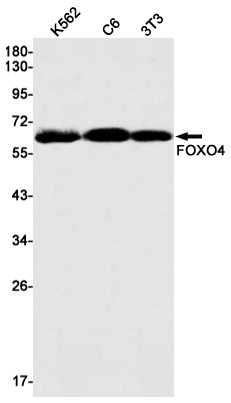

Anti-FOXO4 antibody [R03-3B2] (STJA0034327)
SPECIFICATIONS
ClonalityMonoclonal
HostRabbit
ConjugationUnconjugated
IsotypeIgG
ImmunogenA synthetic peptide of human FOXO4
General Information
| Short Description | Rabbit monoclonal anti-FOXO4 for use in WB and IP in Human, Mouse and Rat samples. Datasheet included with dilution recommendations, and related reagents. |
| Applications | WB/IP |
| Host | Rabbit |
| Reactivity | Human/Mouse/Rat |
| Note | STRICTLY FOR FURTHER SCIENTIFIC RESEARCH USE ONLY (RUO). MUST NOT TO BE USED IN DIAGNOSTIC OR THERAPEUTIC APPLICATIONS. |
Product Properties
| Clonality | Monoclonal |
| Clone ID | R03-3B2 |
| Isotype | IgG |
| Conjugation | Unconjugated |
| Concentration | 0.3 mg/mL |
| Purification | Affinity Purified |
| Dilution Range | WB 1:500-1:1000IP 1:20 |
| Formulation | 50mM Tris-Glycine (pH 7.4) , 0.15M NaCl, 40% Glycerol, 0.01% Sodium azide and 0.05% BSA |
| Storage Instruction | Store at 4°C short term. Aliquot and store at-20°C long term. Avoid freeze/thaw cycles. |
Target Information
| Gene Symbol | FOXO4 |
| Gene ID | 4303 |
| Uniprot ID | FOXO4_HUMAN |
| Immunogen | A synthetic peptide of human FOXO4 |
Additional Info
| Tissue Specificity | Heart, brain, placenta, lung, liver, skeletal muscle, kidney and pancreas. Isoform zeta is most abundant in the liver, kidney, and pancreas. |
| Post Translational Modifications | Acetylation by CREBBP/CBP, which is induced by peroxidase stress, inhibits transcriptional activity. Deacetylation by SIRT1 is NAD-dependent and stimulates transcriptional activity. Phosphorylation by PKB/AKT1 inhibits transcriptional activity and is responsible for cytoplasmic localization. May be phosphorylated at multiple sites by NLK. Monoubiquitinated.monoubiquitination is induced by oxidative stress and reduced by deacetylase inhibitors.results in its relocalization to the nucleus and its increased transcriptional activity. Deubiquitinated by USP7.deubiquitination is induced by oxidative stress.enhances its interaction with USP7 and consequently, deubiquitination.increases its translocation to the cytoplasm and inhibits its transcriptional activity. Hydrogene-peroxide-induced ubiquitination and USP7-mediated deubiquitination have no major effect on its protein stability. |
| Function | Transcription factor involved in the regulation of the insulin signaling pathway. Binds to insulin-response elements (IREs) and can activate transcription of IGFBP1. Down-regulates expression of HIF1A and suppresses hypoxia-induced transcriptional activation of HIF1A-modulated genes. Also involved in negative regulation of the cell cycle. Involved in increased proteasome activity in embryonic stem cells (ESCs) by activating expression of PSMD11 in ESCs, leading to enhanced assembly of the 26S proteasome, followed by higher proteasome activity. |
| Protein Name | Forkhead Box Protein O4Fork Head Domain Transcription Factor Afx1 |
| Database Links | Reactome: R-HSA-198693Reactome: R-HSA-5674400Reactome: R-HSA-5689880Reactome: R-HSA-9614399Reactome: R-HSA-9614657Reactome: R-HSA-9615017Reactome: R-HSA-9617629Reactome: R-HSA-9617828Reactome: R-HSA-9733709 |
| Cellular Localisation | CytoplasmNucleusWhen PhosphorylatedTranslocated From Nucleus To CytoplasmDephosphorylation Triggers Nuclear TranslocationMonoubiquitination Increases Nuclear LocalizationWhen Deubiquitinated |
| Alternative Antibody Names | Anti-Forkhead Box Protein O4 antibodyAnti-Fork Head Domain Transcription Factor Afx1 antibodyAnti-FOXO4 antibodyAnti-AFX antibodyAnti-AFX1 antibodyAnti-MLLT7 antibody |
Information sourced from Uniprot.org