
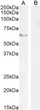


Anti-FOXC2 antibody (C-Term) (STJ70385)
SPECIFICATIONS
ClonalityPolyclonal
HostGoat
ConjugationUnconjugated
IsotypeIgG
General Information
| Short Description | Goat polyclonal antibody anti-FOXC2 (C-Term) is suitable for use in ELISA, Western Blot and Flow Cytometry research applications. |
| Applications | Pep-ELISA/WB/FC |
| Host | Goat |
| Reactivity | Human/Rat/Dog/Cow |
| Note | STRICTLY FOR FURTHER SCIENTIFIC RESEARCH USE ONLY (RUO). MUST NOT TO BE USED IN DIAGNOSTIC OR THERAPEUTIC APPLICATIONS. |
Product Properties
| Clonality | Polyclonal |
| Isotype | IgG |
| Conjugation | Unconjugated |
| Concentration | 0.5 mg/mL |
| Purification | Purified from goat serum by ammonium sulphate precipitation followed by antigen affinity chromatography using the immunizing peptide. |
| Dilution Range | Peptide ELISA: antibody detection limit dilution 1:4000.WB: Approx 60-70kDa band observed in nuclear lysates of cell lines HEK293 (calculated MW of 53.7kDa according to NP_005242.1). This molecular weight is routinely observed by other sources e |
| Formulation | 0.5 mg/ml in Tris saline, 0.02% sodium azide, pH7.3 with 0.5% bovine serum albumin. NA |
| Storage Instruction | Store at-20°C on receipt and minimise freeze-thaw cycles. |
Target Information
| Gene Symbol | FOXC2 |
| Gene ID | 2303 |
| Uniprot ID | FOXC2_HUMAN |
| Accession Number | NP_005242.1 |
| Immunogen Region | C-Term |
| Immunogen Sequence | RHAAPYSYDCTKY |
Additional Info
| Function | Transcriptional activator. |
| Protein Name | Forkhead Box Protein C2Forkhead-Related Protein Fkhl14Mesenchyme Fork Head Protein 1Mfh-1 ProteinTranscription Factor Fkh-14 |
| Database Links | Reactome: R-HSA-9761174Reactome: R-HSA-9830674 |
| Cellular Localisation | Nucleus |
| Alternative Antibody Names | Anti-Forkhead Box Protein C2 antibodyAnti-Forkhead-Related Protein Fkhl14 antibodyAnti-Mesenchyme Fork Head Protein 1 antibodyAnti-Mfh-1 Protein antibodyAnti-Transcription Factor Fkh-14 antibodyAnti-FOXC2 antibodyAnti-FKHL14 antibodyAnti-MFH1 antibody |
Information sourced from Uniprot.org