

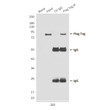
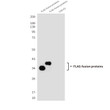


Anti-Flag-Tag antibody [7E1-10D2-3H1] (STJA0032833)
SPECIFICATIONS
ClonalityMonoclonal
HostMouse
ConjugationUnconjugated
IsotypeIgG1
ImmunogenSynthetic Peptide of Flag-Tag
General Information
| Short Description | Mouse monoclonal anti-Flag-Tag for use in WB, ICC, IF and IP in Species-independent samples. Datasheet included with dilution recommendations, and related reagents. |
| Applications | WB/ICC/IF/IP |
| Host | Mouse |
| Reactivity | Species-independent |
| Note | STRICTLY FOR FURTHER SCIENTIFIC RESEARCH USE ONLY (RUO). MUST NOT TO BE USED IN DIAGNOSTIC OR THERAPEUTIC APPLICATIONS. |
Product Properties
| Clonality | Monoclonal |
| Clone ID | 7E1-10D2-3H1 |
| Isotype | IgG1 |
| Conjugation | Unconjugated |
| Concentration | 1.3 mg/mL |
| Purification | Affinity Purified |
| Dilution Range | WB 1:1000-1:10000IF 1:100-1:500IP 1:20 |
| Formulation | Liquid in PBS containing 50% glycerol, 0.5% BSA and 0.02% sodium azide, pH 7.3. |
| Storage Instruction | Store at 4°C short term. Aliquot and store at-20°C long term. Avoid freeze/thaw cycles. |
Target Information
| Immunogen | Synthetic Peptide of Flag-Tag |
Additional Info
| Background | Epitope tags are useful for the labeling and detection of proteins using immunoblotting, immunoprecipitation, and immunostaining techniques. Because of their small size, they are unlikely to affect the tagged protein s biochemical properties.The DYKDDDDK peptide has been used extensively as a general epitope tag in expression vectors. This peptide can be expressed and detected with the protein of interest as an amino-terminal or carboxy-terminal fusion. |
Information sourced from Uniprot.org