
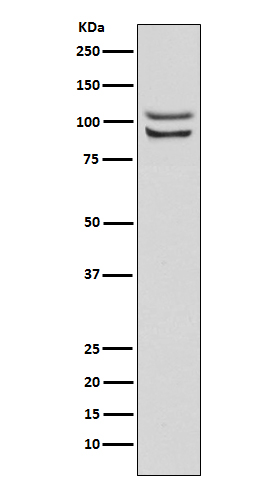

Anti-FGFR4 antibody [R06-1J1] (STJA0036440)
SPECIFICATIONS
ClonalityMonoclonal
HostRabbit
ConjugationUnconjugated
IsotypeIgG
ImmunogenA synthesized peptide derived from human FGFR4
General Information
| Short Description | Rabbit monoclonal anti-FGFR4 for use in WB in Human, Mouse and Rat samples. Datasheet included with dilution recommendations, and related reagents. |
| Applications | WB |
| Host | Rabbit |
| Reactivity | Human/Mouse/Rat |
| Note | STRICTLY FOR FURTHER SCIENTIFIC RESEARCH USE ONLY (RUO). MUST NOT TO BE USED IN DIAGNOSTIC OR THERAPEUTIC APPLICATIONS. |
Product Properties
| Clonality | Monoclonal |
| Clone ID | R06-1J1 |
| Isotype | IgG |
| Conjugation | Unconjugated |
| Purification | Affinity Chromatography |
| Dilution Range | WB 1:500-1:1000 |
| Formulation | Rabbit IgG in phosphate buffered saline, pH 7.4, 150mM NaCl, 0.02% sodium azide and 50% glycerol. |
| Storage Instruction | Store at 4°C short term. Aliquot and store at-20°C long term. Avoid freeze/thaw cycles. |
Target Information
| Gene Symbol | FGFR4 |
| Gene ID | 2264 |
| Uniprot ID | FGFR4_HUMAN |
| Immunogen | A synthesized peptide derived from human FGFR4 |
Additional Info
| Tissue Specificity | Expressed in gastrointestinal epithelial cells, pancreas, and gastric and pancreatic cancer cell lines. |
| Post Translational Modifications | N-glycosylated. Full maturation of the glycan chains in the Golgi is essential for high affinity interaction with FGF19. Ubiquitinated. Subject to proteasomal degradation when not fully glycosylated. Autophosphorylated. Binding of FGF family members together with heparan sulfate proteoglycan or heparin promotes receptor dimerization and autophosphorylation on tyrosine residues. Autophosphorylation occurs in trans between the two FGFR molecules present in the dimer. |
| Function | Tyrosine-protein kinase that acts as a cell-surface receptor for fibroblast growth factors and plays a role in the regulation of cell proliferation, differentiation and migration, and in regulation of lipid metabolism, bile acid biosynthesis, glucose uptake, vitamin D metabolism and phosphate homeostasis. Required for normal down-regulation of the expression of CYP7A1, the rate-limiting enzyme in bile acid synthesis, in response to FGF19. Phosphorylates PLCG1 and FRS2. Ligand binding leads to the activation of several signaling cascades. Activation of PLCG1 leads to the production of the cellular signaling molecules diacylglycerol and inositol 1,4,5-trisphosphate. Phosphorylation of FRS2 triggers recruitment of GRB2, GAB1, PIK3R1 and SOS1, and mediates activation of RAS, MAPK1/ERK2, MAPK3/ERK1 and the MAP kinase signaling pathway, as well as of the AKT1 signaling pathway. Promotes SRC-dependent phosphorylation of the matrix protease MMP14 and its lysosomal degradation. FGFR4 signaling is down-regulated by receptor internalization and degradation.MMP14 promotes internalization and degradation of FGFR4. Mutations that lead to constitutive kinase activation or impair normal FGFR4 inactivation lead to aberrant signaling. |
| Protein Name | Fibroblast Growth Factor Receptor 4Fgfr-4Cd Antigen Cd334 |
| Database Links | Reactome: R-HSA-109704Reactome: R-HSA-1257604Reactome: R-HSA-1307965Reactome: R-HSA-1839128Reactome: R-HSA-190322Reactome: R-HSA-2219530Reactome: R-HSA-5654228Reactome: R-HSA-5654712Reactome: R-HSA-5654719Reactome: R-HSA-5654720Reactome: R-HSA-5654733Reactome: R-HSA-5655291Reactome: R-HSA-5673001Reactome: R-HSA-6811558 |
| Cellular Localisation | Cell MembraneSingle-Pass Type I Membrane ProteinEndosomeEndoplasmic ReticulumInternalized From The Cell Membrane To Recycling EndosomesAnd From There Back To The Cell MembraneIsoform 2: Secreted |
| Alternative Antibody Names | Anti-Fibroblast Growth Factor Receptor 4 antibodyAnti-Fgfr-4 antibodyAnti-Cd Antigen Cd334 antibodyAnti-FGFR4 antibodyAnti-JTK2 antibodyAnti-TKF antibody |
Information sourced from Uniprot.org