
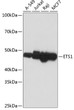


Anti-ETS1 antibody (1-100) [S3MR] (STJ11101723)
SPECIFICATIONS
ClonalityMonoclonal
HostRabbit
ConjugationUnconjugated
IsotypeIgG
General Information
| Short Description | Rabbit monoclonal ETS1 (1-100) antibody for use in WB and ELISA in human samples. Datasheet included with dilution recommendations, and related reagents. |
| Applications | WB/ELISA |
| Host | Rabbit |
| Reactivity | Human |
| Note | STRICTLY FOR FURTHER SCIENTIFIC RESEARCH USE ONLY (RUO). MUST NOT TO BE USED IN DIAGNOSTIC OR THERAPEUTIC APPLICATIONS. |
Product Properties
| Clonality | Monoclonal |
| Clone ID | S3MR |
| Isotype | IgG |
| Conjugation | Unconjugated |
| Concentration | Lot specific |
| Purification | Affinity purification |
| Dilution Range | WB:1:500-1:1000ELISA:Recommended starting concentration is 1 Mu g/mL. Please optimize the concentration based on your specific assay requirements. |
| Formulation | PBS with 0.02% Sodium Azide, 0.05% BSA, 50% Glycerol, pH 7.3. |
| Storage Instruction | Store at-20°C for up to 1 year from the date of receipt, and avoid repeat freeze-thaw cycles. |
Target Information
| Gene Symbol | ETS1 |
| Gene ID | 2113 |
| Uniprot ID | ETS1_HUMAN |
| Immunogen Region | 1-100 |
| Immunogen Sequence | MKAAVDLKPTLTIIKTEKVD LELFPSPDMECADVPLLTPS SKEMMSQALKATFSGFTKEQ QRLGIPKDPRQWTETHVRDW VMWAVNEFSLKGVDFQKFCM |
| Specificity | A synthetic peptide corresponding to a sequence within amino acids 1-100 of human ETS1 (P14921). |
Additional Info
| Tissue Specificity | Highly expressed within lymphoid cells. Isoforms c-ETS-1A and Ets-1 p27 are both detected in all fetal tissues tested, but vary with tissue type in adult tissues. None is detected in brain or kidney. |
| Post Translational Modifications | Sumoylated on Lys-15 and Lys-227, preferentially with SUMO2.which inhibits transcriptional activity. Ubiquitinated.which induces proteasomal degradation. Phosphorylation at Ser-251, Ser-282 and Ser-285 by CaMK2/CaMKII in response to calcium signaling decreases affinity for DNA: an increasing number of phosphoserines causes DNA-binding to become progressively weaker. |
| Function | Transcription factor. Directly controls the expression of cytokine and chemokine genes in a wide variety of different cellular contexts. May control the differentiation, survival and proliferation of lymphoid cells. May also regulate angiogenesis through regulation of expression of genes controlling endothelial cell migration and invasion. Isoform Ets-1 p27: Acts as a dominant-negative for isoform c-ETS-1A. |
| Protein Name | Protein C-Ets-1P54 |
| Database Links | Reactome: R-HSA-2559585 |
| Cellular Localisation | NucleusCytoplasmDelocalizes From Nucleus To Cytoplasm When Coexpressed With Isoform Ets-1 P27 |
| Alternative Antibody Names | Anti-Protein C-Ets-1 antibodyAnti-P54 antibodyAnti-ETS1 antibodyAnti-EWSR2 antibody |
Information sourced from Uniprot.org