

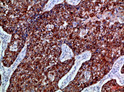


Anti-EPHB3 antibody (650-700 aa) (STJ98982)
SPECIFICATIONS
ClonalityPolyclonal
HostRabbit
ConjugationUnconjugated
IsotypeIgG
ImmunogenSynthetic peptide from the human protein at the amino acid range 650-700
General Information
| Short Description | Rabbit polyclonal anti-Ephrin type-B receptor 3 (650-700 aa) for use in IHC, IF and ELISA in Human, Mouse and Rat samples. Datasheet included with dilution recommendations, and related reagents. |
| Applications | IHC/IF/ELISA |
| Host | Rabbit |
| Reactivity | Human/Mouse/Rat |
| Note | STRICTLY FOR FURTHER SCIENTIFIC RESEARCH USE ONLY (RUO). MUST NOT TO BE USED IN DIAGNOSTIC OR THERAPEUTIC APPLICATIONS. |
Product Properties
| Clonality | Polyclonal |
| Isotype | IgG |
| Conjugation | Unconjugated |
| Concentration | 1 mg/mL |
| Purification | The antibody was affinity-purified from rabbit antiserum by affinity-chromatography using epitope-specific immunogen. |
| Dilution Range | IHC-P 1:50-200ELISA 1:10000-20000IF 1:50-200 |
| Formulation | Liquid in PBS containing 50% Glycerol, 0.5% BSA and 0.02% Sodium Azide. |
| Storage Instruction | Store at-20°C for up to 1 year from the date of receipt, and avoid repeat freeze-thaw cycles. |
Target Information
| Gene Symbol | EPHB3 |
| Gene ID | 2049 |
| Uniprot ID | EPHB3_HUMAN |
| Immunogen | Synthetic peptide from the human protein at the amino acid range 650-700 |
| Immunogen Region | 650-700 aa |
| Specificity | The antibody detects endogenous EphB3 |
Additional Info
| Post Translational Modifications | Phosphorylated. Autophosphorylates upon ligand-binding. Autophosphorylation on Tyr-614 is required for interaction with SH2 domain-containing proteins. Ubiquitinated by RNF186, mainly through 'Lys-48' and 'Lys-63'-linked polyubiquitin chains. |
| Function | Receptor tyrosine kinase which binds promiscuously transmembrane ephrin-B family ligands residing on adjacent cells, leading to contact-dependent bidirectional signaling into neighboring cells. The signaling pathway downstream of the receptor is referred to as forward signaling while the signaling pathway downstream of the ephrin ligand is referred to as reverse signaling. Generally has an overlapping and redundant function with EPHB2. Like EPHB2, functions in axon guidance during development regulating for instance the neurons forming the corpus callosum and the anterior commissure, 2 major interhemispheric connections between the temporal lobes of the cerebral cortex. In addition to its role in axon guidance also plays an important redundant role with other ephrin-B receptors in development and maturation of dendritic spines and the formation of excitatory synapses. Controls other aspects of development through regulation of cell migration and positioning. This includes angiogenesis, palate development and thymic epithelium development for instance. Forward and reverse signaling through the EFNB2/EPHB3 complex also regulate migration and adhesion of cells that tubularize the urethra and septate the cloaca. Finally, plays an important role in intestinal epithelium differentiation segregating progenitor from differentiated cells in the crypt. |
| Protein Name | Ephrin Type-B Receptor 3Eph-Like Tyrosine Kinase 2Eph-Like Kinase 2Embryonic Kinase 2Ek2Hek2Tyrosine-Protein Kinase Tyro6 |
| Database Links | Reactome: R-HSA-2682334Reactome: R-HSA-3928662Reactome: R-HSA-3928664Reactome: R-HSA-3928665 |
| Cellular Localisation | Cell MembraneSingle-Pass Type I Membrane ProteinCell ProjectionDendrite |
| Alternative Antibody Names | Anti-Ephrin Type-B Receptor 3 antibodyAnti-Eph-Like Tyrosine Kinase 2 antibodyAnti-Eph-Like Kinase 2 antibodyAnti-Embryonic Kinase 2 antibodyAnti-Ek2 antibodyAnti-Hek2 antibodyAnti-Tyrosine-Protein Kinase Tyro6 antibodyAnti-EPHB3 antibodyAnti-ETK2 antibodyAnti-HEK2 antibodyAnti-TYRO6 antibody |
Information sourced from Uniprot.org