

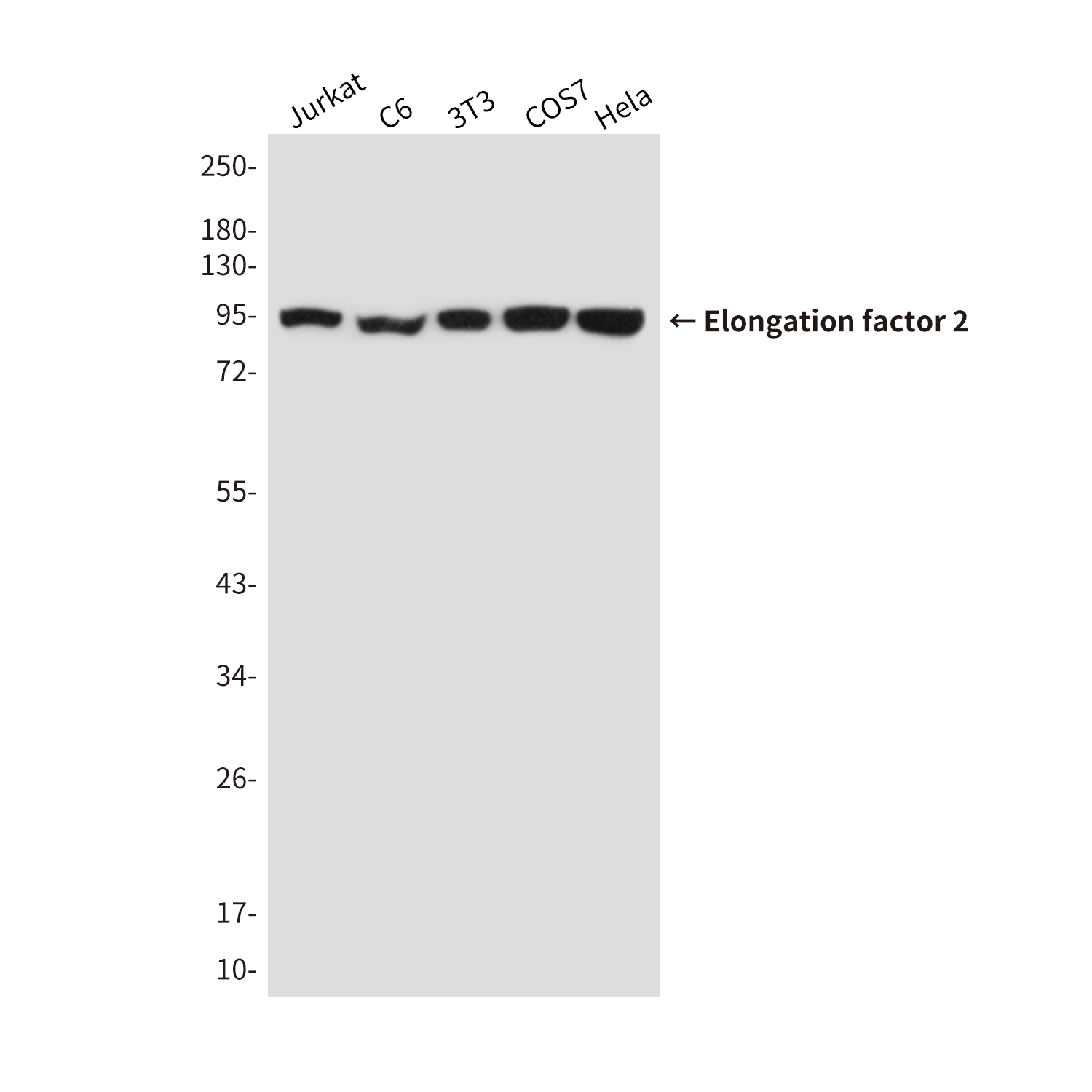

Anti-Elongation factor 2 antibody [4B3-G7-H5] (STJA0038215)
SPECIFICATIONS
ClonalityMonoclonal
HostMouse
ConjugationUnconjugated
IsotypeIgG2b
ImmunogenPurified recombinant human eEF2 protein fragments expressed in E.coli.
General Information
| Short Description | Mouse monoclonal anti-Elongation factor 2 for use in WB, ICC and IF in Human, Mouse, Monkey and Rat samples. Datasheet included with dilution recommendations, and related reagents. |
| Applications | WB/ICC/IF |
| Host | Mouse |
| Reactivity | Human/Mouse/Monkey/Rat |
| Note | STRICTLY FOR FURTHER SCIENTIFIC RESEARCH USE ONLY (RUO). MUST NOT TO BE USED IN DIAGNOSTIC OR THERAPEUTIC APPLICATIONS. |
Product Properties
| Clonality | Monoclonal |
| Clone ID | 4B3-G7-H5 |
| Isotype | IgG2b |
| Conjugation | Unconjugated |
| Concentration | 4.6 mg/mL |
| Purification | Affinity Purified |
| Dilution Range | WB 1:500-1:1000IF 1:50-1:200 |
| Formulation | Liquid in PBS containing 50% glycerol, 0.5% BSA and 0.02% sodium azide, pH 7.3. |
| Storage Instruction | Store at 4°C short term. Aliquot and store at-20°C long term. Avoid freeze/thaw cycles. |
Target Information
| Gene Symbol | EEF2 |
| Gene ID | 1938 |
| Uniprot ID | EF2_HUMAN |
| Immunogen | Purified recombinant human eEF2 protein fragments expressed in E.coli. |
Additional Info
| Post Translational Modifications | Phosphorylation by EF-2 kinase completely inactivates EF-2.it requires prior phosphorylation by CDK2 at Ser-595 during mitotic prometaphase. Phosphorylation by CSK promotes SUMOylation, proteolytic cleavage, and nuclear translocation if the C-terminal fragment. Diphthamide is 2-3-carboxyamido-3-(trimethyl-ammonio)propylhistidine. (Microbial infection) Diphthamide can be ADP-ribosylated by diphtheria toxin and by Pseudomonas exotoxin A, thus arresting protein synthesis. ISGylated. Proteolytically processed at two sites following phosphorylation by CSK. SUMOylated following phosphorylation by CSK, promotes proteolytic cleavage. |
| Function | Catalyzes the GTP-dependent ribosomal translocation step during translation elongation. During this step, the ribosome changes from the pre-translocational (PRE) to the post-translocational (POST) state as the newly formed A-site-bound peptidyl-tRNA and P-site-bound deacylated tRNA move to the P and E sites, respectively. Catalyzes the coordinated movement of the two tRNA molecules, the mRNA and conformational changes in the ribosome. |
| Protein Name | Elongation Factor 2Ef-2 |
| Database Links | Reactome: R-HSA-156902Reactome: R-HSA-5336415Reactome: R-HSA-5358493Reactome: R-HSA-6798695Reactome: R-HSA-8876725 |
| Cellular Localisation | CytoplasmNucleusPhosphorylation By Csk Promotes Cleavage And Sumoylation-Dependent Nuclear Translocation Of The C-Terminal Cleavage Product |
| Alternative Antibody Names | Anti-Elongation Factor 2 antibodyAnti-Ef-2 antibodyAnti-EEF2 antibodyAnti-EF2 antibody |
Information sourced from Uniprot.org