

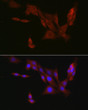
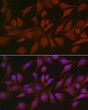
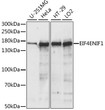


Anti-EIF4ENIF1 antibody (150-250) (STJ117369)
SPECIFICATIONS
ClonalityPolyclonal
HostRabbit
ConjugationUnconjugated
IsotypeIgG
General Information
| Short Description | Rabbit polyclonal EIF4ENIF1 (150-250) antibody for use in WB, IF, ICC and ELISA in human, mouse and rat samples. Datasheet included with dilution recommendations, and related reagents. |
| Applications | WB/IF/ICC/ELISA |
| Host | Rabbit |
| Reactivity | Human/Mouse/Rat |
| Note | STRICTLY FOR FURTHER SCIENTIFIC RESEARCH USE ONLY (RUO). MUST NOT TO BE USED IN DIAGNOSTIC OR THERAPEUTIC APPLICATIONS. |
Product Properties
| Clonality | Polyclonal |
| Isotype | IgG |
| Conjugation | Unconjugated |
| Concentration | Lot specific |
| Purification | Affinity purification |
| Dilution Range | WB:1:500-1:2000IF/ICC:1:50-1:200ELISA:Recommended starting concentration is 1 Mu g/mL. Please optimize the concentration based on your specific assay requirements. |
| Formulation | PBS with 0.01% Thimerosal, 50% Glycerol, pH 7.3. |
| Storage Instruction | Store at-20°C for up to 1 year from the date of receipt, and avoid repeat freeze-thaw cycles. |
Target Information
| Gene Symbol | EIF4ENIF1 |
| Gene ID | 56478 |
| Uniprot ID | 4ET_HUMAN |
| Immunogen Region | 150-250 |
| Immunogen Sequence | LGGRRIGSGRIISARTFEKD HRLSDKDLRDLRDRDRERDF KDKRFRREFGDSKRVFGERR RNDSYTEEEPEWFSAGPTSQ SETIELTGFDDKILEEDHKG R |
| Specificity | A synthetic peptide corresponding to a sequence within amino acids 150-250 of human EIF4ENIF1 (NP_001157973.1). |
Additional Info
| Tissue Specificity | Widely expressed. |
| Post Translational Modifications | Phosphorylation by MAPK8/JNK1 and or MAPK9/JNK2 in response to oxidative stress promotes P-body assembly. Phosphorylated during meiotic maturation. |
| Function | EIF4E-binding protein that regulates translation and stability of mRNAs in processing bodies (P-bodies). Plays a key role in P-bodies to coordinate the storage of translationally inactive mRNAs in the cytoplasm and prevent their degradation. Acts as a binding platform for multiple RNA-binding proteins: promotes deadenylation of mRNAs via its interaction with the CCR4-NOT complex, and blocks decapping via interaction with eIF4E (EIF4E and EIF4E2), thereby protecting deadenylated and repressed mRNAs from degradation. Component of a multiprotein complex that sequesters and represses translation of proneurogenic factors during neurogenesis. Promotes miRNA-mediated translational repression. Required for the formation of P-bodies. Involved in mRNA translational repression mediated by the miRNA effector TNRC6B by protecting TNRC6B-targeted mRNAs from decapping and subsequent decay. Also acts as a nucleoplasmic shuttling protein, which mediates the nuclear import of EIF4E and DDX6 by a piggy-back mechanism. |
| Protein Name | Eukaryotic Translation Initiation Factor 4e Transporter4e-TEif4e TransporterEukaryotic Translation Initiation Factor 4e Nuclear Import Factor 1 |
| Database Links | |
| Cellular Localisation | CytoplasmP-BodyNucleusPml BodyNucleus SpecklePredominantly CytoplasmicMainly Localizes To Processing Bodies (P-Bodies)Shuttles Between The Nucleus And The Cytoplasm In A Crm1-Dependent MannerLocalization To Nuclear Foci And Speckles Requires Active Transcription |
| Alternative Antibody Names | Anti-Eukaryotic Translation Initiation Factor 4e Transporter antibodyAnti-4e-T antibodyAnti-Eif4e Transporter antibodyAnti-Eukaryotic Translation Initiation Factor 4e Nuclear Import Factor 1 antibodyAnti-EIF4ENIF1 antibody |
Information sourced from Uniprot.org