

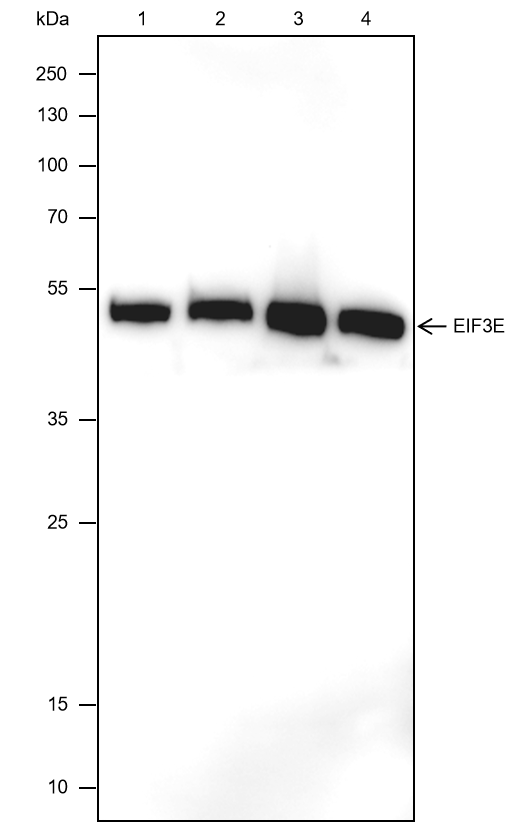

Anti-EIF3E antibody [R01-2L-5] (STJA0033109)
SPECIFICATIONS
ClonalityMonoclonal
HostMouse
ConjugationUnconjugated
IsotypeIgG1k
ImmunogenPeptide
General Information
| Short Description | Mouse monoclonal anti-EIF3E for use in WB in Human, Mouse and Rat samples. Datasheet included with dilution recommendations, and related reagents. |
| Applications | WB |
| Host | Mouse |
| Reactivity | Human/Mouse/Rat |
| Note | STRICTLY FOR FURTHER SCIENTIFIC RESEARCH USE ONLY (RUO). MUST NOT TO BE USED IN DIAGNOSTIC OR THERAPEUTIC APPLICATIONS. |
Product Properties
| Clonality | Monoclonal |
| Clone ID | R01-2L-5 |
| Isotype | IgG1k |
| Conjugation | Unconjugated |
| Purification | Protein G |
| Dilution Range | WB 1:500-1:1000 |
| Formulation | Liquid in PBS, Glycerol and BSA |
| Storage Instruction | Store at-20°C. Avoid freeze/thaw cycles. |
Target Information
| Gene Symbol | EIF3E |
| Gene ID | 3646 |
| Uniprot ID | EIF3E_HUMAN |
| Immunogen | Peptide |
Additional Info
| Tissue Specificity | Ubiquitously expressed. Expressed at highest levels in appendix, lymph, pancreas, skeletal muscle, spleen and thymus. |
| Function | Component of the eukaryotic translation initiation factor 3 (eIF-3) complex, which is required for several steps in the initiation of protein synthesis. The eIF-3 complex associates with the 40S ribosome and facilitates the recruitment of eIF-1, eIF-1A, eIF-2:GTP:methionyl-tRNAi and eIF-5 to form the 43S pre-initiation complex (43S PIC). The eIF-3 complex stimulates mRNA recruitment to the 43S PIC and scanning of the mRNA for AUG recognition. The eIF-3 complex is also required for disassembly and recycling of post-termination ribosomal complexes and subsequently prevents premature joining of the 40S and 60S ribosomal subunits prior to initiation. The eIF-3 complex specifically targets and initiates translation of a subset of mRNAs involved in cell proliferation, including cell cycling, differentiation and apoptosis, and uses different modes of RNA stem-loop binding to exert either translational activation or repression. Required for nonsense-mediated mRNA decay (NMD).may act in conjunction with UPF2 to divert mRNAs from translation to the NMD pathway. May interact with MCM7 and EPAS1 and regulate the proteasome-mediated degradation of these proteins. |
| Protein Name | Eukaryotic Translation Initiation Factor 3 Subunit EEif3eEukaryotic Translation Initiation Factor 3 Subunit 6Viral Integration Site Protein Int-6 HomologEif-3 P48 |
| Database Links | Reactome: R-HSA-156827Reactome: R-HSA-72649Reactome: R-HSA-72689Reactome: R-HSA-72695Reactome: R-HSA-72702Reactome: R-HSA-72706 |
| Cellular Localisation | CytoplasmNucleusPml Body |
| Alternative Antibody Names | Anti-Eukaryotic Translation Initiation Factor 3 Subunit E antibodyAnti-Eif3e antibodyAnti-Eukaryotic Translation Initiation Factor 3 Subunit 6 antibodyAnti-Viral Integration Site Protein Int-6 Homolog antibodyAnti-Eif-3 P48 antibodyAnti-EIF3E antibodyAnti-EIF3S6 antibodyAnti-INT6 antibody |
Information sourced from Uniprot.org