

Anti-EB2 antibody [KT52] (STJA0041196)
SPECIFICATIONS
ClonalityMonoclonal
HostRat
ConjugationUnconjugated
IsotypeIgG2b
ImmunogenClone KT52 was generated from a GST fusion protein containing human EB2. This sequence is highly conserved in rat and mouse EB2.
General Information
| Short Description | Rat monoclonal anti-EB2 for use in ELISA, WB and ICC in Human, Mouse and Rat samples. Datasheet included with dilution recommendations, and related reagents. |
| Applications | ELISA/WB/ICC |
| Host | Rat |
| Reactivity | Human/Mouse/Rat |
| Note | STRICTLY FOR FURTHER SCIENTIFIC RESEARCH USE ONLY (RUO). MUST NOT TO BE USED IN DIAGNOSTIC OR THERAPEUTIC APPLICATIONS. |
Product Properties
| Clonality | Monoclonal |
| Clone ID | KT52 |
| Isotype | IgG2b |
| Conjugation | Unconjugated |
| Purification | Protein G Purified |
| Dilution Range | WB 1:1000ICC 1:100 |
| Formulation | PBS + 0.05% NaN3 |
| Storage Instruction | Recommended that the undiluted antibody be aliquoted into smaller working volumes (10-30 uL/vial depending on usage) upon arrival and stored long term at-20°C C or-80°C C, while keeping a working aliquot stored at 4°C C for short term. Avoid freeze/t |
Target Information
| Gene Symbol | MAPRE2 |
| Gene ID | 10982 |
| Uniprot ID | MARE2_HUMAN |
| Immunogen | Clone KT52 was generated from a GST fusion protein containing human EB2. This sequence is highly conserved in rat and mouse EB2. |
| Immunogen Sequence | Human |
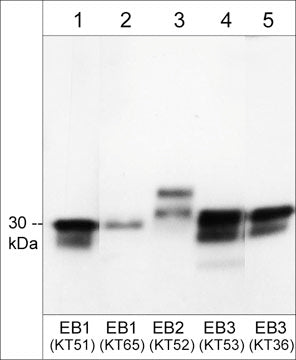
| Specificity | The antibody detects a 36 kDa* protein corresponding to the molecular mass of EB2 on SDS-PAGE immunoblots of human HeLa, mouse brain, and rat PC12 cells. The antibody also detects EB2 by immunocytochemistry in HeLa and A431 cells. |
Additional Info
| Tissue Specificity | Expressed in different tumor cell lines. Up-regulated in activated B- and T-lymphocytes. |
| Post Translational Modifications | Phosphorylated at Ser-236 by CK2 leading to enhanced cell adhesion. Phosphorylated by CDK1 and AURKB during mitosis reduces the binding affinity of MAPRE2 for microtubules. Ubiquitinated in an ASB14-dependent manner.leading to proteasomal degradation. |
| Function | Adapter protein that is involved in microtubule polymerization, and spindle function by stabilizing microtubules and anchoring them at centrosomes. Therefore, ensures mitotic progression and genome stability. Acts as a central regulator of microtubule reorganization in apico-basal epithelial differentiation. Plays a role during oocyte meiosis by regulating microtubule dynamics. Participates in neurite growth by interacting with plexin B3/PLXNB3 and microtubule reorganization during apico-basal epithelial differentiation. Also plays an essential role for cell migration and focal adhesion dynamics. Mechanistically, recruits HAX1 to microtubules in order to regulate focal adhesion dynamics. |
| Protein Name | Microtubule-Associated Protein Rp/Eb Family Member 2Apc-Binding Protein Eb2End-Binding Protein 2Eb2 |
| Database Links | |
| Cellular Localisation | CytoplasmCytoskeletonAssociated With The Microtubule NetworkAccumulates At The Plus End Of Microtubules |
| Alternative Antibody Names | Anti-Microtubule-Associated Protein Rp/Eb Family Member 2 antibodyAnti-Apc-Binding Protein Eb2 antibodyAnti-End-Binding Protein 2 antibodyAnti-Eb2 antibodyAnti-MAPRE2 antibodyAnti-RP1 antibody |
Information sourced from Uniprot.org