



Anti-E2-EPF/UBE2S antibody (1-222aa) [AT2C12] (STJA0041579)
SPECIFICATIONS
ClonalityMonoclonal
HostMouse
ConjugationUnconjugated
IsotypeIgG2ak
ImmunogenRecombinant human UBE2S (1-222aa) purified from E. coli
General Information
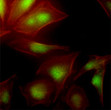
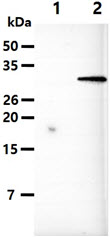
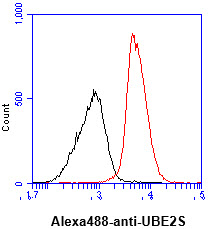
| Short Description | Mouse monoclonal anti-E2-EPF/UBE2S (1-222aa) for use in ELISA, WB, ICC, IF and FACS in Human samples. Datasheet included with dilution recommendations, and related reagents. |
| Applications | ELISA/WB/ICC/IF/FACS |
| Host | Mouse |
| Reactivity | Human |
| Note | STRICTLY FOR FURTHER SCIENTIFIC RESEARCH USE ONLY (RUO). MUST NOT TO BE USED IN DIAGNOSTIC OR THERAPEUTIC APPLICATIONS. |
Product Properties
| Clonality | Monoclonal |
| Clone ID | AT2C12 |
| Isotype | IgG2ak |
| Conjugation | Unconjugated |
| Concentration | 1 mg/mL |
| Purification | By protein-G affinity chromatography |
| Formulation | Liquid in phosphate-Buffered Saline (pH 7.4) with 0.02% Sodium Azide, 10% Glycerol |
| Storage Instruction | For short term storage, keep at +2C to +8C for up to 1 week. For long term storage, aliquot and store at-20C, and avoid repeat freeze-thaw cycles. |
Target Information
| Gene Symbol | UBE2S |
| Gene ID | 27338 |
| Uniprot ID | UBE2S_HUMAN |
| Accession Number | NP_055316.2 |
| Immunogen | Recombinant human UBE2S (1-222aa) purified from E. coli |
| Immunogen Region | 1-222aa |
Additional Info
| Post Translational Modifications | Autoubiquitinated by the APC/C complex during G1, leading to its degradation by the proteasome. |
| Function | Accepts ubiquitin from the E1 complex and catalyzes its covalent attachment to other proteins. Catalyzes 'Lys-11'-linked polyubiquitination. Acts as an essential factor of the anaphase promoting complex/cyclosome (APC/C), a cell cycle-regulated ubiquitin ligase that controls progression through mitosis. Acts by specifically elongating 'Lys-11'-linked polyubiquitin chains initiated by the E2 enzyme UBE2C/UBCH10 on APC/C substrates, enhancing the degradation of APC/C substrates by the proteasome and promoting mitotic exit. Also acts by elongating ubiquitin chains initiated by the E2 enzyme UBE2D1/UBCH5 in vitro.it is however unclear whether UBE2D1/UBCH5 acts as an E2 enzyme for the APC/C in vivo. Also involved in ubiquitination and subsequent degradation of VHL, resulting in an accumulation of HIF1A. In vitro able to promote polyubiquitination using all 7 ubiquitin Lys residues, except 'Lys-48'-linked polyubiquitination. |
| Protein Name | Ubiquitin-Conjugating Enzyme E2 SE2 Ubiquitin-Conjugating Enzyme SE2-EpfUbiquitin Carrier Protein SUbiquitin-Conjugating Enzyme E2-24 KdaUbiquitin-Conjugating Enzyme E2-Epf5Ubiquitin-Protein Ligase S |
| Database Links | Reactome: R-HSA-141430Reactome: R-HSA-174048Reactome: R-HSA-174084Reactome: R-HSA-174154Reactome: R-HSA-174178Reactome: R-HSA-174184Reactome: R-HSA-176407Reactome: R-HSA-176408Reactome: R-HSA-176409Reactome: R-HSA-176412Reactome: R-HSA-179409Reactome: R-HSA-2467813Reactome: R-HSA-2559582Reactome: R-HSA-68867Reactome: R-HSA-69017Reactome: R-HSA-8853884Reactome: R-HSA-8866652Reactome: R-HSA-9687136Reactome: R-HSA-983168 |
| Cellular Localisation | |
| Alternative Antibody Names | Anti-Ubiquitin-Conjugating Enzyme E2 S antibodyAnti-E2 Ubiquitin-Conjugating Enzyme S antibodyAnti-E2-Epf antibodyAnti-Ubiquitin Carrier Protein S antibodyAnti-Ubiquitin-Conjugating Enzyme E2-24 Kda antibodyAnti-Ubiquitin-Conjugating Enzyme E2-Epf5 antibodyAnti-Ubiquitin-Protein Ligase S antibodyAnti-UBE2S antibodyAnti-E2EPF antibodyAnti-OK antibodyAnti-SW-cl.73 antibody |
Information sourced from Uniprot.org