


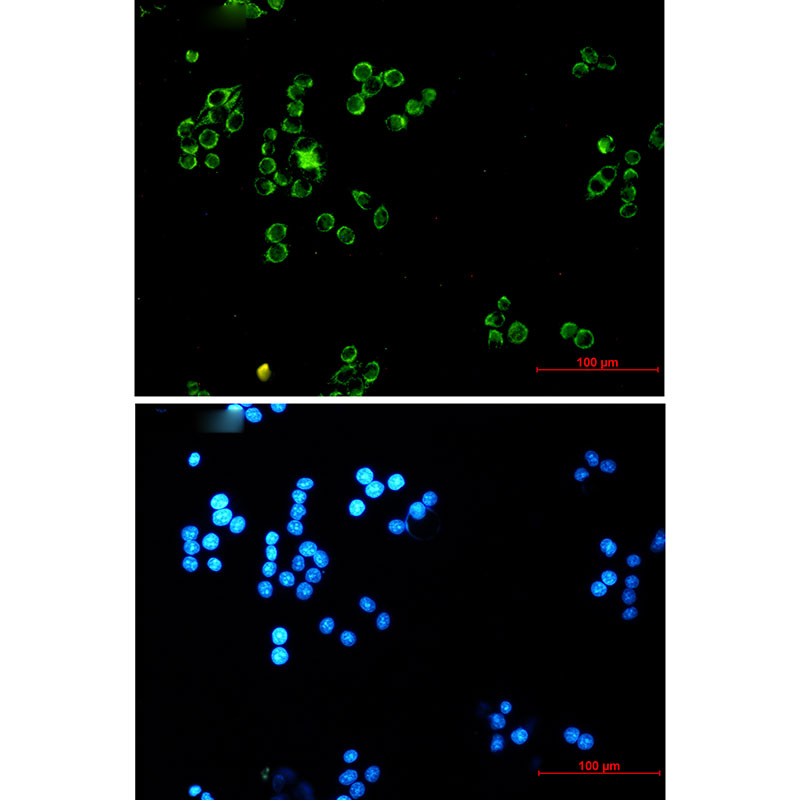


Anti-DLD antibody (488-500 aa) [R05-6D3] (STJA0010749)
SPECIFICATIONS
ClonalityMonoclonal
HostRabbit
ConjugationUnconjugated
IsotypeIgG
ImmunogenA synthetic peptide of human Lipoamide Dehydrogenase
General Information
| Short Description | Rabbit monoclonal anti-Lipoamide Dehydrogenase (488-500 aa) for use in WB, IHC-F, IHC-P, ICC and IF in Human, Mouse and Rat samples. Datasheet included with dilution recommendations, and related reagents. |
| Applications | WB/IHC-F/IHC-P/ICC/IF |
| Host | Rabbit |
| Reactivity | Human/Mouse/Rat |
| Note | STRICTLY FOR FURTHER SCIENTIFIC RESEARCH USE ONLY (RUO). MUST NOT TO BE USED IN DIAGNOSTIC OR THERAPEUTIC APPLICATIONS. |
Product Properties
| Clonality | Monoclonal |
| Clone ID | R05-6D3 |
| Isotype | IgG |
| Conjugation | Unconjugated |
| Concentration | 0.3 mg/mL |
| Purification | Affinity Purified |
| Dilution Range | WB 1:500-1:1000IHC 1:50-1:100IF 1:50-1:200 |
| Formulation | 50mM Tris-Glycine (pH7.4) , 0.15M NaCl, 40% Glycerol, 0.01% Sodium azide and 0.05% BSA |
| Storage Instruction | Store at 4°C short term. Aliquot and store at-20°C long term. Avoid freeze/thaw cycles. |
Target Information
| Gene Symbol | DLD |
| Gene ID | 1738 |
| Uniprot ID | DLDH_HUMAN |
| Immunogen | A synthetic peptide of human Lipoamide Dehydrogenase |
| Immunogen Region | 488-500 aa |
Additional Info
| Post Translational Modifications | Tyrosine phosphorylated. |
| Function | Lipoamide dehydrogenase is a component of the glycine cleavage system as well as an E3 component of three alpha-ketoacid dehydrogenase complexes (pyruvate-, alpha-ketoglutarate-, and branched-chain amino acid-dehydrogenase complex). The 2-oxoglutarate dehydrogenase complex is mainly active in the mitochondrion. A fraction of the 2-oxoglutarate dehydrogenase complex also localizes in the nucleus and is required for lysine succinylation of histones: associates with KAT2A on chromatin and provides succinyl-CoA to histone succinyltransferase KAT2A. In monomeric form may have additional moonlighting function as serine protease. Involved in the hyperactivation of spermatazoa during capacitation and in the spermatazoal acrosome reaction. |
| Protein Name | Dihydrolipoyl Dehydrogenase - MitochondrialDihydrolipoamide DehydrogenaseGlycine Cleavage System L Protein |
| Database Links | Reactome: R-HSA-204174Reactome: R-HSA-5362517Reactome: R-HSA-6783984Reactome: R-HSA-70895Reactome: R-HSA-9837999Reactome: R-HSA-9853506Reactome: R-HSA-9858328Reactome: R-HSA-9859138Reactome: R-HSA-9861559Reactome: R-HSA-9865113Reactome: R-HSA-9907570Reactome: R-HSA-9912481Reactome: R-HSA-9912529 |
| Cellular Localisation | Mitochondrion MatrixNucleusCell ProjectionCiliumFlagellumCytoplasmic VesicleSecretory VesicleAcrosomeMainly Localizes In The MitochondrionA Small Fraction Localizes To The NucleusWhere The 2-Oxoglutarate Dehydrogenase Complex Is Required For Histone Succinylation |
| Alternative Antibody Names | Anti-Dihydrolipoyl Dehydrogenase - Mitochondrial antibodyAnti-Dihydrolipoamide Dehydrogenase antibodyAnti-Glycine Cleavage System L Protein antibodyAnti-DLD antibodyAnti-GCSL antibodyAnti-LAD antibodyAnti-PHE3 antibody |
Information sourced from Uniprot.org