

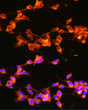
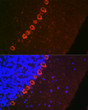
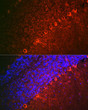


Anti-DCX antibody (265-365) (STJ119578)
SPECIFICATIONS
ClonalityPolyclonal
HostRabbit
ConjugationUnconjugated
IsotypeIgG
General Information
| Short Description | Rabbit polyclonal DCX (265-365) antibody for use in WB, IF, ICC and ELISA in human, mouse and rat samples. Datasheet included with dilution recommendations, and related reagents. |
| Applications | WB/IF/ICC/ELISA |
| Host | Rabbit |
| Reactivity | Human/Mouse/Rat |
| Note | STRICTLY FOR FURTHER SCIENTIFIC RESEARCH USE ONLY (RUO). MUST NOT TO BE USED IN DIAGNOSTIC OR THERAPEUTIC APPLICATIONS. |
Product Properties
| Clonality | Polyclonal |
| Isotype | IgG |
| Conjugation | Unconjugated |
| Concentration | Lot specific |
| Purification | Affinity purification |
| Dilution Range | WB:1:500-1:1000IF/ICC:1:50-1:200ELISA:Recommended starting concentration is 1 Mu g/mL. Please optimize the concentration based on your specific assay requirements. |
| Formulation | PBS with 0.05% Proclin300, 50% Glycerol, pH 7.3. |
| Storage Instruction | Store at-20°C for up to 1 year from the date of receipt, and avoid repeat freeze-thaw cycles. |
Target Information
| Gene Symbol | DCX |
| Gene ID | 1641 |
| Uniprot ID | DCX_HUMAN |
| Immunogen Region | 265-365 |
| Immunogen Sequence | SLDENECRVMKGNPSATAGP KASPTPQKTSAKSPGPMRRS KSPADSGNDQDANGTSSSQL STPKSKQSPISTPTSPGSLR KHKDLYLPLSLDDSDSLGDS M |
| Specificity | Recombinant fusion protein containing a sequence corresponding to amino acids 265-365 of human Doublecortin (NP_835365.1). |
Additional Info
| Tissue Specificity | Highly expressed in neuronal cells of fetal brain (in the majority of cells of the cortical plate, intermediate zone and ventricular zone), but not expressed in other fetal tissues. In the adult, highly expressed in the brain frontal lobe, but very low expression in other regions of brain, and not detected in heart, placenta, lung, liver, skeletal muscles, kidney and pancreas. |
| Post Translational Modifications | Phosphorylation by MARK1, MARK2 and PKA regulates its ability to bind microtubules. Phosphorylation at Ser-265 and Ser-297 seems to occur only in neonatal brain, the levels falling precipitously by postnatal day 21. Ubiquitinated by MDM2, leading to its degradation by the proteasome. Ubiquitinated by MDM2 and subsequent degradation leads to reduce the dendritic spine density of olfactory bulb granule cells. |
| Function | Microtubule-associated protein required for initial steps of neuronal dispersion and cortex lamination during cerebral cortex development. May act by competing with the putative neuronal protein kinase DCLK1 in binding to a target protein. May in that way participate in a signaling pathway that is crucial for neuronal interaction before and during migration, possibly as part of a calcium ion-dependent signal transduction pathway. May be part with PAFAH1B1/LIS-1 of overlapping, but distinct, signaling pathways that promote neuronal migration. |
| Protein Name | Neuronal Migration Protein DoublecortinDoublinLissencephalin-XLis-X |
| Database Links | Reactome: R-HSA-447043 |
| Cellular Localisation | CytoplasmCell ProjectionNeuron ProjectionLocalizes At Neurite Tips |
| Alternative Antibody Names | Anti-Neuronal Migration Protein Doublecortin antibodyAnti-Doublin antibodyAnti-Lissencephalin-X antibodyAnti-Lis-X antibodyAnti-DCX antibodyAnti-DBCN antibodyAnti-LISX antibody |
Information sourced from Uniprot.org