

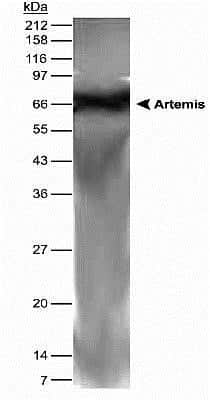

Anti-DCLRE1C antibody (N-Term) (STJA0005732)
SPECIFICATIONS
ClonalityPolyclonal
HostRabbit
ConjugationUnconjugated
IsotypeIgG
ImmunogenSynthetic peptide corresponding to amino acids from the N-terminal region of human Artemis protein.
General Information
| Short Description | Rabbit polyclonal anti-Artemis (N-Term) for use in WB in Human samples. Datasheet included with dilution recommendations, and related reagents. |
| Applications | WB |
| Host | Rabbit |
| Reactivity | Human |
| Note | STRICTLY FOR FURTHER SCIENTIFIC RESEARCH USE ONLY (RUO). MUST NOT TO BE USED IN DIAGNOSTIC OR THERAPEUTIC APPLICATIONS. |
Product Properties
| Clonality | Polyclonal |
| Isotype | IgG |
| Conjugation | Unconjugated |
| Purification | Antigen Affinity Purified |
| Dilution Range | WB 1:500-1:1000 |
| Formulation | PBS + 0.02% NaN3 |
| Storage Instruction | Store at-20°C for up to 1 year from the date of receipt, and avoid repeat freeze-thaw cycles. |
Target Information
| Gene Symbol | DCLRE1C |
| Gene ID | 64421 |
| Uniprot ID | DCR1C_HUMAN |
| Immunogen | Synthetic peptide corresponding to amino acids from the N-terminal region of human Artemis protein. |
| Immunogen Region | N-Term |
| Specificity | Reacts with the N-terminal region of human artemis protein |
Additional Info
| Post Translational Modifications | Phosphorylation on undefined residues by PRKDC may stimulate endonucleolytic activity on 5' and 3' hairpins and overhangs. PRKDC must remain present, even after phosphorylation, for efficient hairpin opening. Also phosphorylated by ATM in response to ionizing radiation (IR) and by ATR in response to ultraviolet (UV) radiation. |
| Function | Nuclease involved in DNA non-homologous end joining (NHEJ).required for double-strand break repair and V(D)J recombination. Required for V(D)J recombination, the process by which exons encoding the antigen-binding domains of immunoglobulins and T-cell receptor proteins are assembled from individual V, (D), and J gene segments. V(D)J recombination is initiated by the lymphoid specific RAG endonuclease complex, which generates site specific DNA double strand breaks (DSBs). These DSBs present two types of DNA end structures: hairpin sealed coding ends and phosphorylated blunt signal ends. These ends are independently repaired by the non homologous end joining (NHEJ) pathway to form coding and signal joints respectively. This protein exhibits single-strand specific 5'-3' exonuclease activity in isolation and acquires endonucleolytic activity on 5' and 3' hairpins and overhangs when in a complex with PRKDC. The latter activity is required specifically for the resolution of closed hairpins prior to the formation of the coding joint. Also required for the repair of complex DSBs induced by ionizing radiation, which require substantial end-processing prior to religation by NHEJ. |
| Protein Name | Protein ArtemisDna Cross-Link Repair 1c ProteinProtein A-ScidSnm1 Homolog CHsnm1cSnm1-Like Protein |
| Database Links | Reactome: R-HSA-5693571 |
| Cellular Localisation | Nucleus |
| Alternative Antibody Names | Anti-Protein Artemis antibodyAnti-Dna Cross-Link Repair 1c Protein antibodyAnti-Protein A-Scid antibodyAnti-Snm1 Homolog C antibodyAnti-Hsnm1c antibodyAnti-Snm1-Like Protein antibodyAnti-DCLRE1C antibodyAnti-ARTEMIS antibodyAnti-ASCID antibodyAnti-SCIDA antibodyAnti-SNM1C antibody |
Information sourced from Uniprot.org