

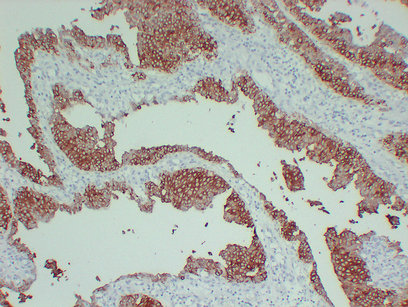
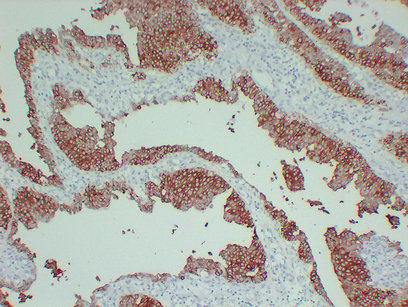

Anti-Cytokeratin 13 antibody [9E5-7A9-6B3] (STJA0033459)
SPECIFICATIONS
ClonalityMonoclonal
HostMouse
ConjugationUnconjugated
IsotypeIgG1
ImmunogenSynthesized peptide derived from human Cytokeratin 13
General Information
| Short Description | Mouse monoclonal anti-Cytokeratin 13 for use in IHC-P in Human samples. Datasheet included with dilution recommendations, and related reagents. |
| Applications | IHC-P |
| Host | Mouse |
| Reactivity | Human |
| Note | STRICTLY FOR FURTHER SCIENTIFIC RESEARCH USE ONLY (RUO). MUST NOT TO BE USED IN DIAGNOSTIC OR THERAPEUTIC APPLICATIONS. |
Product Properties
| Clonality | Monoclonal |
| Clone ID | 9E5-7A9-6B3 |
| Isotype | IgG1 |
| Conjugation | Unconjugated |
| Concentration | 1 mg/mL |
| Purification | Affinity Chromatography |
| Dilution Range | IHC 1:100-1:500 |
| Formulation | Liquid in PBS containing 50% glycerol, 0.5% BSA and 0.02% sodium azide, pH 7.3. |
| Storage Instruction | Store at 4°C short term. Aliquot and store at-20°C long term. Avoid freeze/thaw cycles. |
Target Information
| Gene Symbol | KRT13 |
| Gene ID | 3860 |
| Uniprot ID | K1C13_HUMAN |
| Immunogen | Synthesized peptide derived from human Cytokeratin 13 |
Additional Info
| Tissue Specificity | Expressed in some epidermal sweat gland ducts (at protein level) and in exocervix, esophagus and placenta. |
| Post Translational Modifications | O-glycosylated.glycans consist of single N-acetylglucosamine residues. |
| Function | Type 1 keratin (Probable). Maintains postnatal tongue mucosal cell homeostasis and tissue organization in response to mechanical stress, potentially via regulation of the G1/S phase cyclins CCNE1 and CCNE2. |
| Protein Name | Keratin - Type I Cytoskeletal 13Cytokeratin-13Ck-13Keratin-13K13 |
| Database Links | Reactome: R-HSA-6805567Reactome: R-HSA-6809371 |
| Cellular Localisation | |
| Alternative Antibody Names | Anti-Keratin - Type I Cytoskeletal 13 antibodyAnti-Cytokeratin-13 antibodyAnti-Ck-13 antibodyAnti-Keratin-13 antibodyAnti-K13 antibodyAnti-KRT13 antibody |
Information sourced from Uniprot.org