

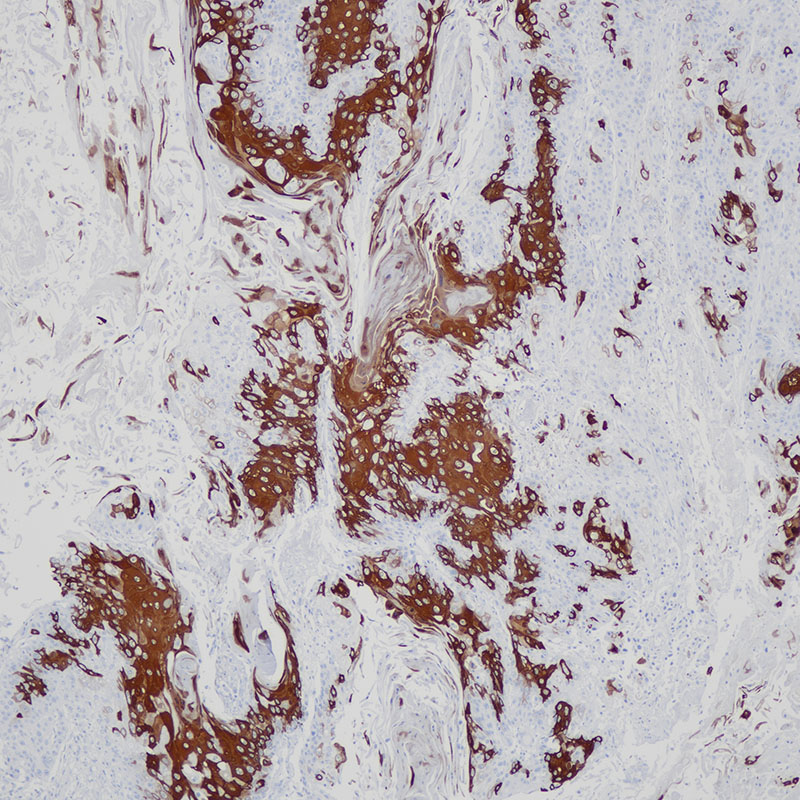

Anti-Cytokeratin 10 antibody [BP6057] (STJA0037617)
SPECIFICATIONS
ClonalityMonoclonal
HostRabbit
ConjugationUnconjugated
IsotypeIgG
ImmunogenA synthesized peptide derived from human KRT10
General Information
| Short Description | Rabbit monoclonal anti-Cytokeratin 10 for use in IHC-P in Human samples. Datasheet included with dilution recommendations, and related reagents. |
| Applications | IHC-P |
| Host | Rabbit |
| Reactivity | Human |
| Note | STRICTLY FOR FURTHER SCIENTIFIC RESEARCH USE ONLY (RUO). MUST NOT TO BE USED IN DIAGNOSTIC OR THERAPEUTIC APPLICATIONS. |
Product Properties
| Clonality | Monoclonal |
| Clone ID | BP6057 |
| Isotype | IgG |
| Conjugation | Unconjugated |
| Purification | Affinity Purified |
| Dilution Range | IHC 1:100-1:200 |
| Formulation | Liquid in PBS containing 50% glycerol, 0.5% BSA and 0.02% sodium azide, pH 7.3. |
| Storage Instruction | Store at 4°C short term. Aliquot and store at-20°C long term. Avoid freeze/thaw cycles. |
Target Information
| Gene Symbol | KRT10 |
| Gene ID | 3858 |
| Uniprot ID | K1C10_HUMAN |
| Immunogen | A synthesized peptide derived from human KRT10 |
Additional Info
| Tissue Specificity | Seen in all suprabasal cell layers including stratum corneum. Expressed on the surface of lung cell lines. Localized on the surface of desquamated nasal epithelial cells (at protein level). |
| Function | Plays a role in the establishment of the epidermal barrier on plantar skin. Involved in the maintenance of cell layer development and keratin filament bundles in suprabasal cells of the epithelium. (Microbial infection) Acts as a mediator of S.aureus adherence to desquamated nasal epithelial cells via clfB, and hence may play a role in nasal colonization. (Microbial infection) Binds S.pneumoniae PsrP, mediating adherence of the bacteria to lung cell lines. Reduction of levels of KRT10 keratin decrease adherence, overexpression increases adherence. Neither protein has to be glycosylated for the interaction to occur. |
| Protein Name | Keratin - Type I Cytoskeletal 10Cytokeratin-10Ck-10Keratin-10K10 |
| Database Links | Reactome: R-HSA-6805567Reactome: R-HSA-6809371Reactome: R-HSA-9725554 |
| Cellular Localisation | SecretedExtracellular SpaceCell SurfaceCytoplasm |
| Alternative Antibody Names | Anti-Keratin - Type I Cytoskeletal 10 antibodyAnti-Cytokeratin-10 antibodyAnti-Ck-10 antibodyAnti-Keratin-10 antibodyAnti-K10 antibodyAnti-KRT10 antibodyAnti-KPP antibody |
Information sourced from Uniprot.org