

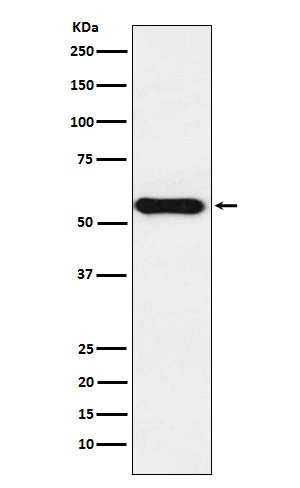

Anti-Cytochrome P450 1A2 antibody [R01-3W8] (STJA0036746)
SPECIFICATIONS
ClonalityMonoclonal
HostRabbit
ConjugationUnconjugated
IsotypeIgG
ImmunogenA synthesized peptide derived from human Cytochrome P450 1A2
General Information
| Short Description | Rabbit monoclonal anti-Cytochrome P450 1A2 for use in WB, ICC, IF and FC in Human samples. Datasheet included with dilution recommendations, and related reagents. |
| Applications | WB/ICC/IF/FC |
| Host | Rabbit |
| Reactivity | Human |
| Note | STRICTLY FOR FURTHER SCIENTIFIC RESEARCH USE ONLY (RUO). MUST NOT TO BE USED IN DIAGNOSTIC OR THERAPEUTIC APPLICATIONS. |
Product Properties
| Clonality | Monoclonal |
| Clone ID | R01-3W8 |
| Isotype | IgG |
| Conjugation | Unconjugated |
| Purification | Affinity Chromatography |
| Dilution Range | WB 1:500-1:1000IF 1:50-1:200FC 1:50-1:100 |
| Formulation | Rabbit IgG in phosphate buffered saline, pH 7.4, 150mM NaCl, 0.02% sodium azide and 50% glycerol. |
| Storage Instruction | Store at 4°C short term. Aliquot and store at-20°C long term. Avoid freeze/thaw cycles. |
Target Information
| Gene Symbol | CYP1A2 |
| Gene ID | 1544 |
| Uniprot ID | CP1A2_HUMAN |
| Immunogen | A synthesized peptide derived from human Cytochrome P450 1A2 |
Additional Info
| Tissue Specificity | Liver. |
| Function | A cytochrome P450 monooxygenase involved in the metabolism of various endogenous substrates, including fatty acids, steroid hormones and vitamins. Mechanistically, uses molecular oxygen inserting one oxygen atom into a substrate, and reducing the second into a water molecule, with two electrons provided by NADPH via cytochrome P450 reductase (NADPH--hemoprotein reductase). Catalyzes the hydroxylation of carbon-hydrogen bonds. Exhibits high catalytic activity for the formation of hydroxyestrogens from estrone (E1) and 17beta-estradiol (E2), namely 2-hydroxy E1 and E2. Metabolizes cholesterol toward 25-hydroxycholesterol, a physiological regulator of cellular cholesterol homeostasis. May act as a major enzyme for all-trans retinoic acid biosynthesis in the liver. Catalyzes two successive oxidative transformation of all-trans retinol to all-trans retinal and then to the active form all-trans retinoic acid. Primarily catalyzes stereoselective epoxidation of the last double bond of polyunsaturated fatty acids (PUFA), displaying a strong preference for the (R,S) stereoisomer. Catalyzes bisallylic hydroxylation and omega-1 hydroxylation of PUFA. May also participate in eicosanoids metabolism by converting hydroperoxide species into oxo metabolites (lipoxygenase-like reaction, NADPH-independent). Plays a role in the oxidative metabolism of xenobiotics. Catalyzes the N-hydroxylation of heterocyclic amines and the O-deethylation of phenacetin. Metabolizes caffeine via N3-demethylation (Probable). |
| Protein Name | Cytochrome P450 1a2Cypia2Cholesterol 25-HydroxylaseCytochrome P(3450Cytochrome P450 4Cytochrome P450-P3Hydroperoxy Icosatetraenoate Dehydratase |
| Database Links | Reactome: R-HSA-156581Reactome: R-HSA-211957Reactome: R-HSA-2142670Reactome: R-HSA-2142816Reactome: R-HSA-5423646Reactome: R-HSA-9018681Reactome: R-HSA-9027307 |
| Cellular Localisation | Endoplasmic Reticulum MembranePeripheral Membrane ProteinMicrosome Membrane |
| Alternative Antibody Names | Anti-Cytochrome P450 1a2 antibodyAnti-Cypia2 antibodyAnti-Cholesterol 25-Hydroxylase antibodyAnti-Cytochrome P(3450 antibodyAnti-Cytochrome P450 4 antibodyAnti-Cytochrome P450-P3 antibodyAnti-Hydroperoxy Icosatetraenoate Dehydratase antibodyAnti-CYP1A2 antibody |
Information sourced from Uniprot.org