

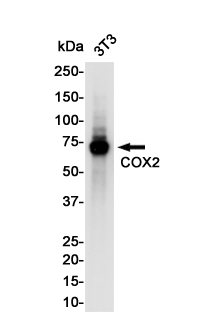

Anti-Cyclooxygenase 2 antibody [R09-3C3] (STJA0034190)
SPECIFICATIONS
ClonalityMonoclonal
HostRabbit
ConjugationUnconjugated
IsotypeIgG
ImmunogenRecombinant protein of mouse COX2
General Information
| Short Description | Rabbit monoclonal anti-Cyclooxygenase 2 for use in WB, ICC, IF and IP in Mouse samples. Datasheet included with dilution recommendations, and related reagents. |
| Applications | WB/ICC/IF/IP |
| Host | Rabbit |
| Reactivity | Mouse |
| Note | STRICTLY FOR FURTHER SCIENTIFIC RESEARCH USE ONLY (RUO). MUST NOT TO BE USED IN DIAGNOSTIC OR THERAPEUTIC APPLICATIONS. |
Product Properties
| Clonality | Monoclonal |
| Clone ID | R09-3C3 |
| Isotype | IgG |
| Conjugation | Unconjugated |
| Concentration | 0.3 mg/mL |
| Purification | Affinity Purified |
| Dilution Range | WB 1:500-1:1000IF 1:50-1:200IP 1:20 |
| Formulation | 50mM Tris-Glycine (pH 7.4) , 0.15M NaCl, 40% Glycerol, 0.01% Sodium azide and 0.05% BSA |
| Storage Instruction | Store at 4°C short term. Aliquot and store at-20°C long term. Avoid freeze/thaw cycles. |
Target Information
| Gene Symbol | Ptgs2 |
| Gene ID | 19225 |
| Uniprot ID | PGH2_MOUSE |
| Immunogen | Recombinant protein of mouse COX2 |
Additional Info
| Tissue Specificity | Following colon injury, expressed in the wound bed mesenchyme during the first phase of repair, probably by colonic mesenchymal stem cells (at protein level). |
| Post Translational Modifications | S-nitrosylation by NOS2 (iNOS) activates enzyme activity. S-nitrosylation may take place on different Cys residues in addition to Cys-526. Acetylated at Ser-565 by SPHK1. During neuroinflammation, acetylation by SPHK1 promotes neuronal secretion of specialized preresolving mediators (SPMs), especially 15-R-lipoxin A4, which results in an increase of phagocytic microglia. |
| Function | Dual cyclooxygenase and peroxidase in the biosynthesis pathway of prostanoids, a class of C20 oxylipins mainly derived from arachidonate, with a particular role in the inflammatory response. The cyclooxygenase activity oxygenates arachidonate (AA, C20:4(n-6)) to the hydroperoxy endoperoxide prostaglandin G2 (PGG2), and the peroxidase activity reduces PGG2 to the hydroxy endoperoxide PGH2, the precursor of all 2-series prostaglandins and thromboxanes. This complex transformation is initiated by abstraction of hydrogen at carbon 13 (with S-stereochemistry), followed by insertion of molecular O2 to form the endoperoxide bridge between carbon 9 and 11 that defines prostaglandins. The insertion of a second molecule of O2 (bis-oxygenase activity) yields a hydroperoxy group in PGG2 that is then reduced to PGH2 by two electrons. Similarly catalyzes successive cyclooxygenation and peroxidation of dihomo-gamma-linoleate (DGLA, C20:3(n-6)) and eicosapentaenoate (EPA, C20:5(n-3)) to corresponding PGH1 and PGH3, the precursors of 1- and 3-series prostaglandins. In an alternative pathway of prostanoid biosynthesis, converts 2-arachidonoyl lysophopholipids to prostanoid lysophopholipids, which are then hydrolyzed by intracellular phospholipases to release free prostanoids. Metabolizes 2-arachidonoyl glycerol yielding the glyceryl ester of PGH2, a process that can contribute to pain response. Generates lipid mediators from n-3 and n-6 polyunsaturated fatty acids (PUFAs) via a lipoxygenase-type mechanism. Oxygenates PUFAs to hydroperoxy compounds and then reduces them to corresponding alcohols. Plays a role in the generation of resolution phase interaction products (resolvins) during both sterile and infectious inflammation. Metabolizes docosahexaenoate (DHA, C22:6(n-3)) to 17R-HDHA, a precursor of the D-series resolvins (RvDs). As a component of the biosynthetic pathway of E-series resolvins (RvEs), converts eicosapentaenoate (EPA, C20:5(n-3)) primarily to 18S-HEPE that is further metabolized by ALOX5 and LTA4H to generate 18S-RvE1 and 18S-RvE2. In vascular endothelial cells, converts docosapentaenoate (DPA, C22:5(n-3)) to 13R-HDPA, a precursor for 13-series resolvins (RvTs) shown to activate macrophage phagocytosis during bacterial infection. In activated leukocytes, contributes to oxygenation of hydroxyeicosatetraenoates (HETE) to diHETES (5,15-diHETE and 5,11-diHETE). Can also use linoleate (LA, (9Z,12Z)-octadecadienoate, C18:2(n-6)) as substrate and produce hydroxyoctadecadienoates (HODEs) in a regio- and stereospecific manner, being (9R)-HODE ((9R)-hydroxy-(10E,12Z)-octadecadienoate) and (13S)-HODE ((13S)-hydroxy-(9Z,11E)-octadecadienoate) its major products. During neuroinflammation, plays a role in neuronal secretion of specialized preresolving mediators (SPMs) 15R-lipoxin A4 that regulates phagocytic microglia. |
| Protein Name | Prostaglandin G/H Synthase 2Cyclooxygenase-2Cox-2Glucocorticoid-Regulated Inflammatory CyclooxygenaseGripghsMacrophage Activation-Associated Marker Protein P71/73Pes-2Phs IiProstaglandin H2 Synthase 2Pgh Synthase 2Pghs-2Prostaglandin-Endoperoxide Synthase 2Tis10 Protein |
| Database Links | Reactome: R-MMU-197264Reactome: -MMU-2142770Reactome: -MMU-2162123Reactome: -MMU-9018677Reactome: -MMU-9018679Reactome: -MMU-9025094Reactome: -MMU-9027604 |
| Cellular Localisation | Microsome MembranePeripheral Membrane ProteinEndoplasmic Reticulum MembraneNucleus Inner MembraneNucleus Outer MembraneDetected On The Lumenal Side Of The Endoplasmic Reticulum And Nuclear Envelope |
| Alternative Antibody Names | Anti-Prostaglandin G/H Synthase 2 antibodyAnti-Cyclooxygenase-2 antibodyAnti-Cox-2 antibodyAnti-Glucocorticoid-Regulated Inflammatory Cyclooxygenase antibodyAnti-Gripghs antibodyAnti-Macrophage Activation-Associated Marker Protein P71/73 antibodyAnti-Pes-2 antibodyAnti-Phs Ii antibodyAnti-Prostaglandin H2 Synthase 2 antibodyAnti-Pgh Synthase 2 antibodyAnti-Pghs-2 antibodyAnti-Prostaglandin-Endoperoxide Synthase 2 antibodyAnti-Tis10 Protein antibodyAnti-Ptgs2 antibodyAnti-Cox-2 antibodyAnti-Cox2 antibodyAnti-Pghs-b antibodyAnti-Tis10 antibody |
Information sourced from Uniprot.org