
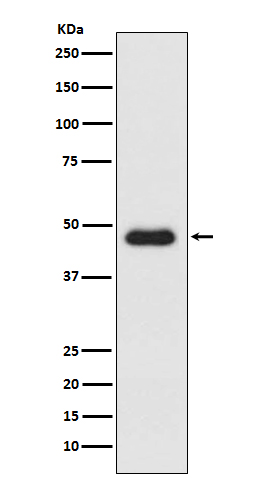

Anti-CXCR3 antibody [R08-3D4] (STJA0036457)
SPECIFICATIONS
ClonalityMonoclonal
HostRabbit
ConjugationUnconjugated
IsotypeIgG
ImmunogenA synthesized peptide derived from human CXCR3
General Information
| Short Description | Rabbit monoclonal anti-CXCR3 for use in WB, ICC, IF and IP in Human samples. Datasheet included with dilution recommendations, and related reagents. |
| Applications | WB/ICC/IF/IP |
| Host | Rabbit |
| Reactivity | Human |
| Note | STRICTLY FOR FURTHER SCIENTIFIC RESEARCH USE ONLY (RUO). MUST NOT TO BE USED IN DIAGNOSTIC OR THERAPEUTIC APPLICATIONS. |
Product Properties
| Clonality | Monoclonal |
| Clone ID | R08-3D4 |
| Isotype | IgG |
| Conjugation | Unconjugated |
| Purification | Affinity Chromatography |
| Dilution Range | WB 1:500-1:1000IF 1:50-1:200IP 1:50 |
| Formulation | Rabbit IgG in phosphate buffered saline, pH 7.4, 150mM NaCl, 0.02% sodium azide and 50% glycerol. |
| Storage Instruction | Store at 4°C short term. Aliquot and store at-20°C long term. Avoid freeze/thaw cycles. |
Target Information
| Gene Symbol | CXCR3 |
| Gene ID | 2833 |
| Uniprot ID | CXCR3_HUMAN |
| Immunogen | A synthesized peptide derived from human CXCR3 |
Additional Info
| Tissue Specificity | Isoform 1 and isoform 2 are mainly expressed in heart, kidney, liver and skeletal muscle. Isoform 1 is also expressed in placenta. Isoform 2 is expressed in endothelial cells. Expressed in T-cells (at protein level). |
| Post Translational Modifications | Sulfation on Tyr-27 and Tyr-29 is essential for CXCL10 binding and subsequent signal transduction induction. N-glycosylated. |
| Function | Isoform 1: Receptor for the C-X-C chemokine CXCL9, CXCL10 and CXCL11 and mediates the proliferation, survival and angiogenic activity of human mesangial cells (HMC) through a heterotrimeric G-protein signaling pathway. Binds to CCL21. Probably promotes cell chemotaxis response. Upon activation by PF4, induces activated T-lymphocytes migration mediated via downstream Ras/extracellular signal-regulated kinase (ERK) signaling. Isoform 2: Receptor for the C-X-C chemokine CXCL4 and also mediates the inhibitory activities of CXCL9, CXCL10 and CXCL11 on the proliferation, survival and angiogenic activity of human microvascular endothelial cells (HMVEC) through a cAMP-mediated signaling pathway. Does not promote cell chemotaxis respons. Interaction with CXCL4 or CXCL10 leads to activation of the p38MAPK pathway and contributes to inhibition of angiogenesis. Overexpression in renal cancer cells down-regulates expression of the anti-apoptotic protein HMOX1 and promotes apoptosis. Isoform 3: Mediates the activity of CXCL11. |
| Protein Name | C-X-C Chemokine Receptor Type 3Cxc-R3Cxcr-3Ckr-L2G Protein-Coupled Receptor 9Interferon-Inducible Protein 10 ReceptorIp-10 ReceptorCd Antigen Cd183 |
| Database Links | Reactome: R-HSA-380108Reactome: R-HSA-418594 |
| Cellular Localisation | Isoform 1: Cell MembraneMulti-Pass Membrane ProteinIsoform 2: Cell Membrane |
| Alternative Antibody Names | Anti-C-X-C Chemokine Receptor Type 3 antibodyAnti-Cxc-R3 antibodyAnti-Cxcr-3 antibodyAnti-Ckr-L2 antibodyAnti-G Protein-Coupled Receptor 9 antibodyAnti-Interferon-Inducible Protein 10 Receptor antibodyAnti-Ip-10 Receptor antibodyAnti-Cd Antigen Cd183 antibodyAnti-CXCR3 antibodyAnti-GPR9 antibody |
Information sourced from Uniprot.org