



Anti-Cullin 4A/4B antibody [R06-3D3] (STJA0034210)
SPECIFICATIONS
ClonalityMonoclonal
HostRabbit
ConjugationUnconjugated
IsotypeIgG
ImmunogenA synthetic peptide of human Cullin 4B
General Information
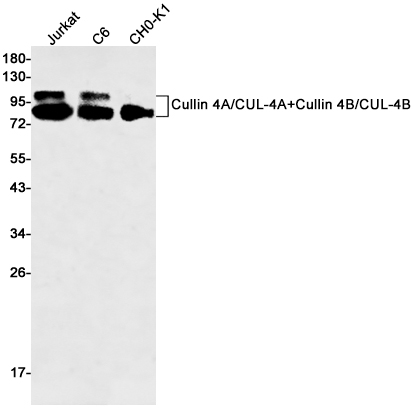
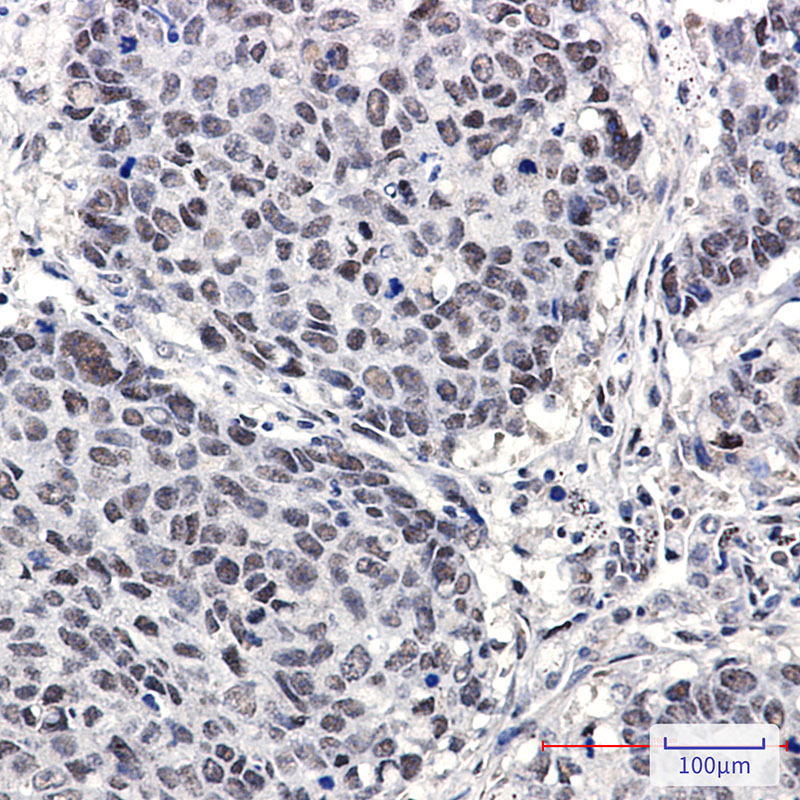
| Short Description | Rabbit monoclonal anti-Cullin 4A/4B for use in WB and IHC-P in Human, Hamster and Rat samples. Datasheet included with dilution recommendations, and related reagents. |
| Applications | WB/IHC-P |
| Host | Rabbit |
| Reactivity | Human/Hamster/Rat |
| Note | STRICTLY FOR FURTHER SCIENTIFIC RESEARCH USE ONLY (RUO). MUST NOT TO BE USED IN DIAGNOSTIC OR THERAPEUTIC APPLICATIONS. |
Product Properties
| Clonality | Monoclonal |
| Clone ID | R06-3D3 |
| Isotype | IgG |
| Conjugation | Unconjugated |
| Concentration | 0.3 mg/mL |
| Purification | Affinity Purified |
| Dilution Range | WB 1:500-1:1000IHC 1:50-1:100 |
| Formulation | 50mM Tris-Glycine (pH 7.4) , 0.15M NaCl, 40% Glycerol, 0.01% Sodium azide and 0.05% BSA |
| Storage Instruction | Store at 4°C short term. Aliquot and store at-20°C long term. Avoid freeze/thaw cycles. |
Target Information
| Gene Symbol | CUL4B |
| Gene ID | 8450 |
| Uniprot ID | CUL4B_HUMAN |
| Immunogen | A synthetic peptide of human Cullin 4B |
Additional Info
| Post Translational Modifications | Neddylated. Deneddylated via its interaction with the COP9 signalosome (CSN) complex. |
| Function | Core component of multiple cullin-RING-based E3 ubiquitin-protein ligase complexes which mediate the ubiquitination and subsequent proteasomal degradation of target proteins. The functional specificity of the E3 ubiquitin-protein ligase complex depends on the variable substrate recognition subunit. CUL4B may act within the complex as a scaffold protein, contributing to catalysis through positioning of the substrate and the ubiquitin-conjugating enzyme. Plays a role as part of the E3 ubiquitin-protein ligase complex in polyubiquitination of CDT1, histone H2A, histone H3 and histone H4 in response to radiation-induced DNA damage. Targeted to UV damaged chromatin by DDB2 and may be important for DNA repair and DNA replication. A number of DCX complexes (containing either TRPC4AP or DCAF12 as substrate-recognition component) are part of the DesCEND (destruction via C-end degrons) pathway, which recognizes a C-degron located at the extreme C terminus of target proteins, leading to their ubiquitination and degradation. The DCX(AMBRA1) complex is a master regulator of the transition from G1 to S cell phase by mediating ubiquitination of phosphorylated cyclin-D (CCND1, CCND2 and CCND3). The DCX(AMBRA1) complex also acts as a regulator of Cul5-RING (CRL5) E3 ubiquitin-protein ligase complexes by mediating ubiquitination and degradation of Elongin-C (ELOC) component of CRL5 complexes. Required for ubiquitination of cyclin E (CCNE1 or CCNE2), and consequently, normal G1 cell cycle progression. Regulates the mammalian target-of-rapamycin (mTOR) pathway involved in control of cell growth, size and metabolism. Specific CUL4B regulation of the mTORC1-mediated pathway is dependent upon 26S proteasome function and requires interaction between CUL4B and MLST8. With CUL4A, contributes to ribosome biogenesis. |
| Protein Name | Cullin-4bCul-4b |
| Database Links | Reactome: R-HSA-110314Reactome: R-HSA-5696394Reactome: R-HSA-5696395Reactome: R-HSA-5696400Reactome: R-HSA-6781823Reactome: R-HSA-6781827Reactome: R-HSA-6782135Reactome: R-HSA-6782210Reactome: R-HSA-8951664 |
| Cellular Localisation | CytoplasmNucleusMore Concentrated In Nuclei Than In Cytoplasm In Germinal Vesicle (Gv) Stage OocytesZygotes And The 2-Cell StageBut Distributed In The Cytoplasm At The Mii-Stage Oocytes |
| Alternative Antibody Names | Anti-Cullin-4b antibodyAnti-Cul-4b antibodyAnti-CUL4B antibodyAnti-KIAA0695 antibody |
Information sourced from Uniprot.org