

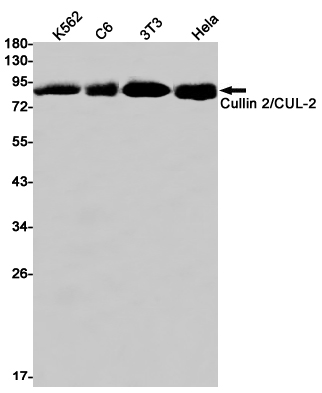

Anti-Cullin 2 antibody [R09-8A9] (STJA0034208)
SPECIFICATIONS
ClonalityMonoclonal
HostRabbit
ConjugationUnconjugated
IsotypeIgG
ImmunogenA synthetic peptide of human Cullin 2
General Information
| Short Description | Rabbit monoclonal anti-Cullin 2 for use in WB and IP in Human, Mouse and Rat samples. Datasheet included with dilution recommendations, and related reagents. |
| Applications | WB/IP |
| Host | Rabbit |
| Reactivity | Human/Mouse/Rat |
| Note | STRICTLY FOR FURTHER SCIENTIFIC RESEARCH USE ONLY (RUO). MUST NOT TO BE USED IN DIAGNOSTIC OR THERAPEUTIC APPLICATIONS. |
Product Properties
| Clonality | Monoclonal |
| Clone ID | R09-8A9 |
| Isotype | IgG |
| Conjugation | Unconjugated |
| Concentration | 0.3 mg/mL |
| Purification | Affinity Purified |
| Dilution Range | WB 1:500-1:1000IP 1:20 |
| Formulation | 50mM Tris-Glycine (pH 7.4) , 0.15M NaCl, 40% Glycerol, 0.01% Sodium azide and 0.05% BSA |
| Storage Instruction | Store at 4°C short term. Aliquot and store at-20°C long term. Avoid freeze/thaw cycles. |
Target Information
| Gene Symbol | CUL2 |
| Gene ID | 8453 |
| Uniprot ID | CUL2_HUMAN |
| Immunogen | A synthetic peptide of human Cullin 2 |
Additional Info
| Post Translational Modifications | Neddylated.which enhances the ubiquitination activity of ECS (Elongin BC-CUL2/5-SOCS-box protein) E3 ubiquitin-protein ligase complexes. Neddylation leads to structural rearrangment in the complex that allows interaction between the E2 ubiquitin-conjugating enzyme and the acceptor ubiquitin. CBC(VHL) complex formation seems to promote neddylation. Deneddylated via its interaction with the COP9 signalosome (CSN) complex. |
| Function | Core component of multiple cullin-RING-based ECS (ElonginB/C-CUL2/5-SOCS-box protein) E3 ubiquitin-protein ligase complexes, which mediate the ubiquitination of target proteins. CUL2 serves as a rigid scaffold in the complex and may contribute to catalysis through positioning of the substrate and the E2 ubiquitin-conjugating enzyme. The E3 ubiquitin-protein ligase activity of the complex is dependent on the neddylation of the cullin subunit and is inhibited by the association of the deneddylated cullin subunit with TIP120A/CAND1. The functional specificity of the ECS complex depends on the substrate recognition component. ECS(VHL) mediates the ubiquitination of hypoxia-inducible factor (HIF). A number of ECS complexes (containing either KLHDC2, KLHDC3, KLHDC10, APPBP2, FEM1A, FEM1B or FEM1C as substrate-recognition component) are part of the DesCEND (destruction via C-end degrons) pathway, which recognizes a C-degron located at the extreme C terminus of target proteins, leading to their ubiquitination and degradation. ECS complexes and ARIH1 collaborate in tandem to mediate ubiquitination of target proteins. ECS(LRR1) ubiquitinates MCM7 and promotes CMG replisome disassembly by VCP and chromatin extraction during S-phase. |
| Protein Name | Cullin-2Cul-2 |
| Database Links | Reactome: R-HSA-1234176Reactome: R-HSA-8951664Reactome: R-HSA-9010553Reactome: R-HSA-983168 |
| Cellular Localisation | Nucleus |
| Alternative Antibody Names | Anti-Cullin-2 antibodyAnti-Cul-2 antibodyAnti-CUL2 antibody |
Information sourced from Uniprot.org