

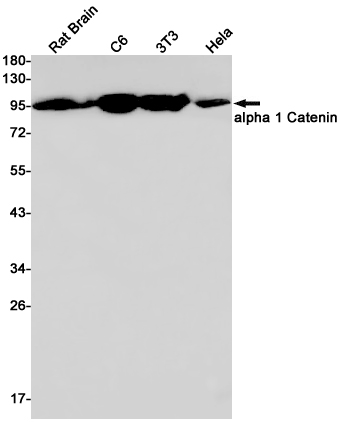

Anti-CTNNA1 antibody [R07-7D5] (STJA0034005)
SPECIFICATIONS
ClonalityMonoclonal
HostRabbit
ConjugationUnconjugated
IsotypeIgG
ImmunogenA synthetic peptide of human alpha 1 Catenin
General Information
| Short Description | Rabbit monoclonal anti-CTNNA1 for use in WB and IP in Human, Mouse and Rat samples. Datasheet included with dilution recommendations, and related reagents. |
| Applications | WB/IP |
| Host | Rabbit |
| Reactivity | Human/Mouse/Rat |
| Note | STRICTLY FOR FURTHER SCIENTIFIC RESEARCH USE ONLY (RUO). MUST NOT TO BE USED IN DIAGNOSTIC OR THERAPEUTIC APPLICATIONS. |
Product Properties
| Clonality | Monoclonal |
| Clone ID | R07-7D5 |
| Isotype | IgG |
| Conjugation | Unconjugated |
| Concentration | 0.3 mg/mL |
| Purification | Affinity Purified |
| Dilution Range | WB 1:500-1:1000IP 1:20 |
| Formulation | 50mM Tris-Glycine (pH 7.4) , 0.15M NaCl, 40% Glycerol, 0.01% Sodium azide and 0.05% BSA |
| Storage Instruction | Store at 4°C short term. Aliquot and store at-20°C long term. Avoid freeze/thaw cycles. |
Target Information
| Gene Symbol | CTNNA1 |
| Gene ID | 1495 |
| Uniprot ID | CTNA1_HUMAN |
| Immunogen | A synthetic peptide of human alpha 1 Catenin |
Additional Info
| Tissue Specificity | Isoform 1: Ubiquitously expressed in normal tissues. Isoform 3: Abundantly expressed in brain and cerebellum, also expressed in the placenta, liver, lung, colon, heart, pancreas, stomach and thymus. |
| Post Translational Modifications | Sumoylated. Phosphorylation seems to contribute to the strength of cell-cell adhesion rather than to the basic capacity for cell-cell adhesion. |
| Function | Associates with the cytoplasmic domain of a variety of cadherins. The association of catenins to cadherins produces a complex which is linked to the actin filament network, and which seems to be of primary importance for cadherins cell-adhesion properties. Can associate with both E- and N-cadherins. Originally believed to be a stable component of E-cadherin/catenin adhesion complexes and to mediate the linkage of cadherins to the actin cytoskeleton at adherens junctions. In contrast, cortical actin was found to be much more dynamic than E-cadherin/catenin complexes and CTNNA1 was shown not to bind to F-actin when assembled in the complex suggesting a different linkage between actin and adherens junctions components. The homodimeric form may regulate actin filament assembly and inhibit actin branching by competing with the Arp2/3 complex for binding to actin filaments. Involved in the regulation of WWTR1/TAZ, YAP1 and TGFB1-dependent SMAD2 and SMAD3 nuclear accumulation. May play a crucial role in cell differentiation. |
| Protein Name | Catenin Alpha-1Alpha E-CateninCadherin-Associated ProteinRenal Carcinoma Antigen Ny-Ren-13 |
| Database Links | Reactome: R-HSA-418990Reactome: R-HSA-5218920Reactome: R-HSA-525793Reactome: R-HSA-5626467Reactome: R-HSA-9762292Reactome: R-HSA-9764302Reactome: R-HSA-9833576 |
| Cellular Localisation | CytoplasmCytoskeletonCell JunctionAdherens JunctionCell MembranePeripheral Membrane ProteinCytoplasmic SideNucleusFound At Cell-Cell Boundaries And Probably At Cell-Matrix BoundariesIsoform 3: Cell Membrane |
| Alternative Antibody Names | Anti-Catenin Alpha-1 antibodyAnti-Alpha E-Catenin antibodyAnti-Cadherin-Associated Protein antibodyAnti-Renal Carcinoma Antigen Ny-Ren-13 antibodyAnti-CTNNA1 antibody |
Information sourced from Uniprot.org