


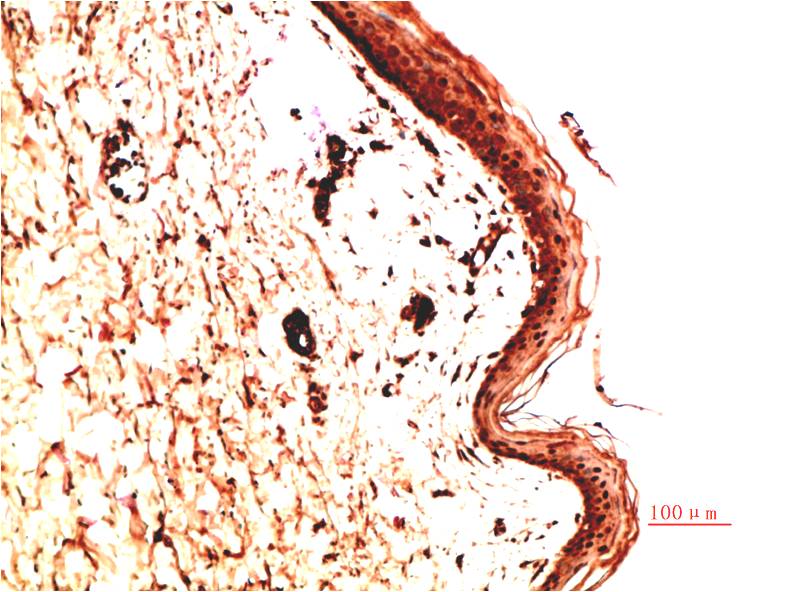

Anti-Collagen IV alpha 1 antibody [2G3-1H1-6E5] (STJA0032951)
SPECIFICATIONS
ClonalityMonoclonal
HostMouse
ConjugationUnconjugated
IsotypeIgG1
ImmunogenSynthetic peptide conjugated to KLH.
General Information
| Short Description | Mouse monoclonal anti-Collagen IV alpha 1 for use in IHC-P in Human, Rat and Mouse samples. Datasheet included with dilution recommendations, and related reagents. |
| Applications | IHC-P |
| Host | Mouse |
| Reactivity | Human/Rat/Mouse |
| Note | STRICTLY FOR FURTHER SCIENTIFIC RESEARCH USE ONLY (RUO). MUST NOT TO BE USED IN DIAGNOSTIC OR THERAPEUTIC APPLICATIONS. |
Product Properties
| Clonality | Monoclonal |
| Clone ID | 2G3-1H1-6E5 |
| Isotype | IgG1 |
| Conjugation | Unconjugated |
| Concentration | 1 mg/mL |
| Purification | Affinity Purified |
| Dilution Range | IHC 1:50-1:100 |
| Formulation | Liquid in PBS containing 50% glycerol, 0.5% BSA and 0.02% sodium azide, pH 7.3. |
| Storage Instruction | Store at 4°C short term. Aliquot and store at-20°C long term. Avoid freeze/thaw cycles. |
Target Information
| Gene Symbol | COL4A1 |
| Gene ID | 1282 |
| Uniprot ID | CO4A1_HUMAN |
| Immunogen | Synthetic peptide conjugated to KLH. |
Additional Info
| Tissue Specificity | Highly expressed in placenta. |
| Post Translational Modifications | Lysines at the third position of the tripeptide repeating unit (G-X-Y) are hydroxylated. The modified lysines can be O-glycosylated. Contains 4-hydroxyproline (Probable). Prolines at the third position of the tripeptide repeating unit (G-X-Y) are hydroxylated in some or all of the chains. Contains 3-hydroxyproline. This modification occurs on the first proline residue in the sequence motif Gly-Pro-Hyp, where Hyp is 4-hydroxyproline. Type IV collagens contain numerous cysteine residues which are involved in inter- and intramolecular disulfide bonding. 12 of these, located in the NC1 domain, are conserved in all known type IV collagens. The trimeric structure of the NC1 domains is stabilized by covalent bonds (sulfilimine cross-links) between Lys and Met residues. These cross-links are important for the mechanical stability of the basement membrane. Sulfilimine cross-link is catalyzed by PXDN. Proteolytic processing produces the C-terminal NC1 peptide, arresten. |
| Function | Type IV collagen is the major structural component of glomerular basement membranes (GBM), forming a 'chicken-wire' meshwork together with laminins, proteoglycans and entactin/nidogen. Arresten, comprising the C-terminal NC1 domain, inhibits angiogenesis and tumor formation. The C-terminal half is found to possess the anti-angiogenic activity. Specifically inhibits endothelial cell proliferation, migration and tube formation. |
| Protein Name | Collagen Alpha-1(Iv Chain Cleaved Into - Arresten |
| Database Links | Reactome: R-HSA-1442490Reactome: R-HSA-1474244Reactome: R-HSA-1650814Reactome: R-HSA-186797Reactome: R-HSA-2022090Reactome: R-HSA-216083Reactome: R-HSA-2214320Reactome: R-HSA-2243919Reactome: R-HSA-3000157Reactome: R-HSA-3000171Reactome: R-HSA-3000178Reactome: R-HSA-3000480Reactome: R-HSA-419037Reactome: R-HSA-8948216 |
| Cellular Localisation | SecretedExtracellular SpaceExtracellular MatrixBasement Membrane |
| Alternative Antibody Names | Anti-Collagen Alpha-1(Iv Chain Cleaved Into - Arresten antibodyAnti-COL4A1 antibody |
Information sourced from Uniprot.org