


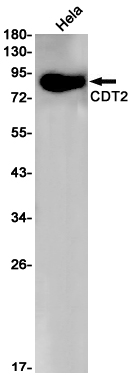
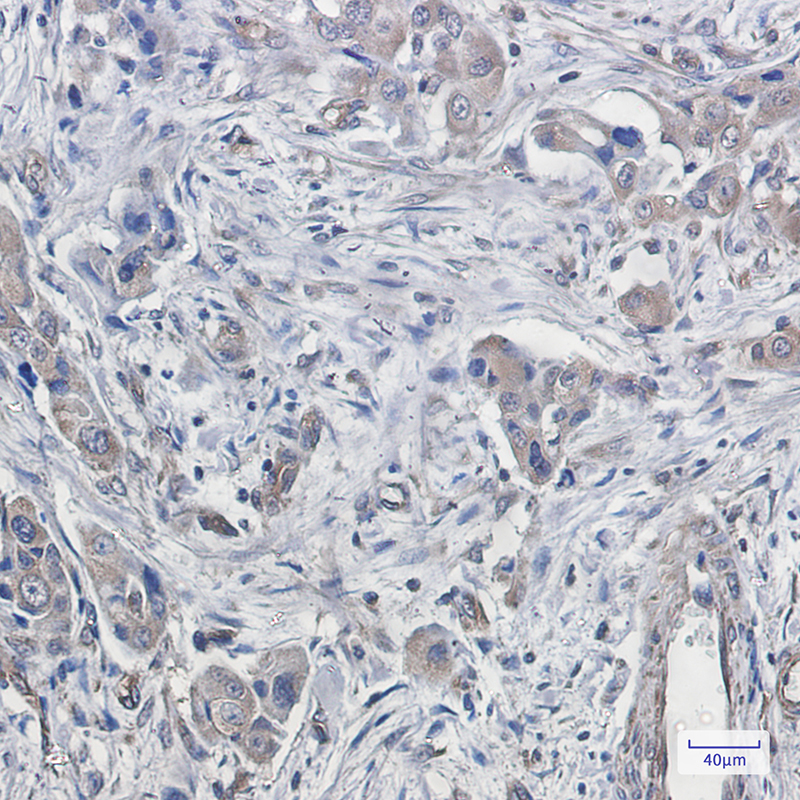

Anti-CDT2 antibody [R03-2G4] (STJA0034162)
SPECIFICATIONS
ClonalityMonoclonal
HostRabbit
ConjugationUnconjugated
IsotypeIgG
ImmunogenRecombinant protein of human CDT2
General Information
| Short Description | Rabbit monoclonal anti-CDT2 for use in WB and IHC-P in Human samples. Datasheet included with dilution recommendations, and related reagents. |
| Applications | WB/IHC-P |
| Host | Rabbit |
| Reactivity | Human |
| Note | STRICTLY FOR FURTHER SCIENTIFIC RESEARCH USE ONLY (RUO). MUST NOT TO BE USED IN DIAGNOSTIC OR THERAPEUTIC APPLICATIONS. |
Product Properties
| Clonality | Monoclonal |
| Clone ID | R03-2G4 |
| Isotype | IgG |
| Conjugation | Unconjugated |
| Concentration | 0.3 mg/mL |
| Purification | Affinity Purified |
| Dilution Range | WB 1:500-1:1000IHC 1:50-1:100 |
| Formulation | 50mM Tris-Glycine (pH 7.4) , 0.15M NaCl, 40% Glycerol, 0.01% Sodium azide and 0.05% BSA |
| Storage Instruction | Store at 4°C short term. Aliquot and store at-20°C long term. Avoid freeze/thaw cycles. |
Target Information
| Gene Symbol | DTL |
| Gene ID | 51514 |
| Uniprot ID | DTL_HUMAN |
| Immunogen | Recombinant protein of human CDT2 |
Additional Info
| Tissue Specificity | Expressed in placenta and testis, very low expression seen in skeletal muscle. Detected in all hematopoietic tissues examined, with highest expression in thymus and bone marrow. A low level detected in the spleen and lymph node, and barely detectable level in the peripheral leukocytes. RA treatment down-regulated the expression in NT2 cell. |
| Post Translational Modifications | Ubiquitinated by the anaphase promoting complex/cyclosome (APC/C). Autoubiquitinated through 'Lys-48'-polyubiquitin chains in a PCNA-independent reaction, allowing proteasomal turnover. Polyubiquitinated by SCF(FBXO11) when not phosphorylated, leading to its degradation. A tight regulation of the polyubiquitination by SCF(FBXO11) is involved in the control of different processes such as TGF-beta signaling, cell cycle progression and exit. Phosphorylated at Thr-464 by CDK1/Cyclin-B and CDK2/Cyclin-A but not by CDK2/Cyclin-E, MAPK1 or PLK1. Phosphorylation at Thr-464 inhibits the interaction with FBXO11 and decreases upon cell cycle exit induced by TGF-beta or serum starvation. |
| Function | Substrate-specific adapter of a DCX (DDB1-CUL4-X-box) E3 ubiquitin-protein ligase complex required for cell cycle control, DNA damage response and translesion DNA synthesis. The DCX(DTL) complex, also named CRL4(CDT2) complex, mediates the polyubiquitination and subsequent degradation of CDT1, CDKN1A/p21(CIP1), FBH1, KMT5A and SDE2. CDT1 degradation in response to DNA damage is necessary to ensure proper cell cycle regulation of DNA replication. CDKN1A/p21(CIP1) degradation during S phase or following UV irradiation is essential to control replication licensing. KMT5A degradation is also important for a proper regulation of mechanisms such as TGF-beta signaling, cell cycle progression, DNA repair and cell migration. Most substrates require their interaction with PCNA for their polyubiquitination: substrates interact with PCNA via their PIP-box, and those containing the 'K+4' motif in the PIP box, recruit the DCX(DTL) complex, leading to their degradation. In undamaged proliferating cells, the DCX(DTL) complex also promotes the 'Lys-164' monoubiquitination of PCNA, thereby being involved in PCNA-dependent translesion DNA synthesis. The DDB1-CUL4A-DTL E3 ligase complex regulates the circadian clock function by mediating the ubiquitination and degradation of CRY1. |
| Protein Name | Denticleless Protein HomologDdb1- And Cul4-Associated Factor 2Lethal(2 Denticleless Protein HomologRetinoic Acid-Regulated Nuclear Matrix-Associated Protein |
| Database Links | Reactome: R-HSA-110314Reactome: R-HSA-8951664 |
| Cellular Localisation | NucleusNucleus MembranePeripheral Membrane ProteinNucleoplasmic SideCytoplasmCytoskeletonMicrotubule Organizing CenterCentrosomeChromosomeNuclear Matrix-Associated ProteinTranslocates From The Interphase Nucleus To The Metaphase Cytoplasm During Mitosis |
| Alternative Antibody Names | Anti-Denticleless Protein Homolog antibodyAnti-Ddb1- And Cul4-Associated Factor 2 antibodyAnti-Lethal(2 Denticleless Protein Homolog antibodyAnti-Retinoic Acid-Regulated Nuclear Matrix-Associated Protein antibodyAnti-DTL antibodyAnti-CDT2 antibodyAnti-CDW1 antibodyAnti-DCAF2 antibodyAnti-L2DTL antibodyAnti-RAMP antibody |
Information sourced from Uniprot.org