

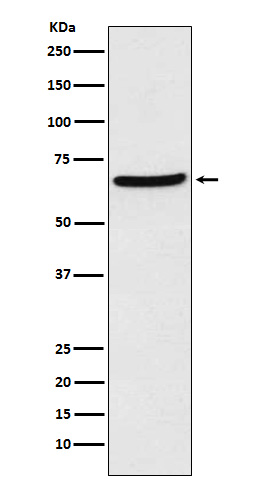

Anti-CDT1 antibody [R14-3Y-9] (STJA0035461)
SPECIFICATIONS
ClonalityMonoclonal
HostRabbit
ConjugationUnconjugated
IsotypeIgG
ImmunogenA synthesized peptide derived from human CDT1
General Information
| Short Description | Rabbit monoclonal anti-CDT1 for use in WB, IHC-P, ICC, IF and IP in Human samples. Datasheet included with dilution recommendations, and related reagents. |
| Applications | WB/IHC-P/ICC/IF/IP |
| Host | Rabbit |
| Reactivity | Human |
| Note | STRICTLY FOR FURTHER SCIENTIFIC RESEARCH USE ONLY (RUO). MUST NOT TO BE USED IN DIAGNOSTIC OR THERAPEUTIC APPLICATIONS. |
Product Properties
| Clonality | Monoclonal |
| Clone ID | R14-3Y-9 |
| Isotype | IgG |
| Conjugation | Unconjugated |
| Purification | Affinity Chromatography |
| Dilution Range | WB 1:500-1:1000IHC 1:100-1:200IF 1:50-1:200IP 1:50 |
| Formulation | Liquid in PBS, pH 7.4, 150mM NaCl, 0.02% sodium azide and 50% glycerol. |
| Storage Instruction | Store at 4°C short term. Aliquot and store at-20°C long term. Avoid freeze/thaw cycles. |
Target Information
| Gene Symbol | CDT1 |
| Gene ID | 81620 |
| Uniprot ID | CDT1_HUMAN |
| Immunogen | A synthesized peptide derived from human CDT1 |
Additional Info
| Post Translational Modifications | Two independent E3 ubiquitin ligase complexes, SCF(SKP2) and the DCX(DTL) complex, mediated CDT1 degradation in S phase. Ubiquitinated by the DCX(DTL) complex, in response to DNA damage, leading to its degradation. Ubiquitination by the DCX(DTL) complex is necessary to ensure proper cell cycle regulation and is PCNA-dependent: interacts with PCNA via its PIP-box, while the presence of the containing the 'K+4' motif in the PIP box, recruit the DCX(DTL) complex, leading to its degradation. Phosphorylation at Thr-29 by CDK2 targets CDT1 for ubiquitination by SCF(SKP2) E3 ubiquitin ligase and subsequent degradation. The interaction with GMNN protects it against ubiquitination. Deubiquitinated by USP37. Ubiquitinated and degraded by the SCF(FBXO31) complex during the G2 phase to prevent re-replication. Phosphorylation by cyclin A-dependent kinases at Thr-29 targets CDT1 for ubiquitynation by SCF(SKP2) E3 ubiquitin ligase and subsequent degradation. Phosphorylated at Thr-29 by MAPK8/JNK1, which blocks replication licensing in response to stress. Binding to GMNN is not affected by phosphorylation. |
| Function | Required for both DNA replication and mitosis. DNA replication licensing factor, required for pre-replication complex assembly. Cooperates with CDC6 and the origin recognition complex (ORC) during G1 phase of the cell cycle to promote the loading of the mini-chromosome maintenance (MCM) complex onto DNA to generate pre-replication complexes (pre-RC). Required also for mitosis by promoting stable kinetochore-microtubule attachments. Potential oncogene. |
| Protein Name | Dna Replication Factor Cdt1Double Parked HomologDup |
| Database Links | Reactome: R-HSA-68867Reactome: R-HSA-68949Reactome: R-HSA-68962Reactome: R-HSA-69052Reactome: R-HSA-69205 |
| Cellular Localisation | NucleusChromosomeCentromereKinetochoreTransiently Localizes To Kinetochores During Prometaphase And Metaphase |
| Alternative Antibody Names | Anti-Dna Replication Factor Cdt1 antibodyAnti-Double Parked Homolog antibodyAnti-Dup antibodyAnti-CDT1 antibody |
Information sourced from Uniprot.org