

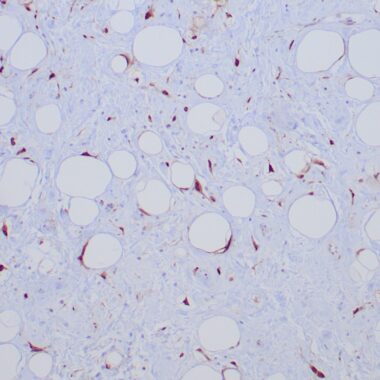

Anti-CDK4 antibody [ZR394] (STJ180606)
SPECIFICATIONS
ClonalityMonoclonal
HostRabbit
ConjugationUnconjugated
IsotypeIgG
ImmunogenRecombinant fragment corresponding to N-terminal of human CDK4 protein
General Information
| Short Description | Rabbit monoclonal CDK4 antibody for use in IHC-P in human samples. Datasheet included with dilution recommendations, and related reagents. |
| Applications | IHC-P |
| Host | Rabbit |
| Reactivity | Human |
| Note | STRICTLY FOR FURTHER SCIENTIFIC RESEARCH USE ONLY (RUO). MUST NOT TO BE USED IN DIAGNOSTIC OR THERAPEUTIC APPLICATIONS. |
Product Properties
| Clonality | Monoclonal |
| Clone ID | ZR394 |
| Isotype | IgG |
| Conjugation | Unconjugated |
| Purification | Affinity purified |
| Dilution Range | 1:100-200 |
| Formulation | Tris-HCI buffer containing stabilizing protein (BSA) and <0.1% ProClin |
| Storage Instruction | Store at 2‐8°C for up to 24 months. Predilute: Ready to use, no reconstitution necessary. Concentrate: Use dilution range and appropriate lab‐standardized diluent. Stability after dilution: 7 days at 24°C, 3 months at 2‐8°C, 6months at ‐20°C. |
Target Information
| Gene Symbol | CDK4 |
| Gene ID | 1019 |
| Uniprot ID | CDK4_HUMAN |
| Immunogen | Recombinant fragment corresponding to N-terminal of human CDK4 protein |
| Specificity | Urothelial carcinoma, well-differentiated liposarcoma |
Additional Info
| Post Translational Modifications | Phosphorylation at Thr-172 is required for enzymatic activity. Phosphorylated, in vitro, at this site by CCNH-CDK7, but, in vivo, appears to be phosphorylated by a proline-directed kinase. In the cyclin D-CDK4-CDKN1B complex, this phosphorylation and consequent CDK4 enzyme activity, is dependent on the tyrosine phosphorylation state of CDKN1B. Thus, in proliferating cells, CDK4 within the complex is phosphorylated on Thr-172 in the T-loop. In resting cells, phosphorylation on Thr-172 is prevented by the non-tyrosine-phosphorylated form of CDKN1B. |
| Function | Ser/Thr-kinase component of cyclin D-CDK4 (DC) complexes that phosphorylate and inhibit members of the retinoblastoma (RB) protein family including RB1 and regulate the cell-cycle during G(1)/S transition. Phosphorylation of RB1 allows dissociation of the transcription factor E2F from the RB/E2F complexes and the subsequent transcription of E2F target genes which are responsible for the progression through the G(1) phase. Hypophosphorylates RB1 in early G(1) phase. Cyclin D-CDK4 complexes are major integrators of various mitogenenic and antimitogenic signals. Also phosphorylates SMAD3 in a cell-cycle-dependent manner and represses its transcriptional activity. Component of the ternary complex, cyclin D/CDK4/CDKN1B, required for nuclear translocation and activity of the cyclin D-CDK4 complex. |
| Protein Name | Cyclin-Dependent Kinase 4Cell Division Protein Kinase 4Psk-J3 |
| Database Links | Reactome: R-HSA-187577Reactome: R-HSA-2559580Reactome: R-HSA-2559582Reactome: R-HSA-2559585Reactome: R-HSA-3214858Reactome: R-HSA-381340Reactome: R-HSA-69231Reactome: R-HSA-75815Reactome: R-HSA-8849470Reactome: R-HSA-8878166Reactome: R-HSA-912446Reactome: R-HSA-9616222Reactome: R-HSA-9630791Reactome: R-HSA-9630794Reactome: R-HSA-9632697Reactome: R-HSA-9632700Reactome: R-HSA-9661069Reactome: R-HSA-9754119 |
| Cellular Localisation | CytoplasmNucleusNucleus MembraneCytoplasmic When Non-ComplexedForms A Cyclin D-Cdk4 Complex In The Cytoplasm As Cells Progress Through G(1) PhaseThe Complex Accumulates On The Nuclear Membrane And Enters The Nucleus On Transition From G(1) To S PhaseAlso Present In Nucleoli And Heterochromatin LumpsColocalizes With Rb1 After Release Into The Nucleus |
| Alternative Antibody Names | Anti-Cyclin-Dependent Kinase 4 antibodyAnti-Cell Division Protein Kinase 4 antibodyAnti-Psk-J3 antibodyAnti-CDK4 antibody |
Information sourced from Uniprot.org