
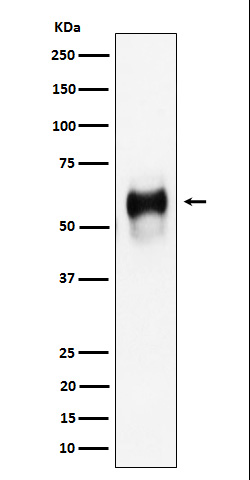

Anti-CD58 antibody [R65-3U-7] (STJA0035522)
SPECIFICATIONS
ClonalityMonoclonal
HostRabbit
ConjugationUnconjugated
IsotypeIgG
ImmunogenA synthesized peptide derived from human CD58
General Information
| Short Description | Rabbit monoclonal anti-CD58 for use in WB, IP and FC in Human samples. Datasheet included with dilution recommendations, and related reagents. |
| Applications | WB/IP/FC |
| Host | Rabbit |
| Reactivity | Human |
| Note | STRICTLY FOR FURTHER SCIENTIFIC RESEARCH USE ONLY (RUO). MUST NOT TO BE USED IN DIAGNOSTIC OR THERAPEUTIC APPLICATIONS. |
Product Properties
| Clonality | Monoclonal |
| Clone ID | R65-3U-7 |
| Isotype | IgG |
| Conjugation | Unconjugated |
| Purification | Affinity Chromatography |
| Dilution Range | WB 1:500-1:1000IP 1:50FC 1:50 |
| Formulation | Liquid in PBS, pH 7.4, 150mM NaCl, 0.02% sodium azide and 50% glycerol. |
| Storage Instruction | Store at 4°C short term. Aliquot and store at-20°C long term. Avoid freeze/thaw cycles. |
Target Information
| Gene Symbol | CD58 |
| Gene ID | 965 |
| Uniprot ID | LFA3_HUMAN |
| Immunogen | A synthesized peptide derived from human CD58 |
Additional Info
| Function | Ligand of the T-lymphocyte CD2 glycoprotein. This interaction is important in mediating thymocyte interactions with thymic epithelial cells, antigen-independent and -dependent interactions of T-lymphocytes with target cells and antigen-presenting cells and the T-lymphocyte rosetting with erythrocytes. In addition, the LFA-3/CD2 interaction may prime response by both the CD2+ and LFA-3+ cells. |
| Protein Name | Lymphocyte Function-Associated Antigen 3Ag3Surface Glycoprotein Lfa-3Cd Antigen Cd58 |
| Database Links | Reactome: R-HSA-202733Reactome: R-HSA-6798695 |
| Cellular Localisation | Isoform 1: Cell MembraneSingle-Pass Type I Membrane Protein |
| Alternative Antibody Names | Anti-Lymphocyte Function-Associated Antigen 3 antibodyAnti-Ag3 antibodyAnti-Surface Glycoprotein Lfa-3 antibodyAnti-Cd Antigen Cd58 antibodyAnti-CD58 antibodyAnti-LFA3 antibody |
Information sourced from Uniprot.org