
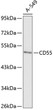


Anti-CD55 antibody (40-300) (STJ115854)
SPECIFICATIONS
ClonalityPolyclonal
HostRabbit
ConjugationUnconjugated
IsotypeIgG
General Information
| Short Description | Rabbit polyclonal CD55 (40-300) antibody for use in WB and ELISA in human and mouse samples. Datasheet included with dilution recommendations, and related reagents. |
| Applications | WB/ELISA |
| Host | Rabbit |
| Reactivity | Human/Mouse |
| Note | STRICTLY FOR FURTHER SCIENTIFIC RESEARCH USE ONLY (RUO). MUST NOT TO BE USED IN DIAGNOSTIC OR THERAPEUTIC APPLICATIONS. |
Product Properties
| Clonality | Polyclonal |
| Isotype | IgG |
| Conjugation | Unconjugated |
| Concentration | Lot specific |
| Purification | Affinity purification |
| Dilution Range | WB:1:500-1:2000ELISA:Recommended starting concentration is 1 Mu g/mL. Please optimize the concentration based on your specific assay requirements. |
| Formulation | PBS with 0.02% Sodium Azide, 50% Glycerol, pH 7.3. |
| Storage Instruction | Store at-20°C for up to 1 year from the date of receipt, and avoid repeat freeze-thaw cycles. |
Target Information
| Gene Symbol | CD55 |
| Gene ID | 1604 |
| Uniprot ID | DAF_HUMAN |
| Immunogen Region | 40-300 |
| Immunogen Sequence | PDVPNAQPALEGRTSFPEDT VITYKCEESFVKIPGEKDSV ICLKGSQWSDIEEFCNRSCE VPTRLNSASLKQPYITQNYF PVGTVVEYECRPGYRREPSL SPKLTCLQNLKWSTAVEFCK KKSCPNPGEIRNGQIDVPGG ILFGATISFSCNTGYKLFGS TSSFCLISGSSVQWSDPLPE CREIYCPAPPQIDNGIIQGE RDHYGYRQSVTYACNKGFTM IGEHSIYCTVNNDEGEWSG |
| Specificity | Recombinant fusion protein containing a sequence corresponding to amino acids 40-300 of human CD55 (NP_000565.1). |
Additional Info
| Tissue Specificity | Expressed on the plasma membranes of all cell types that are in intimate contact with plasma complement proteins. It is also found on the surfaces of epithelial cells lining extracellular compartments, and variants of the molecule are present in body fluids and in extracellular matrix. |
| Post Translational Modifications | The Ser/Thr-rich domain is heavily O-glycosylated. |
| Function | This protein recognizes C4b and C3b fragments that condense with cell-surface hydroxyl or amino groups when nascent C4b and C3b are locally generated during C4 and c3 activation. Interaction of daf with cell-associated C4b and C3b polypeptides interferes with their ability to catalyze the conversion of C2 and factor B to enzymatically active C2a and Bb and thereby prevents the formation of C4b2a and C3bBb, the amplification convertases of the complement cascade. Inhibits complement activation by destabilizing and preventing the formation of C3 and C5 convertases, which prevents complement damage. (Microbial infection) Acts as a receptor for Coxsackievirus A21, coxsackieviruses B1, B3 and B5. (Microbial infection) Acts as a receptor for Human enterovirus 70 and D68 (Probable). (Microbial infection) Acts as a receptor for Human echoviruses 6, 7, 11, 12, 20 and 21. |
| Protein Name | Complement Decay-Accelerating FactorCd Antigen Cd55 |
| Database Links | Reactome: R-HSA-373080Reactome: R-HSA-6798695Reactome: R-HSA-6807878Reactome: R-HSA-977606 |
| Cellular Localisation | Isoform 1: Cell MembraneSingle-Pass Type I Membrane ProteinIsoform 2: Cell MembraneLipid-AnchorGpi-AnchorIsoform 3: SecretedIsoform 4: SecretedIsoform 5: SecretedIsoform 6: Cell MembraneIsoform 7: Cell Membrane |
| Alternative Antibody Names | Anti-Complement Decay-Accelerating Factor antibodyAnti-Cd Antigen Cd55 antibodyAnti-CD55 antibodyAnti-CR antibodyAnti-DAF antibody |
Information sourced from Uniprot.org