

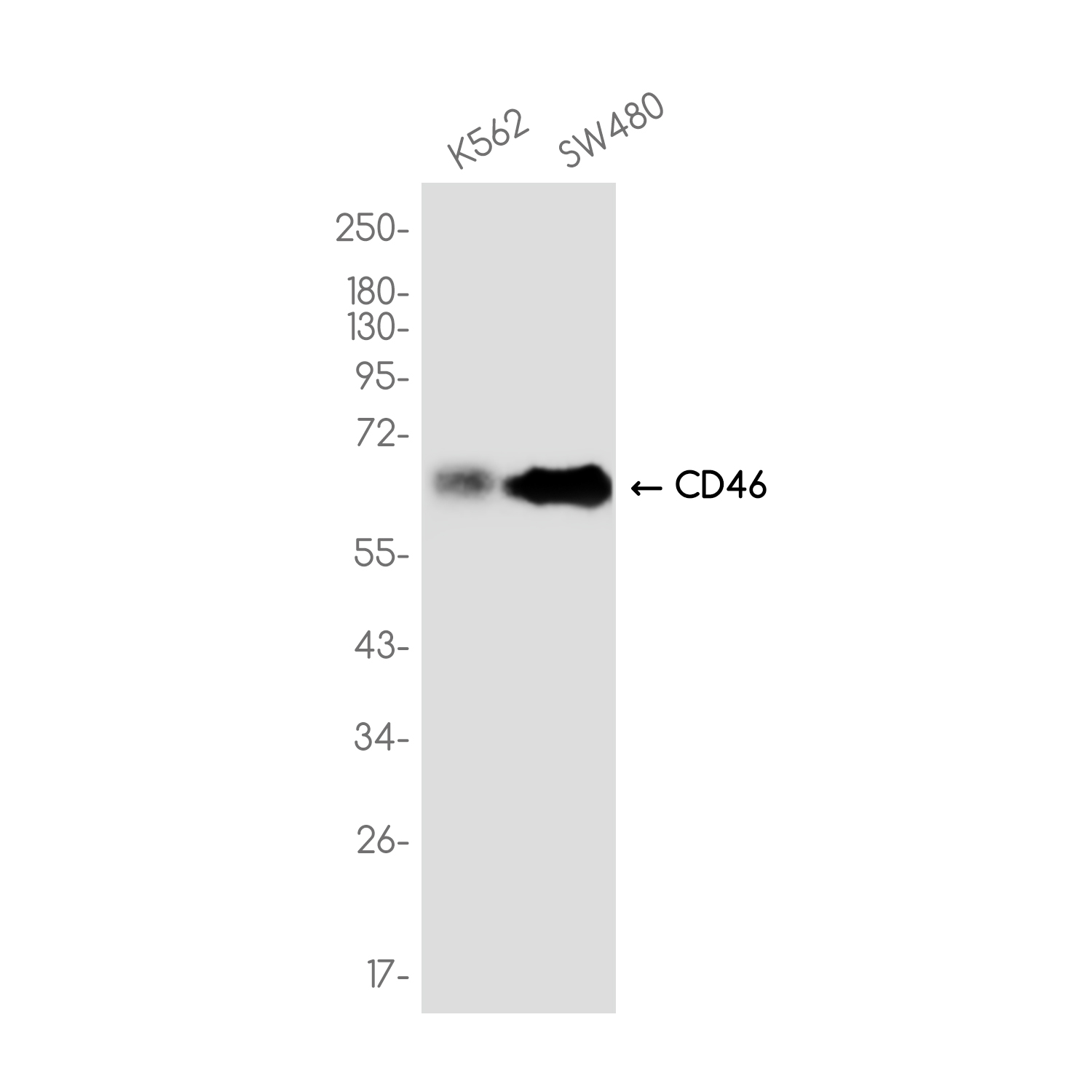

Anti-CD46 antibody (STJA0037533)
SPECIFICATIONS
ClonalityMonoclonal
HostRabbit
ConjugationUnconjugated
IsotypeIgG
ImmunogenPeptide
General Information
| Short Description | Rabbit monoclonal anti-CD46 for use in WB and IHC-P in Human samples. Datasheet included with dilution recommendations, and related reagents. |
| Applications | WB/IHC-P |
| Host | Rabbit |
| Reactivity | Human |
| Note | STRICTLY FOR FURTHER SCIENTIFIC RESEARCH USE ONLY (RUO). MUST NOT TO BE USED IN DIAGNOSTIC OR THERAPEUTIC APPLICATIONS. |
Product Properties
| Clonality | Monoclonal |
| Isotype | IgG |
| Conjugation | Unconjugated |
| Purification | Affinity Purified |
| Dilution Range | WB-1:1000-1:5000IHC-P-1:200-1:1000 |
| Formulation | Liquid in 50mM Tris-Glycine (pH 7.4) , 0.15M NaCl, 40%Glycerol, 0.01% sodium azide and 0.05% BSA. |
| Storage Instruction | Store at 4°C short term. Aliquot and store at-20°C long term. Avoid freeze/thaw cycles. |
Target Information
| Gene Symbol | CD46 |
| Gene ID | 4179 |
| Uniprot ID | MCP_HUMAN |
| Immunogen | Peptide |
Additional Info
| Tissue Specificity | Expressed by all cells except erythrocytes. |
| Post Translational Modifications | N-glycosylated on Asn-83.Asn-114 and Asn-273 in most tissues, but probably less N-glycosylated in testis. N-glycosylation on Asn-114 and Asn-273 is required for cytoprotective function. N-glycosylation on Asn-114 is required for Measles virus binding. N-glycosylation on Asn-273 is required for Neisseria binding. N-glycosylation is not required for human adenovirus binding. Extensively O-glycosylated in the Ser/Thr-rich domain. O-glycosylation is required for Neisseria binding but not for Measles virus or human adenovirus binding. In epithelial cells, isoforms B/D/F/H/J/L/3 are phosphorylated by YES1 in response to infection by Neisseria gonorrhoeae.which promotes infectivity. In T-cells, these isoforms may be phosphorylated by LCK. |
| Function | Acts as a cofactor for complement factor I, a serine protease which protects autologous cells against complement-mediated injury by cleaving C3b and C4b deposited on host tissue. May be involved in the fusion of the spermatozoa with the oocyte during fertilization. Also acts as a costimulatory factor for T-cells which induces the differentiation of CD4+ into T-regulatory 1 cells. T-regulatory 1 cells suppress immune responses by secreting interleukin-10, and therefore are thought to prevent autoimmunity. (Microbial infection) A number of viral and bacterial pathogens seem to bind MCP in order to exploit its immune regulation property and directly induce an immunosuppressive phenotype in T-cells. (Microbial infection) Acts as a receptor for Adenovirus subgroup B2 and Ad3. (Microbial infection) Acts as a receptor for cultured Measles virus. (Microbial infection) Acts as a receptor for Herpesvirus 6/HHV-6. (Microbial infection) May act as a receptor for pathogenic bacteria Neisseria and Streptococcus pyogenes. |
| Protein Name | Membrane Cofactor ProteinTlxTrophoblast Leukocyte Common AntigenCd Antigen Cd46 |
| Database Links | Reactome: R-HSA-977606 |
| Cellular Localisation | Cytoplasmic VesicleSecretory VesicleAcrosome Inner MembraneSingle-Pass Type I Membrane ProteinInner Acrosomal Membrane Of SpermatozoaInternalized Upon Binding Of Measles VirusHerpesvirus 6 Or Neisseria GonorrhoeaeWhich Results In An Increased Susceptibility Of Infected Cells To Complement-Mediated InjuryIn Cancer Cells Or Cells Infected By NeisseriaShedding Leads To A Soluble Peptide |
| Alternative Antibody Names | Anti-Membrane Cofactor Protein antibodyAnti-Tlx antibodyAnti-Trophoblast Leukocyte Common Antigen antibodyAnti-Cd Antigen Cd46 antibodyAnti-CD46 antibodyAnti-MCP antibodyAnti-MIC10 antibody |
Information sourced from Uniprot.org