

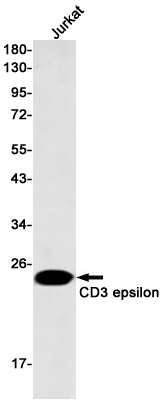
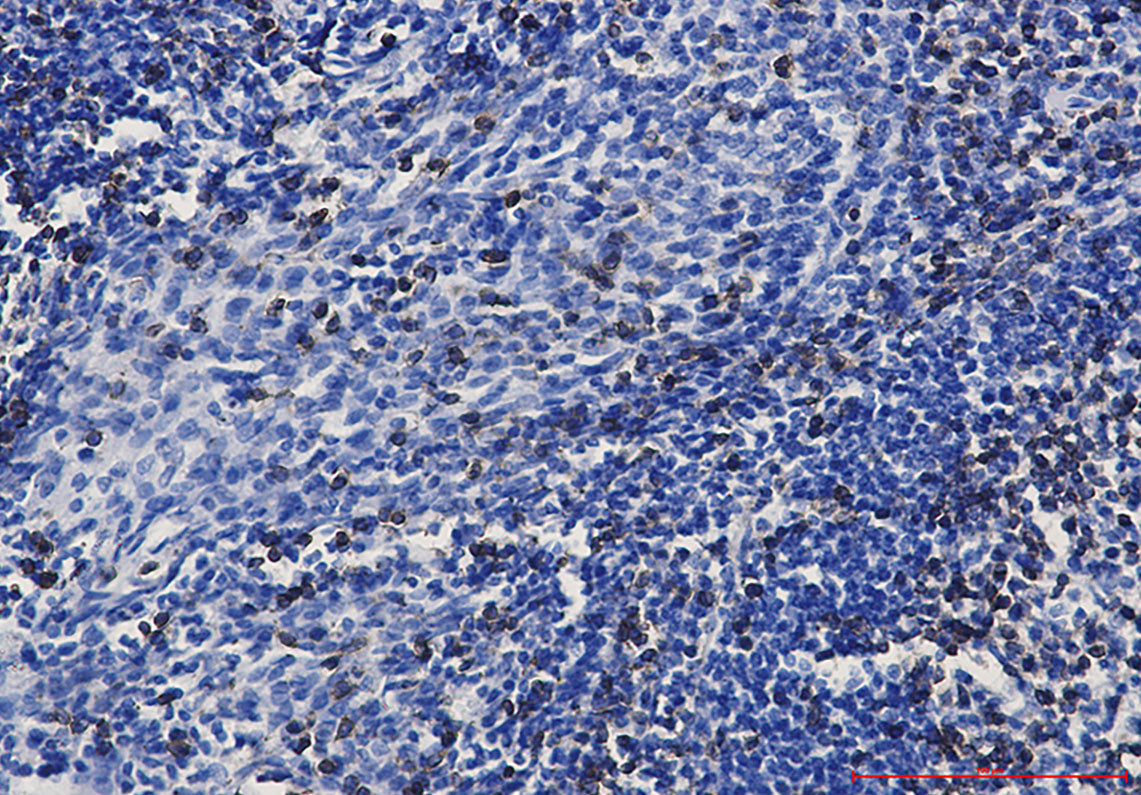

Anti-CD3 epsilon antibody [R02-1B5] (STJA0034137)
SPECIFICATIONS
ClonalityMonoclonal
HostRabbit
ConjugationUnconjugated
IsotypeIgG
ImmunogenA synthetic peptide of human CD3 epsilon
General Information
| Short Description | Rabbit monoclonal anti-CD3 epsilon for use in WB, IHC-P and IP in Human samples. Datasheet included with dilution recommendations, and related reagents. |
| Applications | WB/IHC-P/IP |
| Host | Rabbit |
| Reactivity | Human |
| Note | STRICTLY FOR FURTHER SCIENTIFIC RESEARCH USE ONLY (RUO). MUST NOT TO BE USED IN DIAGNOSTIC OR THERAPEUTIC APPLICATIONS. |
Product Properties
| Clonality | Monoclonal |
| Clone ID | R02-1B5 |
| Isotype | IgG |
| Conjugation | Unconjugated |
| Concentration | 0.3 mg/mL |
| Purification | Affinity Purified |
| Dilution Range | WB 1:500-1:1000IHC 1:50-1:100IP 1:20 |
| Formulation | 50mM Tris-Glycine (pH 7.4) , 0.15M NaCl, 40% Glycerol, 0.01% Sodium azide and 0.05% BSA |
| Storage Instruction | Store at 4°C short term. Aliquot and store at-20°C long term. Avoid freeze/thaw cycles. |
Target Information
| Gene Symbol | CD3E |
| Gene ID | 916 |
| Uniprot ID | CD3E_HUMAN |
| Immunogen | A synthetic peptide of human CD3 epsilon |
Additional Info
| Post Translational Modifications | Phosphorylated on Tyr residues after T-cell receptor triggering by LCK in association with CD4/CD8. |
| Function | Part of the TCR-CD3 complex present on T-lymphocyte cell surface that plays an essential role in adaptive immune response. When antigen presenting cells (APCs) activate T-cell receptor (TCR), TCR-mediated signals are transmitted across the cell membrane by the CD3 chains CD3D, CD3E, CD3G and CD3Z. All CD3 chains contain immunoreceptor tyrosine-based activation motifs (ITAMs) in their cytoplasmic domain. Upon TCR engagement, these motifs become phosphorylated by Src family protein tyrosine kinases LCK and FYN, resulting in the activation of downstream signaling pathways. In addition of this role of signal transduction in T-cell activation, CD3E plays an essential role in correct T-cell development. Initiates the TCR-CD3 complex assembly by forming the two heterodimers CD3D/CD3E and CD3G/CD3E. Also participates in internalization and cell surface down-regulation of TCR-CD3 complexes via endocytosis sequences present in CD3E cytosolic region. In addition to its role as a TCR coreceptor, it serves as a receptor for ITPRIPL1. Ligand recognition inhibits T-cell activation by promoting interaction with NCK1, which prevents CD3E-ZAP70 interaction and blocks the ERK-NFkB signaling cascade and calcium influx. |
| Protein Name | T-Cell Surface Glycoprotein Cd3 Epsilon ChainT-Cell Surface Antigen T3/Leu-4 Epsilon ChainCd Antigen Cd3e |
| Database Links | Reactome: R-HSA-198933Reactome: R-HSA-202424Reactome: R-HSA-202427Reactome: R-HSA-202430Reactome: R-HSA-202433Reactome: R-HSA-389948 |
| Cellular Localisation | Cell MembraneSingle-Pass Type I Membrane Protein |
| Alternative Antibody Names | Anti-T-Cell Surface Glycoprotein Cd3 Epsilon Chain antibodyAnti-T-Cell Surface Antigen T3/Leu-4 Epsilon Chain antibodyAnti-Cd Antigen Cd3e antibodyAnti-CD3E antibodyAnti-T3E antibody |
Information sourced from Uniprot.org