

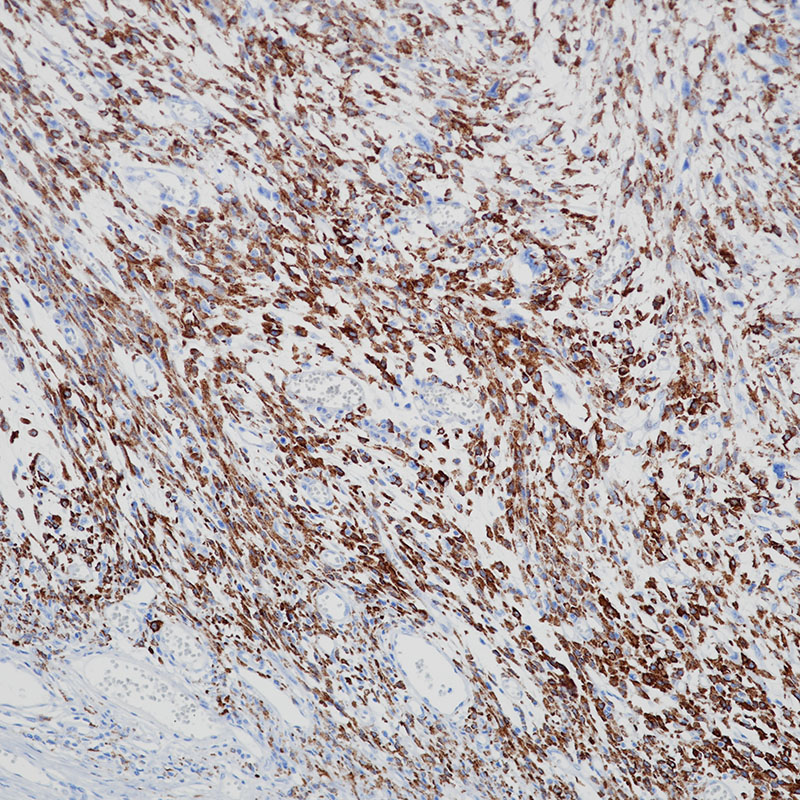

Anti-CD163 antibody [BP6063] (STJA0037622)
SPECIFICATIONS
ClonalityMonoclonal
HostRabbit
ConjugationUnconjugated
IsotypeIgG
ImmunogenA synthesized peptide derived from human CD163
General Information
| Short Description | Rabbit monoclonal anti-CD163 for use in IHC-P in Human samples. Datasheet included with dilution recommendations, and related reagents. |
| Applications | IHC-P |
| Host | Rabbit |
| Reactivity | Human |
| Note | STRICTLY FOR FURTHER SCIENTIFIC RESEARCH USE ONLY (RUO). MUST NOT TO BE USED IN DIAGNOSTIC OR THERAPEUTIC APPLICATIONS. |
Product Properties
| Clonality | Monoclonal |
| Clone ID | BP6063 |
| Isotype | IgG |
| Conjugation | Unconjugated |
| Purification | Affinity Purified |
| Dilution Range | IHC 1:100-1:200 |
| Formulation | Liquid in PBS containing 50% glycerol, 0.5% BSA and 0.02% sodium azide, pH 7.3. |
| Storage Instruction | Store at 4°C short term. Aliquot and store at-20°C long term. Avoid freeze/thaw cycles. |
Target Information
| Gene Symbol | CD163 |
| Gene ID | 9332 |
| Uniprot ID | C163A_HUMAN |
| Immunogen | A synthesized peptide derived from human CD163 |
Additional Info
| Tissue Specificity | Expressed in monocytes and mature macrophages such as Kupffer cells in the liver, red pulp macrophages in the spleen, cortical macrophages in the thymus, resident bone marrow macrophages and meningeal macrophages of the central nervous system. Expressed also in blood. Isoform 1 is the lowest abundant in the blood. Isoform 2 is the lowest abundant in the liver and the spleen. Isoform 3 is the predominant isoform detected in the blood. |
| Post Translational Modifications | A soluble form (sCD163) is produced by proteolytic shedding which can be induced by lipopolysaccharide, phorbol ester and Fc region of immunoglobulin gamma. This cleavage is dependent on protein kinase C and tyrosine kinases and can be blocked by protease inhibitors. The shedding is inhibited by the tissue inhibitor of metalloproteinase TIMP3, and thus probably induced by membrane-bound metalloproteinases ADAMs. Phosphorylated. |
| Function | Acute phase-regulated receptor involved in clearance and endocytosis of hemoglobin/haptoglobin complexes by macrophages and may thereby protect tissues from free hemoglobin-mediated oxidative damage. May play a role in the uptake and recycling of iron, via endocytosis of hemoglobin/haptoglobin and subsequent breakdown of heme. Binds hemoglobin/haptoglobin complexes in a calcium-dependent and pH-dependent manner. Exhibits a higher affinity for complexes of hemoglobin and multimeric haptoglobin of HP*1F phenotype than for complexes of hemoglobin and dimeric haptoglobin of HP*1S phenotype. Induces a cascade of intracellular signals that involves tyrosine kinase-dependent calcium mobilization, inositol triphosphate production and secretion of IL6 and CSF1. Isoform 3 exhibits the higher capacity for ligand endocytosis and the more pronounced surface expression when expressed in cells. After shedding, the soluble form (sCD163) may play an anti-inflammatory role, and may be a valuable diagnostic parameter for monitoring macrophage activation in inflammatory conditions. |
| Protein Name | Scavenger Receptor Cysteine-Rich Type 1 Protein M130Hemoglobin Scavenger ReceptorCd Antigen Cd163 Cleaved Into - Soluble Cd163Scd163 |
| Database Links | Reactome: R-HSA-2168880Reactome: R-HSA-9662834 |
| Cellular Localisation | Soluble Cd163: SecretedCell MembraneSingle-Pass Type I Membrane ProteinIsoform 1 And Isoform 2 Show A Lower Surface Expression When Expressed In Cells |
| Alternative Antibody Names | Anti-Scavenger Receptor Cysteine-Rich Type 1 Protein M130 antibodyAnti-Hemoglobin Scavenger Receptor antibodyAnti-Cd Antigen Cd163 Cleaved Into - Soluble Cd163 antibodyAnti-Scd163 antibodyAnti-CD163 antibodyAnti-M130 antibody |
Information sourced from Uniprot.org