

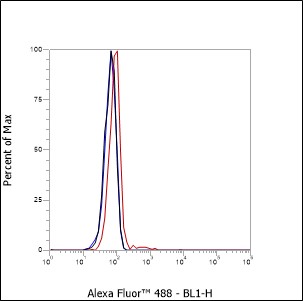

Anti-CD154 antibody [R08-1R-8] (STJA0033152)
SPECIFICATIONS
ClonalityMonoclonal
HostMouse
ConjugationUnconjugated
IsotypeIgG1k
ImmunogenPeptide
General Information
| Short Description | Mouse monoclonal anti-CD154 for use in FC in Human samples. Datasheet included with dilution recommendations, and related reagents. |
| Applications | FC |
| Host | Mouse |
| Reactivity | Human |
| Note | STRICTLY FOR FURTHER SCIENTIFIC RESEARCH USE ONLY (RUO). MUST NOT TO BE USED IN DIAGNOSTIC OR THERAPEUTIC APPLICATIONS. |
Product Properties
| Clonality | Monoclonal |
| Clone ID | R08-1R-8 |
| Isotype | IgG1k |
| Conjugation | Unconjugated |
| Purification | Protein G |
| Dilution Range | FC 1:50-1:100 |
| Formulation | Liquid in PBS, Glycerol and BSA |
| Storage Instruction | Store at-20°C. Avoid freeze/thaw cycles. |
Target Information
| Gene Symbol | CD40LG |
| Gene ID | 959 |
| Uniprot ID | CD40L_HUMAN |
| Immunogen | Peptide |
Additional Info
| Tissue Specificity | Specifically expressed on activated CD4+ T-lymphocytes. |
| Post Translational Modifications | The soluble form derives from the membrane form by proteolytic processing. N-linked glycan is a mixture of high mannose and complex type. Glycan structure does not influence binding affinity to CD40. Not O-glycosylated. |
| Function | Cytokine that acts as a ligand to CD40/TNFRSF5. Costimulates T-cell proliferation and cytokine production. Its cross-linking on T-cells generates a costimulatory signal which enhances the production of IL4 and IL10 in conjunction with the TCR/CD3 ligation and CD28 costimulation. Induces the activation of NF-kappa-B. Induces the activation of kinases MAPK8 and PAK2 in T-cells. Induces tyrosine phosphorylation of isoform 3 of CD28. Mediates B-cell proliferation in the absence of co-stimulus as well as IgE production in the presence of IL4. Involved in immunoglobulin class switching. CD40 ligand, soluble form: Acts as a ligand for integrins, specifically ITGA5:ITGB1 and ITGAV:ITGB3.both integrins and the CD40 receptor are required for activation of CD40-CD40LG signaling, which have cell-type dependent effects, such as B-cell activation, NF-kappa-B signaling and anti-apoptotic signaling. |
| Protein Name | Cd40 LigandCd40-LT-Cell Antigen Gp39Tnf-Related Activation ProteinTrapTumor Necrosis Factor Ligand Superfamily Member 5Cd Antigen Cd154 Cleaved Into - Cd40 Ligand - Membrane Form - Cd40 Ligand - Soluble FormScd40l |
| Database Links | Reactome: R-HSA-198933Reactome: R-HSA-5668541Reactome: R-HSA-5676594 |
| Cellular Localisation | Cell MembraneSingle-Pass Type Ii Membrane ProteinCell SurfaceCd40 LigandSoluble Form: SecretedRelease Of Soluble Cd40l From Platelets Is Partially Regulated By Gp Iib/IiiaActin PolymerizationAnd A Matrix Metalloproteinases (Mmp) Inhibitor-Sensitive Pathway |
| Alternative Antibody Names | Anti-Cd40 Ligand antibodyAnti-Cd40-L antibodyAnti-T-Cell Antigen Gp39 antibodyAnti-Tnf-Related Activation Protein antibodyAnti-Trap antibodyAnti-Tumor Necrosis Factor Ligand Superfamily Member 5 antibodyAnti-Cd Antigen Cd154 Cleaved Into - Cd40 Ligand - Membrane Form - Cd40 Ligand - Soluble Form antibodyAnti-Scd40l antibodyAnti-CD40LG antibodyAnti-CD40L antibodyAnti-TNFSF5 antibodyAnti-TRAP antibody |
Information sourced from Uniprot.org